Follow Us on Google
From Juliana Taiwo-Obalonye, Abuja
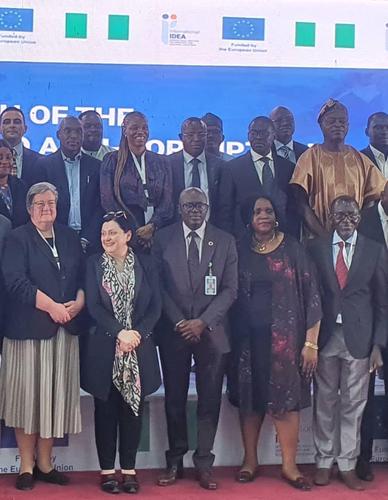
The European Union, yesterday, announced a €30 million support to Nigeria to strengthen the rule of law, fight corruption, and reduce gender-based violence while promoting respect for human rights, and ensuring inclusivity for all Nigerians.
The EU ambassador and head of delegation to Nigeria and ECOWAS, Samuela Isopi, made the disclosure at the launch of the programme, which would be financed through the second phase of the Rule of Law and Anti-Corruption (ROLAC II) Programme, to be implemented by the International Institute for Democracy and Electoral Assistance (International IDEA).
She described as impressive the over 1.5 million people, who benefitted from ROLAC during the first phase.
Isopi listed the impacts ROLAC has made to include contribution to set up and strengthening of policies and processes; increased implementation and compliance with the Administration of Criminal Justice law; and increased inter-agency cooperation in the fight against corruption as well as creating synergies between government and civil society organizations.
Other contributions include increased access to justice for survivors of Sexual and Gender Base Violence (SGBV) through the establishment of sexual assault referral centers and special SGBV courts; increased and improved the protection of the rights of children. All states have now adopted the child rights Act or its equivalent, and 35 out of 36 states have adopted the Violence Against Persons Prohibition (VAPP) law.
“These are crucial achievements that we are proud to celebrate on the eve of the 16 days of activism against gender based violence and on the occasion of the celebration the 75th anniversary of the Universal Declaration of Human Rights.
“Based on these results, it was clear to us at the European Union, that a second phase of this ROLAC was needed, to consolidate the progress and continue the work on strengthening the rule of law and fighting corruption in Nigeria,” the EU envoy to Nigeria and ECOWAS said.
He explained that in the second phase, ROLAC would continue to focus on criminal justice, prison reforms, curbing sexual and gender based violence and strengthening and implementing the anti-corruption policies and tools.
She added that the EU is providing the support for the ROLAC II Programme, to be implemented at the federal level, and in five states of Adamawa, Anambra, Edo, Kano, and Lagos, with possibility of extension to two more states.
She assured that the EU would continue to support the consolidation of the rule of law and anti-corruption process in Nigeria with technical and financial support and political engagement.
This is because sustainable peace, development and prosperity are truly possible only when founded on respect for human rights, democracy and the rule of law.
She explained that the overall objective of RoLAC Phase II is to consolidate the rule of law and anti-corruption reforms in Nigeria. More specifically, it will target and support enhanced performance, quality and oversight of the criminal justice system and of justice service delivery; improved access to justice for vulnerable women, children, juveniles, persons with disabilities and victims of sexual and gender-based violence; and increased transparency and accountability of anti-corruption systems and reforms.
In her welcome remarks, Executive Director, International Institute for Democracy and Electoral Assistance (International IDEA), Fiona Rowley, explained that ROLAC Phase II is an EU project funded under its Neighbourhood, Development and International Cooperation Instrument (NDICI-Global Europe) and implemented by the International IDEA.
The Minister of Budget and Economic planning, Atiku Bagudu, declared that ROLAC Phase 1 was hugely successful and expressed confidence that the phase 2 would not be any different.
Represented by Director, International Cooperation, Lanre Adekanye, the minister noted that the 11 European Development Fund ROLAC Project Phase 1 ended with significant achievements recorded, one of which is to the provision of prison case management systems that facilitated prison decongestion and digital courts, in response to the COVID-19 pandemic; provision of shelters and sexual assault referral centers; the first national database of sex offenders; contribution to the adoption of a national anti-corruption strategy, to improve behavioural changes at both federal and state levels, mainly in the transparency of procurement processes; convictions of anti-corruption cases, and improvement in investigative reporting; and timely access to justice for vulnerable persons, including People with Disabilities (PWD), among others.
He said the second phase intervention aligns with the national development plan 2021-2025; the blueprint for Nigeria’s economic recovery, conceived to create strong and sustainable governance structures, and efficient institutions that promote citizens’ protection.
He said the expectation is that the intervention would drive productivity for sustainable growth in line with the Renewed Hope Agenda of the current administration.
Solicitor General of the Federation and Permanent Secretary in the Ministry of Justice, Beatrice Jedy-Agba, expressed the Ministry’s appreciation and happiness to collaborate on Phase II programmes.
She expressed optimism that the outcomes captured under your Phase II programme will bridge the gaps in Criminal Justice and Administrative Reform and Enhance Systems and Structures in the justice sector.
Jedy-Agba, who was represented by Director, Planning, Research and Statistics, Victoria Ojogbane, commended the leadership of the Rule of Law and Anti-Corruption (ROLAC II) program and Head of Programme, Nigeria International IDEA, Danladi Plang, for the robust interface and quality programmes targeted at nation building.
Plang presented the overview of ROLAC II to the audience.