Follow Us on Google
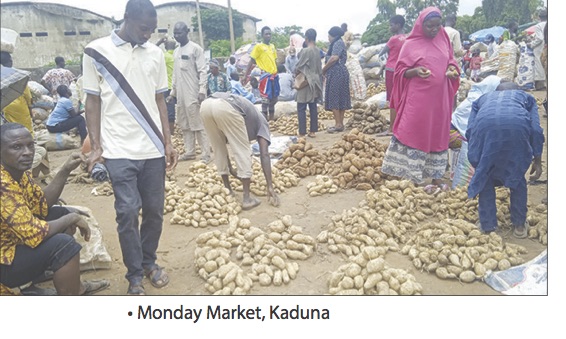
From Noah Ebije, Kaduna
In recent times, sweet potato has assumed a position of pride in many homes in Kaduna State. The good old delicious meal, grown by local farmers, especially women and sold for a small amount of money has become the king of meals in many homes, rich and poor.
Like the biblical cornerstone, families no longer consume this food crop as leisure or a make-up meal but depend entirely on it for survival in the face of these difficult times.
It was gathered that in many homes in the city, the old sweet potato is smoothened into clean powder form and converted to local swallow, competing favourably with the likes of amala, eba and tuwon. That is when it is not fried and eaten with akamu or cooked to boiling point and eaten with stew, sauce or oil.
There are many reasons for this change of lifestyle or eating habit. The most cogent is the recent hike in poverty and hunger in the wake of the present administration. This has caused many residents to think of alternative ways to survive. One of such is reverting to this food crop, hitherto regarded as the food for the poor.
Jummai Nuhu told Daily Sun that her neighbour taught her how to make “swallow” out of sweet potato: “It is the same process of soaking raw cassava for a few days to squeeze out or drain out the toxic aspect of it.
“After that process, you spread it in the sun to dry well, say for three to four days. Store it in your kitchen, and take out of it and grind it into powder in order to make a ‘swallow’ out of it. I can tell you that it is very good.
“More importantly, many people said it is rich in nutrition and good for controlling diabetes. So, when I bought a big bag of it, my family and I enjoyed it for a very long time.
“Though, there is hardship in the land, it has helped us rediscover the food crop that we used to ignore in the past. I am appealing to the state government to support the farmers of sweet potatoes to expand their farming capacity and increase their harvest.”
Philomena Igba resides in the same neighbourhood: “In our house, we were not used to eating sweet potatoes before now. But because of hunger and hardship in the country, we have no choice but to patronise the food. It is cheaper than many other root crops.”
Cecilia Atuwa argued: “Before, who cared about potatoes or used to buy sweet potatoes? Nobody! Nobody buys sweet potatoes or treats it as a serious food or meal at home. But times have changed. It is now the best food in the market, the best food for mothers thinking of how to manage family menu for survival.
“Look at how sweet potatoes have become more expensive than yams. That is because so many people are now interested in the crop. The bag that used to go for N7,000 is now N16,000. Something that people ate reluctantly in the past. But because of hardship and hunger in the land, it has become costly again.
“We are calling on government to help us soften the present hardship. Many homes are going to bed without meals, on empty stomachs. Everybody is passing through serious hardship.
“For some women, if they don’t go out to engage in menial jobs, they will not be able to feed their families. The little money they get from there, they come to this kind of market to buy sweet potatoes and take home.
“Government should help us. Many people are dying because of the poverty. The level of poverty in the land is too much. We voted politicians into power to help us but unfortunately they climbed the seats and turned their backs on the poor. They should please come to the aid of the people. The poverty in the land is too much.”
Happiness Abel said: “I came to buy sweet potatoes worth N1,500 but what I got is not big enough. It will not even take my family two days to finish. Government should help us. This suffering is too much. Children are hungry so they have resorted to eating potatoes. It’s commonly available and relatively cheap.”
Medical experts testified: “Sweet potatoes are nutritious, packing a good amount of vitamin A, vitamin C, and manganese into each serving. Its consumption helps control diabetes in those suffering from such ailment. It also has anti-cancer properties and may promote immune
Traders at the weekly Monday Market in Kakuri were unanimous that the recent influx of buyers of sweet potatoes and coco-yams had tripled the prices of the commodities. Shehu Aliyu, a potato trader at the market, said: “A 100kg bag of the sweet potatoes used to sell at N1500 to N2000.
“This year, the same quantity sells between N20,000 and N25,000. However, now that new ones are being harvested, the price per bag has crashed to between N12,000 and N15,000. But there are small bags that sell for N7,000 to N9,000.”
He blamed the hike in price on the removal of fuel subsidy. Aliyu, who came from a nearby village around Kawo, Kaduna, implored the Federal Government to put in place necessary measures to cushion the effects of the economic hardship, observing that transport fare affected the price:
“Many people want to buy. Once we tell them the price, they just turn back. This is because the poor masses are broke. The poor masses want to buy the sweet potatoes, but they don’t the money.
“This development is affecting our business. At the close of the day, towards evening, we begin to sell at give-away prices. We are calling on government through this channel to note that we can sell our products at a cheaper rate if we can get transportation at a cheaper rate.
“The removal of fuel subsidy made transport fares go up. We are facing big challenges of moving our farm products to market in the urban centres. We used to transport our products from the interior with just N500. But the transport fare has gone up to as much as N2000 per trip.”