Follow Us on Google
With Okorie Uguru
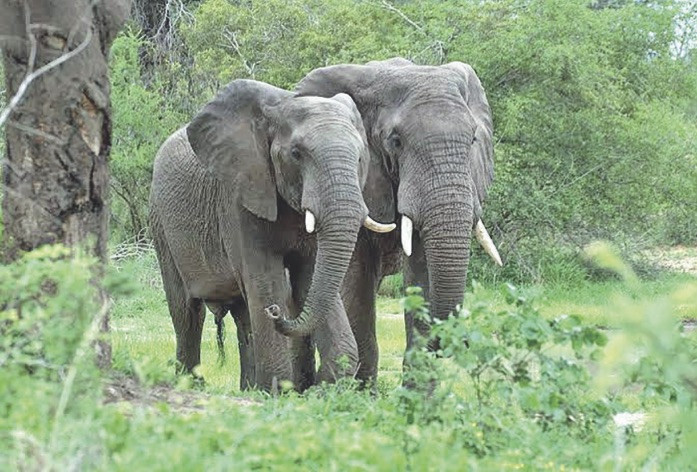
Omo Forest Reserve in Ijebu East Local Government Area of Ogun State is an old, pristine forest and serves as home to different flora and fauna. Its reputation is not built only on having more than 200 types of plants and trees, or more than 100 species of birds and other animals; rather it is built majorly on being a sanctuary for critically endangered forest elephants. It is estimated that more than 50 forest elephants live in this forest reserve.
Considering that these behemoths listed among the most endangered species of elephants have made the reserve their home, the place is very important to both environmentalists and tourists. That is why conservation organisations like the Nigerian Conservation Foundation (NCF) and other international organisations take special interest in the forest in an effort to protect these animals and the biodiversity.
Apart from conservation purposes, the Omo Forest Reserve is ideal for tourism due to its beautiful landscape and natural ambience. However, the rate at which this forest and its biodiversity is being lost to human encroachment and commercial logging, might lead to the reserve and its diversity going into extinction in a few years, if concerted efforts are not made to aggressively protect the forest.

The once dense and thick periphery of the forest is gradually being stripped of its forest coat due to aggressive commercial wood logging. The rich ecosystem is becoming a large expanse of open space as tall trees in the forest are felled and carried away for local and international wood markets.
The elephants, in reaction to the gradual encroachment, and noise all-around are retreating deeper into the forest to avoid human contacts and disturbance. The forest is shrinking daily; the noisy chain saws are unrelenting in felling trees.
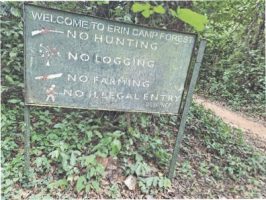
The Omo Forest Reserve was first ceded to the government on 18th October, 1918 with an agreement between the District Officer, Ijebu Ode on behalf of the Government and the Awujale of Ijebu Ode on behalf of the Ijebu Native Administration. The reserve covers an area of 1305.5km2 divided into Areas J1 – J3 (519.3km2), Area J4 (565.8km2), Area J6 (220.4km2) and enclaves (65km2).
The Forest Reserve was legally constituted by Order No. 10 of 1925 which was amended in 1952. It is the only internationally recognised forest reserve in the South West and considered a biosphere reserve by the United Nations Educational, Scientific, and Cultural Organization (UNESCO) due to its pristine nature in 1977. However, the forest is gradually disappearing little by little and the biggest tragedy would be that the forest elephants, for which the reserve serves as natural habitat, may be lost forever if the logging activities around the area are not properly checked and the government making greater efforts to protect the elephants and the forest’s biodiversity.
A recent tour of the forest reserve with the Cre8ative Naija team paints a picture of a nature reserve in need of funds and attention.
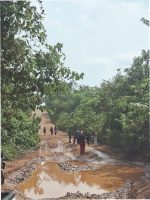
Omo Forest is about 150 kilometres from Lagos. The journey is in two stages. The first is driving from Lagos, through Sagamu, Ijebu Ode, to the J4 Junction in Ijebu East Local government area. At J4 Junction Omo Forest Reserve, the vehicle branched left into the forest. The road is a long stretch leading deep into the forest. There are several checkpoints and barriers with keepers who search visitors for clearance into the forest. Few kilometres into the stretch, the road became extremely bad due to constant movement of heavy logging trucks carrying wood out of the forest. The regular salon vehicles cannot ply the road. At a point even the bus brought could not continue. The first point of call is the Elephant House. From Elephant House to the Erin Camp inside the core elephants’ forest reserve is about 16 kilometres and took close to an hour to get there by bike due to the rough nature of the road.
Other News
Omo Forest Reserve, for nature lovers, is idyllic, with a thick forest that makes walking a little difficult. From deep inside the forest, it is difficult to see the sun, except sunlight piercing through the green canopy above that is formed by trees’ branches.
There are makeshift accommodation and few camping kits, so for those visiting, it is important to come with camp tents. The reserve is run by rangers of the Nigerian Conservation Foundation (NCF). They go out of their way to make visitors feel reassured of their safety and comfort. The food was not five-star, but good enough for one to relish. It was almost like communal living. The rangers also monitor the wellbeing of the elephants and forest’s biodiversity.
Despite the efforts of the NCF, it is obvious that the elephant sanctuary needs greater government presence for it to survive. Although owned by the Ogun State government, the state’s interest seems more focused on the wood loggers who pay for cutting down the trees. The state’s forestry department office is close to the Elephant House where their officers monitor the loggers.
The Project Manager of NCF’s Omo Forest Reserve Elephant Initiative, Emmanuel Olabode who is in charge of elephants’ conservation efforts, spoke on the efforts and challenges of protecting the elephants. On the forest, gradual encroachment by humans and interface with communities around the forest, he said: “We don’t have problems working with the community. Most of the communities understand what our mission is; they know why we are here. And there are times that we have issues, which have to do with checking what they are doing, how they are, you know, their activities in the forest. But, they always want to comply with any effort, any instruction that we try to pass across that will make our relationship peaceful. But that is not to say that there is no pressure coming from the community side. Because the community keeps expanding and that shows that there are more people coming in, and that means that we are losing more forest because the main business here is to farm. So, that means we are losing space, we are losing forest areas, you know, which is not the purpose why the government intended this place. We are having challenges in that area. The forest is shrinking due to the expansion in agricultural activities and expansion in settlements and villages.”
The first night ended with a bonfire and dance round the raging flame.
Despite the distance it took to get to the camp and density of the forests, the activities of commercial loggers and increasing villages are obviously affecting the forest reserves. The elephants have retreated far deep into the jungles, leaving only their footprints and dung as telltale signs of their presence.
Along the way to the reserve, there were new clearings and villages that were springing up along the way.
The noise from the chainsaws, added to the noise from the heavy duty trucks conveying wood from forests, does not seem ideal for a forest reserve. Olonade speaks of the effect of human activities and the perpetual presence of humans on elephants in the forest.
“When you have a conservation landscape and there’s logging around it, if it’s not well managed, it’s going to be counterproductive at the end of the day. This is because elephants or animals generally know no boundary. And the level of deforestation just around this core area that they are can also even increase the stress level of the elephants, and it can even affect their breeding. And it can make them want to leave that area when there is too much. And the elephant is an animal that actually requires a large home range to operate, to move around. So, they travel several kilometres each day to remain healthy. Yes. So, they can’t be confined within an area. So, now, when we have logging concessions just around the forest area where they are, it will restrict their movement, thereby leading to population decline,” he said.
“We have elephants in Omo Forest Reserve. And these elephants need our support. We need to protect them because globally now, forest elephant is considered to be critically endangered, meaning that they are on the verge of going into extinction. Any step after being critically endangered means that they are going to extinction. They are going into extinction if care is not taken.”
Mr. Frank Meke, a managing director of Cre8ative Naija, who is a travel consultant and environmental activist, has this to say about the Omo Forest Reserve and the current conservation efforts.
“The vast Omo–Shasha–Oluwa Forest Reserve, located along the border of Ogun and Ondo states, remains one of Nigeria’s most remarkable yet underappreciated ecological treasures. This extensive landscape, possibly the richest biodiversity haven in South-West Nigeria, was carefully divided into compartments for both scientific conservation and economic forestry purposes.
“In the late 1960s, the South Western Region established plantations of exotic tree species—including Gmelina arborea, Tectona grandis (teak) and Pinus caribaea to supply raw materials to the Iwopin Pulp and Paper Mill established in 1969. While the initiative once held great economic promise, the plantations have since suffered from aggressive and poorly regulated logging activities by concessionaire companies operating within the reserve.
“The harvesting methods employed by some of these companies raise serious concerns. In many cases, the practices violate global conservation standards and threaten the long-term survival of the restricted biosphere areas that make up nearly 40 per cent of the Shasha–Oluwa forest ecosystem.
“These restricted areas are home to endangered wildlife including chimpanzees, white-throated guenon monkeys and forest elephants.
“Apart from strategic conservation interventions by the Nigerian Conservation Foundation (NCF)—particularly its elephant sanctuary project—the few remaining protected biodiversity zones managed by the Forestry Research Institute of Nigeria and recognised by UNESCO remain the only structured conservation spaces within the vast reserve.
“Yet fears persist that even these areas could eventually fall victim to illegal logging and corrupt practices within forestry management systems. One possible long-term solution would be to designate these critical zones as a National Park, providing stronger legal protection and conservation oversight.”
The lack of state support and continuous neglect of the forest reserve is a danger signal for the conservation efforts to preserve and nurture the endangered forest elephants, and unless the government changes approach to the conservation of the overall ecosystem of the Omo Forest including the endangered elephants, we may be seeing the last of the reserve and the elephants. The current elephant population in Omo Forest might just equally be the last, as the elephants are in danger of going into extinction.