Follow Us on Google

•NADDC, SON roll out VehCAP to clean up used vehicles market
By Moses Akaigwe
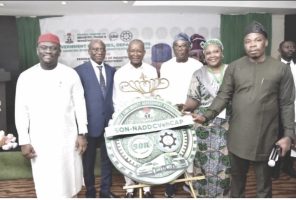
The Federal Ministry of Industry, Trade and Investment (FMITI), in collaboration with the National Automotive Design and Development Council (NADDC) and the Standards Organisation of Nigeria (SON), recently launched the Vehicle Conformity Assessment Programme (VehCAP) to strengthen Nigeria’s automotive regulatory framework and curb the influx of substandard vehicles.
The programme addresses rising concerns over the influx of used vehicles without proper verification of safety standards, structural integrity, emissions performance and lifecycle history – key issues that contribute to road accidents, environmental risks and unfair competition within the automotive sector.
Speaking at the official launch in Abuja, the Minister of State for Industry in the FMITI, Senator John Owan Enoh, described VehCAP as a strong testament to the power of inter-agency collaboration between NADDC and SON.

The minister further explained that VehCAP integrates vehicle safety into Nigeria’s broader economic policy framework, encompassing fiscal measures, foreign exchange management, import financing and vehicle renewal strategies—all aligned with national safety and standardisation goals.
Enoh emphasised that under the SON-NADDC VehCAP, all new and used vehicles, as well as other automotive products entering the country, must obtain the shipment certification before undergoing Customs valuation, port processing, import clearance, and eventual market entry.
In his remarks, the director-general of NADDC, Otunba Oluwemimo Joseph Osanipin, noted that VehCAP introduces a proactive inspection regime that will ensure that vehicles are assessed and certified prior to shipment to Nigeria.
He described this innovation as a critical transition from the former “inspect-after-arrival” model to a more efficient “verify-before-entry” system.
He added that NADDC will provide technical oversight for the programme, including vehicle classification, model verification and alignment with national automotive policies—ensuring a balance between regulatory enforcement and industry development.
Also speaking, the director-general of SON, Dr. Ifeanyi Chukwunonso Okeke, described the programme as a structured and preventive mechanism designed to ensure that only compliant vehicles and automotive products are allowed into circulation.
According to him, VehCAP builds on existing conformity assessment systems while introducing a sector-specific approach tailored to the complexity of vehicles, aligning with national priorities on industrial growth, consumer protection, and safety.
VehCAP is expected to significantly improve road safety, strengthen consumer protection, promote environmental sustainability and restore market discipline by reducing the influx of substandard vehicles while encouraging compliance with established standards.
Related to this initiative is the End-of-Life Vehicle (ELV) policy, which the Federal Government, through NADDC, recently introduced to enforce strict inspections and ensure that only roadworthy vehicles are allowed into the country.
In the auto manufacturing sector, the efforts being made by the two Federal Government agencies to address the issue of unregulated used vehicle importation is seen as a welcome development.
It will be recalled that some global original equipment manufacturers (OEMs) have always argued that uncontrolled importation of used vehicles was one of the reasons the local assembly plants were not making progress in Nigeria. Volkswagen, for instance, cited this as a major factor contributing to the global number two auto maker pulling out of Nigeria years ago.
Apart from the lack of a legal framework for the Nigeria Automotive Industry Development Plan (NAIDP), Volkswagen executives have always cited the ‘reign’ of imported used (Tokunbo) vehicles over new ones as a disincentive to investment in Nigeria’s automotive industry, as well as one of the reasons the automaker is yet to return to the country.
Giving an insight into the VehCAP in an exclusive interview with The Sun, the NADDC DG stated that it was created with the aim of regulating the importation of both new and used vehicles in terms of conformity with quality standards.
Currently, he said, conformity with quality standards regarding the importation of new vehicles is covered by SONCAP (Standards Organisation of Nigeria Conformity Assessment Programme).
SONCAP covers not only automotive products, but also regulates most other imported manufactured goods to ensure compliance with Nigerian Industrial Standards.
“Unfortunately, as of today, we do not have anything for used vehicles in terms of standards regulation,” Osanipin said – which explains why the new VehCAP was initiated.
He said that when new vehicles are compared side by side with used vehicles, the latter pose bigger risks for users.
“But because motor vehicles are so peculiar compared to other products, we decided to create a separate programme called VehCAP, instead of remaining in the existing SONCAP.”
Chief Osanipin further explained that what NADDC and SON did at the unveiling on March 31 was to sensitise key people in the ministries, departments and agencies of government (MDAs) and launch the programme, adding that preparations are ongoing ahead of full sensitisation and implementation.
“We have not started implementation yet. We are going to carry out sensitisation across the country so that importers will be aware of what we are doing.
“But let me emphasize something: Implementation of VehCAP will come at no cost to buyers of vehicles in Nigeria.”
He noted that countries such as Tanzania, South Africa, Zimbabwe, Uganda and Kenya have taken steps to prevent their markets from becoming dumping grounds for expired or end-of-life vehicles.
“We want to ensure that when a Nigerian is buying a vehicle, he is not expected to go underneath it to determine whether it is good or not, whether the chassis is damaged, or whether it is a flood-damaged vehicle. (Certification will take care of all that).
“In developed countries, some vehicles carry flood certificates, indicating that they were earlier submerged in water
“This is what we want to achieve in Nigeria. We want to ensure that when you pay for a vehicle, you get value for your money.”
He cited China as an example, noting that, under its Auto Policy 2026, the country seeks to protect its reputation by ensuring that exported vehicles meet quality standards of importing countries and have after-sales support.
Other News
“In countries like China and Japan, you cannot ship vehicles without certification of their condition and guarantees of after-sales support in the destination countries”
Explaining how certification will work, he said that, just as is the case in SONCAP, importers of used vehicles will be required to obtain certification in the country of origin before shipment.
“They will engage international agents recognised by global standards organisations such as International Standards Organisation (ISO), who will inspect and certify that the vehicles meet required standards.”
Similarly, any company exporting used vehicles to Nigeria must comply with globally acceptable standards and obtain a certificate of roadworthiness under VehCAP.
“What we are insisting on is compliance with international standards. This is not new—we are simply asking importers to obey global rules.”
He stressed that Nigeria, as a signatory to international standards, must enforce them.
“You cannot bring vehicles that can no longer be used elsewhere and dump them in Nigeria. That is what we want to stop—vehicles rejected by Tanzania, Kenya, South Africa, Uganda and elsewhere.”
“We are not the poorest country in the world,” the NADDC DG said, pledging that VehCAP would not ban used vehicle importation but would ensure that only roadworthy vehicles are brought into the country.
“We are looking at the third quarter for implementation,” he added, noting that this will be preceded by months of sensitisation and engagement with stakeholders such as AMDON. He also disclosed that there will be a three-month moratorium window.
However, even before sensitisation and implementation have commenced, VehCAP is already facing what industry watchers describe as rash and unfair criticisms.
Some vehicle importers, clearing agents, and dealers who appear to have misinterpreted the government’s intentions have opposed the programme.
Among other concerns, they alleged that the policy undermines the National Single Window initiative, could worsen port congestion and increase the cost of imported vehicles.
Faulting the programme, the national president of the Association of Motor Dealers of Nigeria (AMDON), Ajibola Adedoyin, insisted that stakeholders were neither consulted nor properly informed before its rollout.
“Nobody was informed. It was just a solo policy,” he said, warning that while the intention may be valid, execution might not favour the sector.
Adedoyin also cautioned that the policy could affect vehicles already awaiting clearance at the various ports.
Responding, Osanipin said the criticisms were premature, noting that the initiative was still at the groundwork stage.
He reiterated that VehCAP does not signal a ban on used vehicles, will not lead to increase in vehicle prices and will not negatively impact port operations.
“We have not even reached the level of full sensitisation, let alone implementation. What we held at the launch was a sensitisation workshop for relevant MDAs,” he said.
“Later, we will engage stakeholders like AMDON, Customs and others with full details of the process.”
He added that stakeholder engagement will help identify gaps, including issues relating to vehicles already shipped before VehCAP’s implementation.
He dismissed fears of port congestion, noting that uncertified vehicles would not even be shipped to Nigeria in the first place when enforcement commences.
“If a vehicle does not have certification, it will not come in. That reduces pressure on the ports.”
He added that certification will be completed in the country of origin, with reports transmitted to the Nigerian end ahead of arrival.
“They will not need to ask questions at the port in Nigeria because the information is already available with them.”
Meanwhile, vehicle manufacturers and assemblers have welcomed VehCAP as a measure to curb the influx of substandard vehicles.
Industry players who have long criticised the uncontrolled importation of Tokunbo vehicles as a barrier to growth commended NADDC and SON for the initiative.
The Chairman of the Nigerian Automotive Manufacturers Association (NAMA), Bawo Omagbitse, described VehCAP as a forward-thinking programme essential for sustainable industry development.
“What is required now is effective stakeholder sensitisation for sector-wide understanding and acceptance,” he said.
Similarly, the Chairman of Innoson Vehicle Manufacturing Company Ltd, Dr. Innocent Chukwuma, CON, lauded the initiative but advised that implementation should support industry growth.
The Managing Director of Nord Automobile, Oluwatobi Ajayi, also described VehCAP as “good news.”
“Taking our safety seriously is always the priority,” Ajayi said.
The NADDC Director-General acknowledged the challenges ahead, but maintained that VehCAP is in the overall interest of vehicle buyers in Nigeria, the economy, and the automotive sector.
He emphasised that improving capacity utilisation in local vehicle production remains a key objective.
Osanipin reiterated that while the importation of used vehicles will continue, it must not turn Nigeria into a dumping ground.
“And this is what even Volkswagen and other global OEMs have been asking Nigeria to address, because without it, the automotive industry cannot develop in this country.”