Follow Us on Google
Day South East asked hard questions about equity
By Jude Chinedu, Enugu
Across southeastern Nigeria, concerns about security and human rights have become increasingly difficult to ignore.
While many communities continue to go about their daily lives, incidents of kidnapping, violent attacks and allegations of arbitrary arrests, prolonged detention and excessive use of force have left many residents questioning whether justice and security are keeping pace with the region’s challenges.
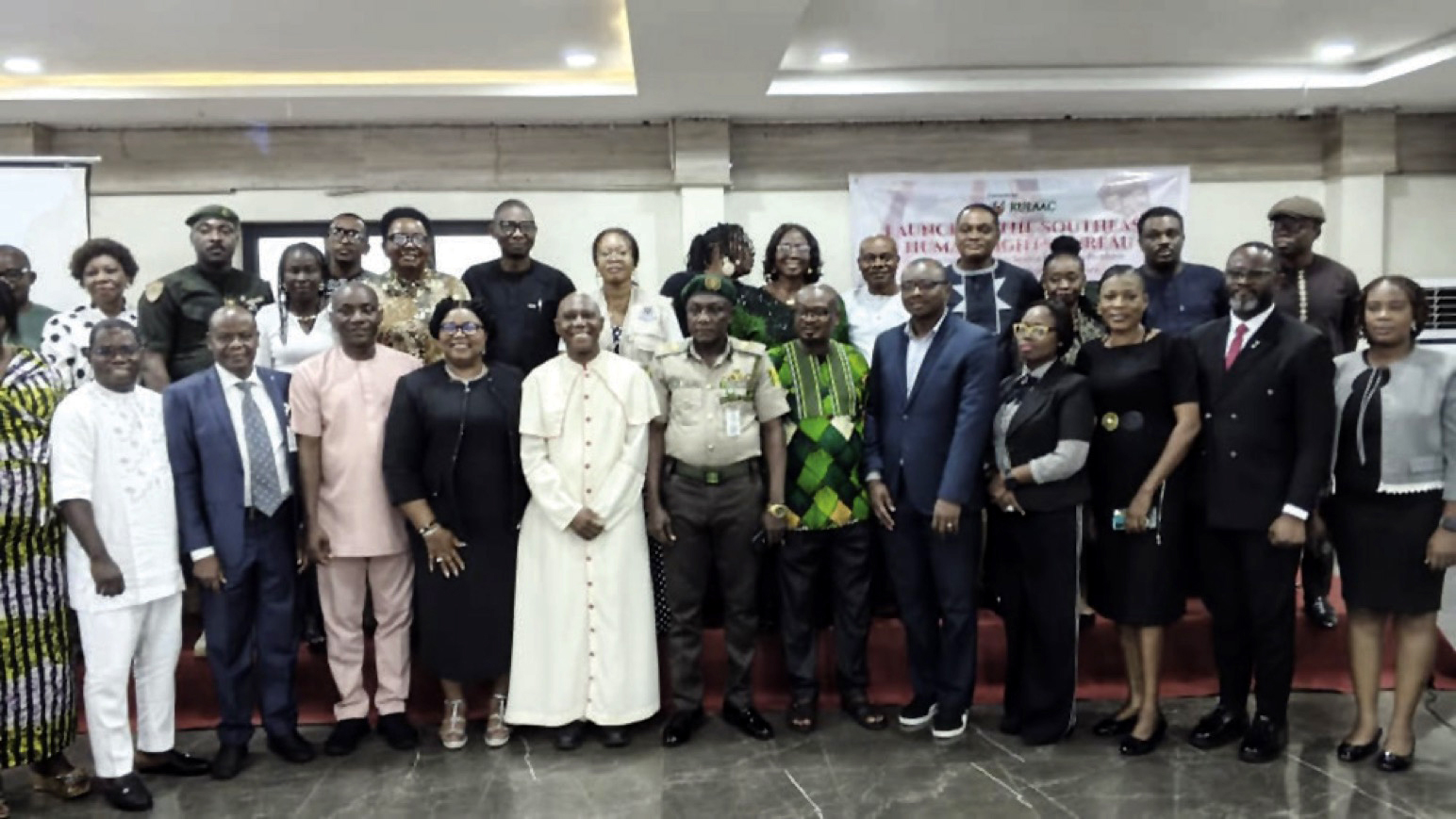
It was against this backdrop that stakeholders gathered in Enugu State last week. What began as the launch of a new human rights bureau soon evolved into a frank conversation about whether justice, accountability and respect for the rule of law can be strengthened across the region.
Officially, the event was the launch of the South East Human Rights Bureau and its Open Source Reporting Platform by the Rule of Law and Accountability Advocacy Centre (RULAAC).
In reality, it became an intense conversation about fear, impunity, justice and the growing urgency of rebuilding public trust. For much of the day, one message echoed through the conference hall: peace cannot endure where justice is absent.
The bureau, supported by partners, including the Ford Foundation, is expected to document rights violations, coordinate advocacy, support strategic litigation, strengthen early-warning systems and train human rights defenders across Abia, Anambra, Ebonyi, Enugu and Imo states.
For RULAAC executive director, Okechukwu Nwanguma, the initiative represents the outcome of conversations that began nearly 17 months ago during the South East Stakeholders Summit on Peace and Security.
According to him, participants at that summit reached one difficult conclusion, that insecurity must never become an excuse for abandoning constitutional rights.
“Today is far more than the inauguration of a new institution, it is the fulfilment of a collective aspiration born out of dialogue, strengthened by partnership, inspired by courage and sustained by our common commitment to justice, accountability, peace and respect for human dignity.
“The summit acknowledged that, while insecurity remains one of the gravest challenges confronting the South East, our response must never sacrifice the values of justice, constitutionalism, accountability and respect for fundamental human rights,” Nwanguma said.
He explained that the bureau was not intended to compete with the National Human Rights Commission or other accountability institutions. Instead, it’s designed to bridge gaps by documenting violations, supporting victims, strengthening evidence-gathering, encouraging dialogue between communities and security agencies, and promoting strategic legal interventions.
He said: “The South East Human Rights Bureau is more than an institution. It is a declaration that human rights matter; that every victim deserves justice; that every public institution should be accountable; and that lasting peace can only flourish where fairness, dignity and the rule of law prevail.”
Perhaps the strongest indication of the bureau’s intended direction came when Nwanguma disclosed that consultations had already begun with lawyers and partner organisations on a proposed class action concerning alleged abuses linked to the notorious Tiger Base detention facility.
Without elaborating, he stressed that documenting violations without pursuing accountability would defeat the entire purpose.
“Credible documentation must lead to meaningful accountability, and advocacy is most effective when reinforced by strategic legal action.”
If Nwanguma explained why the bureau was created, Prof. Joy Ngozi Ezeilo explained why many believe the region can no longer afford to delay.
The former United Nations Special Rapporteur on Trafficking in Persons delivered what was perhaps the most forceful address of the event.
Discarding ceremonial pleasantries, she confronted the audience with what she described as the harsh reality confronting southeast Nigeria.
“We are not gathered here today to merely launch another platform, unveil digital tools or indulge in the comfortable prose of diplomacy. We are here because human dignity in Southeast Nigeria is under siege and our silence is no longer an option,” she said.
For Ezeilo, the South East is confronting not only insecurity but also a crisis of governance and accountability. Communities, she argued, increasingly fear both violent criminals and institutions legally empowered to protect them.
“We have witnessed arbitrary arrests and prolonged detentions, excessive use of force, shrinking civic space, economic hardship that fuels desperation and rising violence that has destabilised livelihoods and communities.
“These are political failures. Failures of governance. Failures of accountability. Failures of institutions that have drifted too far from the people they are meant to serve.”
She rejected suggestions that protecting human rights weakens security operations. Instead, she insisted that respect for rights remains the strongest foundation for lasting peace.
“Human rights protection is not a barrier to security; rather, it is the foundation of sustainable peace and human security.
“When rights are respected, trust is built. When justice is accessible, grievances are reduced. When accountability is genuine, impunity diminishes. Consequently, human rights should be seen as the ultimate security strategy,” she said.
Ezeilo also challenged the region to confront abuses taking place far from public attention.
She described the exploitation of young girls in domestic servitude as modern slavery and warned that societies cannot claim to value human dignity while ignoring abuses occurring inside homes.
The launch also highlighted the growing role of technology in the human rights movement.
The bureau’s Open Source Reporting Platform will rely on digital evidence—including videos, photographs, geolocation data and other open-source intelligence—to document violations.
But Ezeilo warned that technology without integrity could become another instrument of misinformation.
“Digital evidence can expose abuses. It can challenge official narratives. It can empower communities to demand justice.
“But misinformation can inflame tensions and destabilise communities. Therefore, open-source investigations must be rigorous, ethical and grounded in truth.”
Addressing participants selected for the bureau’s first training programme, she urged them to resist political influence.
“Do not back down. Do not sell out. Do not yield to fear. However, you must act on credible information, with integrity and in accordance with the law. Don’t use it as a political tool. You must remain apolitical to discharge this function creditably.”
The speech delivered by Very Rev. Msgr. Prof. Obiora Ike at the event revolved around one unforgettable encounter with a six-year-old girl.
Asked why Nigeria was not working as it should, the child simply replied: “They are not serious.”
Years later, Ike said, he still believes that answer explains much of Nigeria’s predicament.
“A small girl of six or seven tells me that the reason why we have problems in our society is that we are not serious people.”
Tracing humanity’s relationship with law from Adam and Eve through Moses and the Ten Commandments, he argued that people naturally resist rules.
“Human history shows that we do not want to accept a rule or a guide. The first thing human beings do is to break it.
“The resistance of a rational, conscientious, well-created being is the resistance to order and to doing good. The people even created an eleventh commandment—break any law, but don’t be caught.”
Representing the Ford Foundation, Umar Njiye described the bureau as “a milestone of hope,” saying human rights and the rule of law remain indispensable to peace and nation-building.
“Ford Foundation has been part of this initiative for some time, and we are really happy today that we reached that milestone. And this is the milestone of hope.
“The opening of the Bureau of the South East on human rights is a big hope for us, and we also want to congratulate all of you who have contributed, who have been contributing to this achievement,” he said.
The National Human Rights Commission, represented by its executive director for Civil and Political Rights, Halilu Adamu, also pledged support, describing the bureau as an opportunity to strengthen partnerships among governments, civil society organisations and communities.
He stressed that technology would be useful only if every allegation is carefully verified and due process respected.