Follow Us on Google
Nations are judged not only by the monuments they erect but by the discipline with which they preserve what already sustains them.
The First Niger Bridge, completed in 1965 and linking Onitsha in Anambra State to Asaba in Delta State, is no ordinary span of steel and concrete. It is the oldest artery of commerce between the Southeast and the rest of the federation, a structure on which the livelihoods of traders, students, civil servants and families have rested for six decades.
When vandals stripped its expansion joints of their bolts and nuts, and the bridge was closed on the 7th of September, the nation was confronted with a prospect too grave for levity; the strangulation of the most consequential crossing in the region.
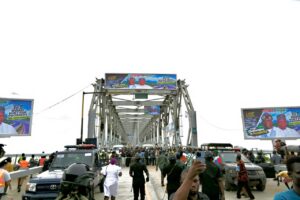
That the Minister of Works, Engineer David Umahi, restored it and reopened it to traffic after 38 days is an achievement that deserves sober acknowledgement.
The significance of the intervention becomes plain once we consider what was at stake. A bridge does not fail by degrees that the public can observe.
It fails suddenly and catastrophically, and the lessons are written in grief. The collapse of the Interstate 35W bridge in Minneapolis in 2007 and of the Morandi Bridge in Genoa in 2018 taught engineers and statesmen alike that deferred maintenance is a gamble wagered with human lives.
Expansion joints and their fastenings are precisely the components that permit a structure of this age to bear thermal stress and the relentless pounding of heavy vehicles.
To have identified the stolen components, replaced them, and demanded further repainting and structural assessment above and below the waterline is to practice the engineering conscience that the occasion demanded.
The Minister of Works, Engineer Umahi declined to be stampeded into premature reopening, insisting that critical works be concluded and that concrete attain its requisite strength before the full load of traffic was admitted.
Such restraint is the opposite of showmanship. It is prudence of the highest order.
The comparative lesson is instructive. The Second Niger Bridge, commissioned in 2023 and later formally handed over by Julius Berger to the federal government, offered a vital alternative during the closure.
Yet, an alternative is not a substitute. The diversion of traffic placed considerable strain on surrounding routes, lengthening journeys and raising costs for those who can least absorb them.
A region cannot be asked to survive indefinitely on a single corridor when history has endowed it with two.
Equally noteworthy is that Engineer Umahi has coupled restoration with prevention; closed circuit surveillance to be linked with the monitoring architecture of the Second Niger Bridge, a directive to Anambra and Delta authorities to police the scrap markets that feed on stolen infrastructure, a prohibition on dredging that could undermine the foundations, and an order against checkpoints near the bridgehead.
Repair without protection is merely the postponement of the next emergency. Here, both were attempted together.
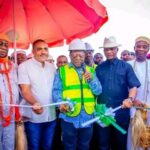
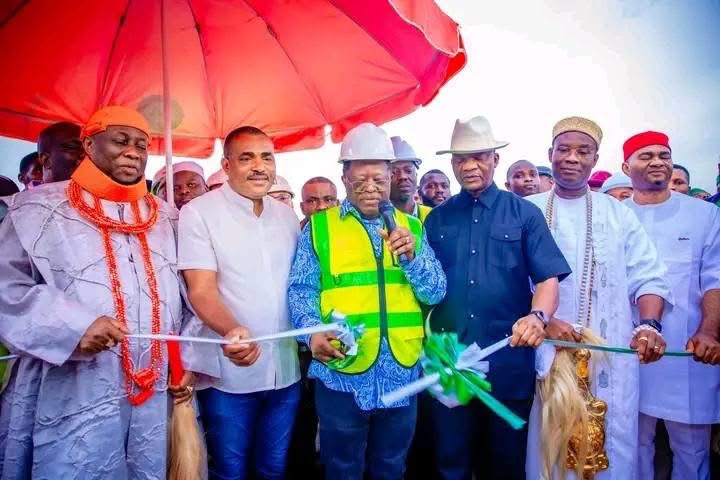
Why, then, the ceremony? Cynics hold that the cutting of a ribbon is vanity. They misunderstand the function of public ritual in a Republic.
A ceremony is the means by which a government converts a technical fact into public confidence. A motorist cannot inspect the torque of a bolt or the cure of a concrete slab.
He relies on an authoritative voice to certify that the passage is safe, and he needs to see that voice standing on the very structure in question.
The ceremonial reopening was an act of accountability as much as celebration. It placed the Minister, before traditional rulers and officials of both states, on record as guarantor of the work.
Every civilised polity marks the restoration of critical infrastructure in precisely this fashion, because symbols teach a people that their institutions still function and that their suffering has been noticed.
The timing lends the gesture a moral urgency. The festive season approaches, and with it the great annual homecoming in which Southeasterners return in their multitudes to their towns and villages.
It is a migration of affection and obligation, and it funnels through this very crossing. Had the bridge remained shut, the season of reunion would have become a season of gridlock, expense and danger, with elderly parents and young children stranded on congested roads.
The Minister, himself a son of the Southeast, understood that the calendar was an adversary and worked against it.
That he delivered before the peak of travel is an act of solicitude toward his own people, and solicitude of this kind ought not to be repaid with ridicule.
It is therefore regrettable that Rufai Oseni, the Arise Television host, saw fit to treat the commissioning as occasion for mockery. Let it be said plainly that a free press is the lifeblood of democracy, and that scrutiny of public expenditure is its noblest duty.
The questions that have been raised on this programme about the costs and procedures of other federal projects are the legitimate business of journalism, and no Minister is immune from them. But scrutiny and scorn are different things.
To interrogate a contract is a service to the public. To sneer at the reopening of a bridge on which millions depend is a disservice, and it betrays a failure of proportion.
A broadcaster commands a vast audience, and with that reach comes the obligation to distinguish between what warrants censure and what warrants thanks.
Derision directed at a successful rescue of a critical asset does not sharpen accountability. It cheapens it.
Nor can the sceptic’s complaint about political imagery carry the weight that has been placed upon it.
Governments in every democracy attach their names and likenesses to their works, and voters are free to weigh those claims at the ballot box.
The proper response to a political message is a better argument, not the trivialisation of the deed. The bridge, after all, is indifferent to partisan allegiance.
The trader from Onitsha, the student bound for Asaba and the family travelling home for Christmas will cross it irrespective of the banners that flutter above them.
To politicise an intervention of this kind is to hold the public hostage to a quarrel that is not theirs.
There is a deeper principle at stake. A country that cannot applaud even its necessary repairs will soon find that it has fewer repairs to applaud.
Public officials respond to incentives, and if diligence earns jeers while negligence goes unnoticed, the rational course will be inaction.
Engineer Umahi, whatever his critics may say of his politics, acted decisively when a viral video exposed a danger, ordered emergency works, and saw them through.
For that, the Southeast and the wider federation owe him acknowledgement.
Commendation is not capitulation, and gratitude is not servility. It is the ordinary courtesy that a mature society extends to those who deliver.
Let the debates about cost and conduct continue in their proper forum. But on the matter of the Niger Bridge, the honest verdict is simple; the work was necessary, it was done, and the people are better for it.