Follow Us on Google

From Uche Usim, Abuja
What many know as Caverton Helicopters is actually an arm of Caverton Offshore Support Group, which began marine logistics services for the Nigerian Liquefied Natural Gas (NLNG) in 1999 before expanding into marine transportation, aviation, training, maintenance and others.
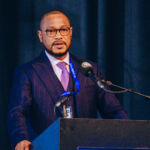
But today, the company, according to its Executive Vice-Chairman and Chief Executive Officer, Mr Olabode Makanjuola, has delved into local production of water buses with eco sounder to tackle the water transportation nightmare.
This move is in response to new challenges thrown up by the COVID-19 pandemic and to hoist its flag on other non-oil and gas sectors, especially with the global declining appetite for fossil fuels, amid loud calls for transition.
Makanjuola, a Mechanical Engineering graduate from the University of Leicester also holds a Master’s Degree in Trade, Shipping and Finance from City University Business School, United Kingdom.
The Caverton CEO said having been involved in providing aviation services in the country since the company discovered the biggest challenges the industry was facing was lack of training centres for operators in the aviation industry.
In this interview with Daily Sun, held on the sidelines of the 2022 Nigerian Oil and Gas Conference (NOG) in Abuja, he speaks more about the company, the strides taken to remain relevant and its place in the logistics value chain.
Motivation for diversification
Caverton Marine Limited is a wholly owned subsidiary of Caverton Offshore Support Group operating in both aviation and marine sectors of the economy. We started as a marine company in 1999. We started the Nigeria LNG Liquefied petroleum gas (LPG) distribution programme. The company brought in two large tankers/carriers for the programme. In 2004, Caverton moved into the aviation business space, with the support of the Nigerian Content Development Monitoring Board (NCDMB) at the time. Shell made it possible for us to break into the market. We control about 60 percent of that market.
In terms of diversification, Caverton’s niche is to try to find problems, or look for where there are challenges to resolve, or seek out opportunities to develop a sector. We first got into the helicopter business because we realized that there were no Nigerians interested in that sector. We were able to conquer that. But then, we realized that one of the things the aviation sector was struggling with was maintenance capacity, and most importantly, training. So, we built the first ever maintenance, repair overhaul (MRO) centre in Lagos. What the centre means, effectively, is that Caverton does not have to fly any of its aircraft outside the country for major repairs. Caverton can actually strip an aircraft down, take the components apart, repair it and put them back together again.
If people want to export helicopter, they can come to Caverton to request. The interesting is that we do that for our internal fleet and third party as well.
So, the Nigerian Navy, Nigerian Army, Nigerian Air Force, even the Presidential Fleet of Benin Republic actually use the Caverton service. The idea is to establish a hub in Sub-Saharan Africa to cater for these sorts of operations. Again, training is something we hold dear, especially when local content is concerned. When we started at Caverton, 80 percent of all our pilots were expatriates.
Today, between 75 and 90 percent of our pilots are Nigerians, mostly trained by Caverton. What we did was that we also trained a lot of pilots as part of the Amnesty Programme in the Niger Delta by the Federal Government. A lot of the personnel we trained are flying with Caverton today.
Caverton is also gender sensitive. Quite a lot of our pilots are females. That is also something we at Caverton are very proud of. When we found out that we had to fly out all these people to Dubai, US and Europe for the trainings, and these facilities are very hard to come by, and spaces very limited, because if someone is sent to US, Dubai or anywhere abroad in Europe for training, the only slot he might have will be 3 am in the morning. That did not allow them have proper experience. What we had to do was that we bought the first Simulator facility for helicopter training. This is a device, which when one enters, is like one is flying. Everything is a lot more complicated than this. An hour in the simulator is equivalent to an hour of flying. It’s really for people who want to learn how to fly the Reality H, Level D AW139 full flight simulator in comfort. The graphics and modules are designed for Nigerians. If you enter the simulator, you would be flying over the Niger Delta area or Lagos and all of that.
Going into boat building
Going into boat building was the same way Caverton wanted to address a problem in Lagos. A lot of people who live in Lagos know what the traffic situation is like. For the past six to 10 years, we have been trying to address this problem. Our concern was how we can address the traffic situation and moving people around safely.
Initially, we thought of working with the Lagos State Government to supply or provide vessels, and we found out that it costs so much to bring into the country high quality vessels. We started asking ourselves about the boatyards we used to have in the Delta region in Port Harcourt, Calabar, Oron and Warri. We wanted to know what exactly happened to them. Why did they go out of business? Why are they not providing this service? And what exactly is the issue? We also discovered that a lot of the boats that were in the market were of very low quality and unsafe.
Even though there were operators, nobody felt safe in them. So, Caverton resolved to do something to bridge the gap and provide a safe, convenient and comfortable alternative for the community or the State. That’s when the idea of the water bus, a mass transit system for the Lagos State waterways, came up. We were to build the first prototype boat for the oil industry, meaning it is extremely safe. It’s got segregated hulls and all that, such that if it were to ever get involved in an accident, or hit a debris, it would not just sink automatically. It’s an achievement we at Caverton are very proud of. It’s our newest project, and we are hoping that it will help address problems that we all know so well. It also has oil and gas applications, and it can be used as crew boat for the IOCs and the other operators in the industry.
Are you planning to provide these services in Lagos State alone?
No! But we are looking at all riverine areas. We are very particular about meeting all international operational standards in the oil industry. Recently, we completed our audit with Shell and Agip. Another one is coming up soon. So, we are constantly being checked, in terms of ensuring that we meet the right level of safety and service quality in our operations. So, it’s a sector we always try to manage.
That is why we try to branch out into other areas to manage our revenues and cash flows. So, aviation is dear to us, we also need to diversify our operational portfolios.
Challenge of aviation fuel supply in your operations
Caverton business is slightly different. We work based on contracts by our clients. We have contracts with Shell (our main contractor) and Agip. They provide us with fuel, and then debit from the accounts. We do not have same sort of challenges that commercial aviation sector operators have. Although we feel the pinch a little bit in our bottomline, it is something we need to pay for to go on.
Outside the oil and gas industry, do you operate in other areas of the economy?
We do VIP and air shuttle flights for non-oil sector workers. We also operate outside Nigeria, in Cameroun. We are looking at other West African countries. We are looking at the possibility of starting our operations in Ghana, Senegal and Morocco.
What impact does the current global energy transition have on your operations as most of your activities in the oil and gas sector?
Yes, definitely we are feeling the pressure. The global COVID-19 pandemic and the current energy transition affects our output as well, because we get paid based on the number of hours we fly. So, if we are not moving around as many people for business as it is supposed to be as a result of one restriction or another, then definitely our revenue drops. That is why we are looking at the transition and diversification of our business to broaden our coverage and boost our revenues, because we realise that our business cannot survive on just our day to day logistics and other services to the oil and gas industry alone. So, developing training capabilities, offering third parties maintenance and marine business help keep the company growing, because we now have a more diversified portfolio.