Follow Us on Google
From Jude Chinedu, Enugu
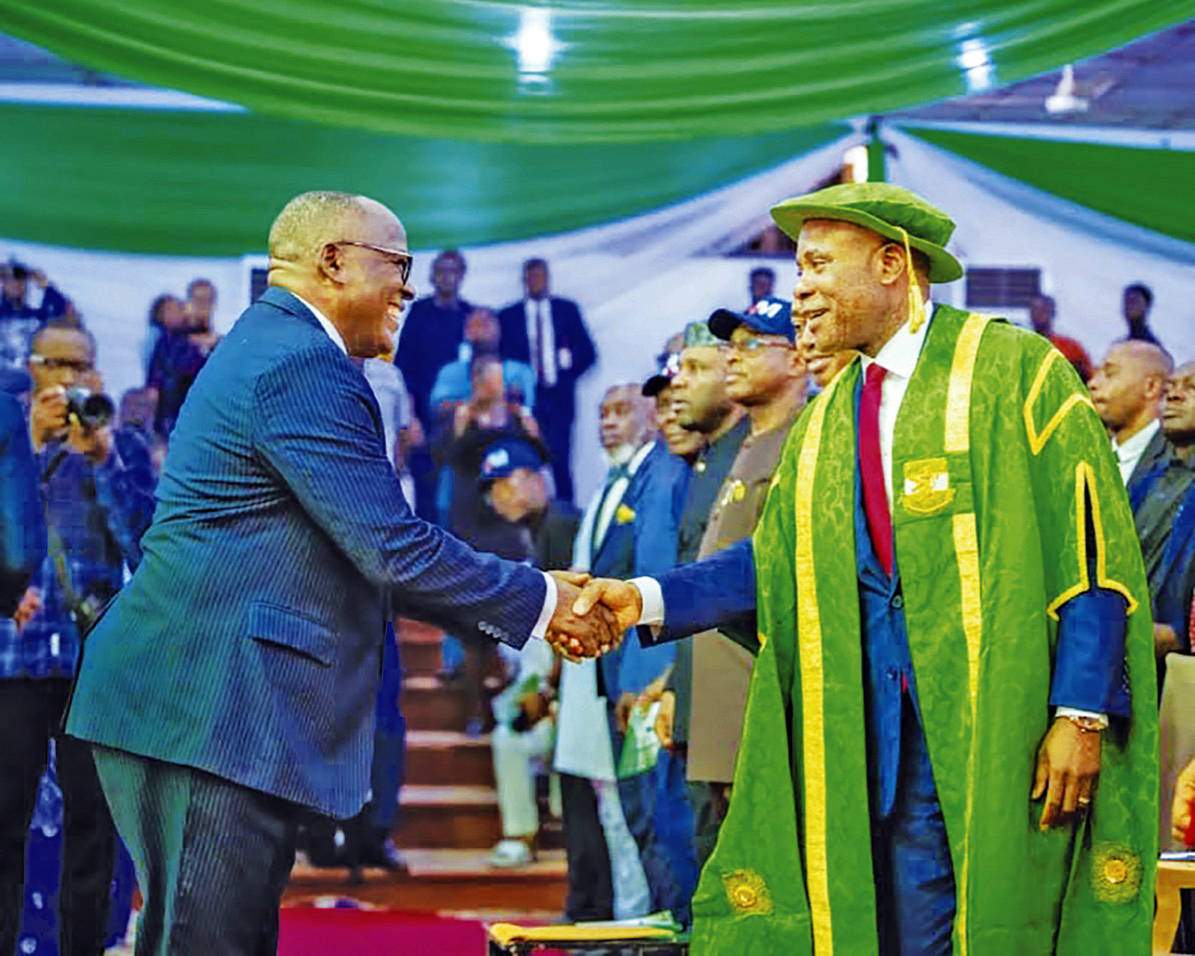
When Governor Peter Mbah mounted the podium at the Princess Alexandra Unity Hall and Theatre of the University of Nigeria, Nsukka (UNN), to deliver the institution’s 55th Convocation Lecture, it quickly became clear that the audience was not about to listen to another ceremonial address.
For nearly two hours, the governor presented what was less a political speech than a comprehensive philosophical framework linking education, governance, technology and economic development under one central idea: restoring human dignity through the expansion of human capability.
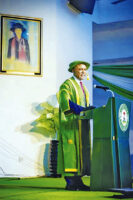
Coming to an institution whose founding motto is “To Restore the Dignity of Man,” Mbah carefully aligned his government’s development agenda with the vision of the university’s founder, Dr. Nnamdi Azikiwe, arguing that the demands of the twenty-first century require a new interpretation of that timeless ideal.
Rather than focusing on infrastructure as an end in itself, the governor repeatedly insisted that development should ultimately be measured by what citizens become capable of achieving.
“The true measure of development is the expansion of human capability—the capacity to live a long and healthy life, acquire meaningful knowledge, participate productively in society, solve problems creatively, and improve the lives of others,” he declared.
Perhaps the most striking aspect of Mbah’s address was his attempt to redefine governance away from the familiar language of roads, bridges and buildings towards measurable improvements in human potential.
He argued that governments often mistake spending for transformation.
“The scale of these deficits may tempt us to believe that the answer lies simply in more money, schools, hospitals, roads, programmes, or policies. These investments matter. But investment alone does not guarantee transformation.
“A new school operating through obsolete pedagogy may expand enrolment without expanding learning. A hospital without trained personnel, medicines, power, referral systems, and accountable management may increase infrastructure without improving health. A skills programme designed without industry may produce certificates without employability.”
Throughout the lecture, Mbah repeatedly returned to what he described as the difference between “inputs” and “outcomes,” insisting that government should be judged not by the projects it commissions but by the lives those projects transform.
While acknowledging the importance of traditional academic learning, Mbah argued that universities and schools can no longer define success merely by producing graduates with certificates.
Instead, he advocated experiential learning that equips students with practical competence, creativity and problem-solving abilities.
“In an age when Artificial Intelligence can retrieve information instantly and perform routine cognitive tasks, education can no longer be defined by the transmission of facts. It must cultivate curiosity, creativity, critical thinking, collaboration, character, and the confidence to solve problems not yet imagined.
“Experiential learning transforms knowledge into capability, enabling learners not merely to know the world, but to shape it.”
The governor linked this educational philosophy to Enugu State’s Smart Green Schools initiative, teacher development programmes, digital literacy projects and the establishment of the Centre for Experiential Learning and Innovation (CELI).
Rather than presenting these as isolated government projects, he framed them as components of one integrated human development system.
Mbah introduced what he repeatedly called the “poverty of imagination.” According to him, underdevelopment is sustained not merely by financial limitations but by societies accepting inherited constraints as permanent realities.
“By poverty of imagination, I mean the inability of individuals, institutions, and societies to conceive, design, and build possibilities beyond inherited constraints.
Other News
“It is the condition in which yesterday’s limitations become today’s expectations and tomorrow’s assumptions; when what has not yet been achieved is treated as what cannot be achieved.”
He argued that every major transformation first begins in the imagination before it is translated into budgets, institutions and public policy.
“The future is built twice—first in the imagination, and then in law, budgets, concrete, technology, and practice.”
Perhaps the most emotionally compelling section of the lecture came when Mbah narrated the story of Arinze Edeoga, a pupil from one of Enugu’s pilot Smart Green Schools.
Instead of presenting statistics alone, the governor used the child’s experience to illustrate what experiential education could achieve.
He recounted how Arinze, from the rural community of Owo, eventually stood before students in Enugu metropolis teaching them digital literacy.
“For too long, we accepted that knowledge flows in one direction—from cities to villages, the privileged to the overlooked.
“But when we democratize quality education, knowledge moves in every direction. A rural school becomes a centre of innovation. A village child becomes a teacher of urban peers.”
“In Arinze, you see more than a young boy using a computer. You see restored confidence, democratized opportunity, and a child once defined by geography becoming a creator of knowledge rather than merely a consumer of it. You see the dignity of man.”
In his welcome address, the Vice Chancellor of the University, Prof. Simon Ortuanya said the university itself was undergoing a deliberate transformation aimed at remaining globally competitive.
He explained that UNN was embracing academic renewal, digital transformation, institutional reforms and research excellence while remaining faithful to its founding vision.
“We resolved that the University of Nigeria must not merely celebrate its illustrious past; it must consciously prepare for a future worthy of that past,” the Vice-Chancellor said.
He described the convocation lecture as the convergence of three powerful ideas: Dr. Nnamdi Azikiwe’s vision of restoring human dignity, UNN’s rebuilding agenda and Governor Mbah’s development philosophy captured in the slogan, “Tomorrow Is Here.”
“Tomorrow is not an abstract promise but a present assignment. The future is fashioned not by those who postpone action until tomorrow, but by those who summon tomorrow into the decisions they make today.”
Former Vice-Chancellor and chairman of the occasion, Venerable Prof. Chinedu Nebo, reinforced the central message by arguing that education must now produce innovators rather than mere certificate holders.
“The true measure of development is not merely the construction of roads, buildings, or industries, but the transformation of human lives.
“Experiential learning has become one of the defining imperatives of 21st-century education. Our graduates must not only know; they must be able to create, innovate, solve problems, and lead societal transformation.”
Convocation lectures are often remembered for ceremonial speeches and lofty aspirations. Mbah’s presentation, however, sought to function differently by blending public policy, development economics, educational philosophy and political vision into one narrative.
Whether every ambition outlined, from Smart Green Schools to a 30-billion-dollar economy and integrated human development architecture, will ultimately be realised remains a question that only time can answer.
What is difficult to dispute, however, is that the lecture represented one of the most intellectually ambitious policy speeches delivered by a serving Nigerian governor in recent years.