Follow Us on Google
By Ngozi Nwoke
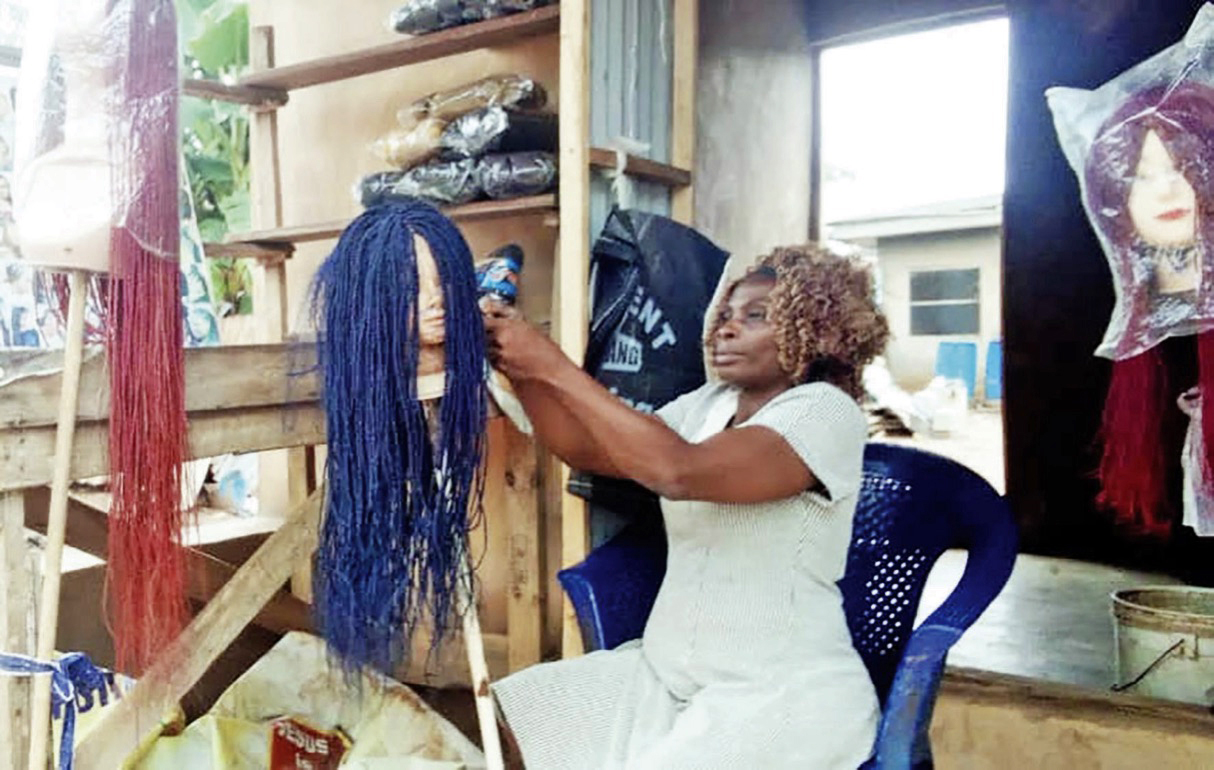
For 36-year-old Patricia Osademe, the day starts at 5:30am, rushing to have her bath that early to avoid being pushed down by her co-tenants whom she shares the same bathroom with.
Thereafter, she taps her white cane along her familiar Thompson Street in Oyinbo, counting the potholes she has memorised, and listening for vehicles to know when it is safe to cross the roads. By 9:30am she is at her store, where she makes beaded bags, sells them and braids people’s hair.
After losing her sight as a child from an unexplained illness, and attending a special needs school, she learnt the bead making skill, and now lives independently, but daily life is expensive.

She shared: “My biggest need is accessible transport. Drivers rush off when they see my cane. BRT buses have no audio announcements, so I often miss my stop and always need someone to hold my hand.
“I also struggle with healthcare costs. Eye checkups, drugs, and screen reader subscriptions are not cheap. I wish NHIS covered assistive technology.”
“I have been blind since I was nine from measles. People think because I have a craft that earns me a living, life is easy. But getting here every day is a fight. Buses don’t stop for me. Sidewalks are blocked and if my phone battery dies, I am cut off from everything. I’m not asking for sympathy, I just want inclusion.”
She added that what she needs most is accessible public transport, affordable assistive technology to aid her movement, and patronage of her wares without doubting her ability.
Olatunji Olajide is a basket weaver and father of three children who became blind at 28 after untreated glaucoma. He now runs a small weaving business from his home.
His 16-year-old son helps him read and write. He lamented that accessible the market to shop for materials are difficult because there are no tactile pathways suitable for him and traders sometimes cheat him.
“People pity you instead of buying from you. They said a blind man cannot do business. But I trained myself. We need skills training and micro loans that don’t require us to see or sign with a pen. Also, health centres should have Braille forms so we can register ourselves. What I need most is vocational support, financial inclusion, and health services that can assist my independence.”
Jackson Victor was born with congenital cataracts. He attends a boarding school for the blind in Lawanson, Surulere.
“I love literature, but we don’t have enough Braille textbooks. Moving around is not easy, but I have learnt my way around and know how to help myself. I want to study law in the university to defend people like me. Sadly I heard that the Joint Admissions and Matriculation Board (JAMB) does not always provide Braille papers on time.”
He called for inclusive exams and safe school infrastructure for the visually impaired.
Their stories represent more than 25 million Nigerians living with a disability. Of that number, an estimated 1.3 million are blind and 3.2 million have low vision, according to the Federal Ministry of Health. For many, the biggest disability is not the loss of sight, but the barriers and negligence built by society.
In 2019, former President Muhammadu Buhari signed the Discrimination Against Persons with Disabilities (Prohibition) Act, 2018. It is Nigeria’s primary law to end discrimination and advance inclusion. The Act mandates: Accessibility: Public buildings, schools, hospitals, seaports, railways and airports must provide ramps, lifts, and other aids. A five-year transition period was given. Transport: Service providers must make provisions for the visually impaired and give priority in queues and boarding. Education: Inclusive education with reasonable accommodations like Braille, audio formats, scribes, and extra time. Healthcare: Guarantees the right to healthcare. Employment: All public organisations must reserve at least five per cent of jobs for persons with disabilities. To enforce it, the National Commission for Persons with Disabilities (NCPWD), was established. In 2024, the commission said it had developed guidelines to enforce accessibility standards and issue compliance certificates, and that “effective and efficient enforcement mechanisms have been put in place.”
However, advocates say implementation is slow. The five-year deadline for accessible public buildings expired in 2023, yet many spaces remain inaccessible. Barriers cited include inadequate funding, poor enforcement, low awareness, and weak coordination.
Disability rights expert, Yinka Olaito, said: “Many public places, schools, transportation systems, and essential services remain inaccessible. The biggest challenge is not the absence of policies but the failure to enforce them.”
The NCPWD, working with the Head of Civil Service, stated that efforts are underway to introduce accountability frameworks across MDAs.
Tolu Adeyemi, consultant ophthalmologist at Vision Care Centre, Ikeja, spoke on causes and prevention.“The leading causes of blindness in Nigeria are cataract, glaucoma, refractive error, and childhood blindness from measles, vitamin A deficiency and harmful traditional eye practices. About 75 per cent of blindness is preventable or treatable if caught early.
Other News
“Cost is the biggest barrier. A cataract surgery can cost ₦100,000 and up. Low vision devices like magnifiers and screen readers are not subsidised. Many primary health centres don’t have an eye clinic, so people travel far or go to quacks.
“Parents should watch for white pupil in photos, squinting, frequent eye rubbing, or a child not tracking objects by 3 months. Adults should not ignore gradual loss of side vision, halos around lights, or sudden blur. Come for a comprehensive eye check every two years after age 40.”
Mrs Folake Johnson, proprietor of Hope Centre for the Blind, an NGO in Ogun State, spoke on teaching challenges.
“Our biggest challenge is learning materials. A single Braille textbook costs ₦25,000 to produce. We rely on donations. We also need more trained teachers. One teacher can have 15 students with different needs.
“Beyond academics, our students need mobility training, ICT skills with screen readers, vocational skills like catering and bead making, and self-advocacy. If they leave school without these, they will depend on family forever. The goal is for them to earn and contribute.”
Solomon Okenna, Executive Director, Vision Forward Group, Abuja, said members face three things daily: transport, money, and attitude.
“Buses won’t wait. Employers assume they can’t work. Landlords refuse to rent to them. Even ATMs and government websites are not screen-reader friendly.
“The biggest misconception is that blind people are helpless or a burden. People speak loudly to them as if they are also deaf. We change this through awareness in schools, churches, and on radio. We push companies to hire PWDs not out of charity, but because they are capable. Inclusion starts when we see ability first.”
Ezekiel Yusuf, Group Head of Human Resources at Chisco Group, said companies must look beyond conventional talent pools to build resilient organisations.
“Hiring visually impaired persons is not an act of charity or CSR. It is a strategic talent decision. We look for intellectual capacity, problem-solving skills, and resilience — qualities many visually impaired Nigerians possess from navigating our challenging environment daily.“With assistive technologies like screen readers, JAWS or NVDA, and smart phone accessibility features, a visually impaired professional can execute administrative and analytical tasks with excellent accuracy.
“Inclusive hiring also strengthens company culture. It brings unique perspectives on problem-solving into our teams.”
The HR head dismissed the belief that accommodations are expensive. “In reality, most accommodations are digital. Many tools are already built into standard operating systems or available via free, open-source software, requiring minimal financial investment.”
He also addressed concerns about output. “A visually impaired employee using auditory feedback, listening to document text at high speeds, can process information and draft reports just as rapidly as a sighted colleague. When we judge talent solely on how a task is physically executed rather than the value of the final deliverable, companies miss out on brilliant minds.”
Yusuf urged government to support businesses willing to hire persons with disabilities. “The government could offer direct tax write-offs or custom duty waivers on specialised hardware and software imports. This would significantly lower the entry barrier for small and medium-sized enterprises (SMEs).”
“Companies that actively meet diversity and inclusion benchmarks should receive matching advantages, such as preferential scoring or priority status when bidding for public contracts,” he added.
He concluded: “By shifting our corporate mindset from sympathy to capability, we can build a more inclusive economy where sight is never confused with vision.”
Seven years after the Disability Act, Nigeria stands at a crossroads. The legal framework exists. The NCPWD has a mandate. But as the 2024 State of Disability Inclusion Report showed, critical gaps remain in education, health, and employment.
Policy experts recommend strengthening enforcement and sanctions, adopting universal design in infrastructure, and public-private partnerships to fund accessible transport.
He concluded: “By shifting our corporate mindset from sympathy to capability, we can build a more inclusive economy where sight is never confused with vision.”
Seven years after the Disability Act, Nigeria stands at a crossroads. The legal framework exists. The NCPWD has a mandate. But as the 2024 State of Disability Inclusion Report showed, critical gaps remain in education, health, and employment. Policy experts recommend stronger enforcement and sanctions, universal design in infrastructure, and public-private partnerships to fund accessible transport.
Until then, for Patricia, Olatunji, and Jackson, every day remains a fight — not against blindness, but against a system that is yet to see them