Follow Us on Google

Jeff Amechi Agbodo, Onitsha
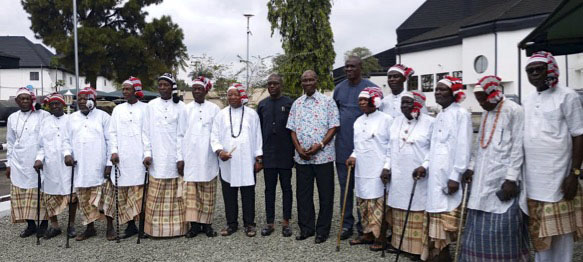
Traditional ruler of Umumbo community in Ayamelum Local Government Area of Anambra state, Igwe Simeon Ikechukwu Chidubem (Ibobora), Aboh 1 said the community stayed 13 years without a monarch after his predecessor died in 2001.
During the period, he said the custom and tradition of his people almost went into extinction. He also talked about their plight in the hands of mindless herdsmen.
What was it like the years your community stayed without a traditional ruler?
Any community that has no Igwe may not move forward because the Igwe is the chief custodian of the culture and tradition. There was no security in the community and the culture of the community was deteriorating because nobody was there to direct the people the way it should be done. So, we lost a lot of things between when the then Igwe died and the time I was crowned. Even though I was the President General of the town union at some point but there were areas the community was lagging behind due to the absence of the Igwe. There are customs and tradition, which the town union president had little or no knowledge about.
What areas have you impacted positively on the community as their monarch?
I can authoritatively say that the elusive peace in the community has returned in the community since I ascended the stool to the glory of God. This was evident when I was crowned, because the tussle wasn›t tough and I had the mandate and support of the people, so it helped me to bring the people together. There was no faction, though there must be those who would always disagree in in any situation but they are very small. Today, Umumbo has relative peace compared to when there was no Igwe.
In the area of infrastructural development, I was on the throne when the state governor started the construction of Umumbo road which was very bad that we can’t use it during the rainy season. Now, the road is receiving a facelift courtesy of Governor Willie Obiano. Then, Josan rice mill located at Umumbo was resuscitated by Josan Agro Industry Limited in partnership with the state government. This time around, Umumbo is looking forward to having potable water through the efforts of state government and Josan Agro Company. Our children are embracing education now unlike before. I do a lot to encourage both male and female to go to school.
Which cultural activities have you been able to revive?
I mentioned earlier that some of our culture died for whatever reasons but when I became the Igwe, I tried to revive some of them. For instance, during my first Ofala festival in February 2015, I tried with the council of elders, the Igwe-in-council to ensure that some of them came alive again. One of them is Chikwoje; this festival showcases the maidens, girls who are not married and those who just married newly but have not given birth. The festival is very interesting as they showcase themselves using bird feathers to design and decorate themselves as crown on their heads. They would file out and young men searching for wives will choose from the girls. They go around the community, village by village in turn. There is another one called Asator festival, celebrated by one of the villages in the community. To revive these cultural festivals, the community has equally allotted to each, two-sister villages (quarter) a particular feast that is peculiar for them like in Ezi quarter which comprises Eziumumbo and Uga villages; their cultural event is Ogbe Agu festival where they showcase and display masquerades both day and night. So, this festival is now peculiar to them; no other village joins them whenever they are celebrating it. Then Obune and Ikenga; the two villages that followed Eziumumbo and Uga village in seniority in Umumbo community celebrate Asator festival celebrated between March and April. Then Isamaoyi and Ifuteora is another quarter. Their festival is called Igilige. It’s a period the two villages visit each other each year. The last quarter made up of Umudim and Umuezechi villages is known for Okwele festival which is similar to that of Ogbe Agu in Ezi quarter. They also display their masquerades. This is what we’ve done to imbibe the culture and keep them going, so that they will not go into extinction.
How expensive are marriage and burial ceremonies in your community?
Marriage is as cheap as anything in Umumbo community. In my place, you can marry a girl with N5000, that’s the bride price even if she is a Ph.D holder. You pay N5000 as bride price and there are other necessary things you should be able to do which includes to ensure that you buy clothes for your father in-law and mother in-law, buy red cap and staff for your father in-law and hair tie and handbag for your mother in-law and then settle your age grade. The issue of wedding is optional.
However, burial is more expensive in Umumbo today and that is against our cultural heritage. What we normally do before was that if any person dies, we bury him or her immediately with little ceremony. But this time, it is a different thing all together, the western civilization has made people to showcase their wealth, so in my community today, people use burial of their father, mother and loved ones to show how wealthy or connected they are; which is not proper. With this, the cost of burial in my place is getting very high day after day unlike before and we are doing something to curtail these expenses that people normally do during burials. But as we work to curtail the expenses, the people will follow another way to showcase their wealth. The issue of taking somebody to mortuary was not part of our culture and tradition, because our parents told us to bury them immediately they died but this time around, people take their loved ones to the morgue for more than one year before they bury. They even sew different types of uniform (Ashebi) for the burial which takes a lot of money. All these now make burial very expensive. But we’ve finally succeeded in prohibiting wake in the community because during the wake, you find out that all the drinks and food meant for burial or funeral would be finished before the day breaks. This will put the person in problem running around to replace the drinks in the morning. We are trying with my cabinet and Atta age grade to curtail all the excesses in burial, so, by the time we fine-tune the law; we pronounce it and try to implement. Then the cost of burial would be minimised in the community because we see it as a waste.
How is your community coping with the menace of herdsmen?
We are an agrarian community; we cultivate rice, cassava, yam, local beans in abundance, vegetable among others. The issue of cattle menace is not peculiar to Umumbo community, it is a general issue and as a community, we are trying as much as we can to ensure that there is no crisis emanating from the farmers and herders. But we are not finding it easy. A lot of destruction has happened, wanton destruction of our crops; the issue of raping, the issue of breaking our yam bans and huts among others. But good enough, the state government foresaw this serious problem and proactively constituted a committee called Anambra state cattle control, menace committee headed by Director, Department of State Services in the state. The committee is doing a very nice job and I equally commend the government for the quick response to issues of cattle destruction in the state. The worst thing about the herdsmen is that they don’t tell anybody that they are coming to our place, even as the traditional ruler of Umumbo, they didn’t inform me that they were coming to my community and my people will be accusing me of having collected money from the Fulani to allow them stay, how will I pursue them when the constitution of the country allows everyone to go to any place to stay. However, your freedom stopped where another person’s started but they don’t know that because their educational background and ours is not the same, they live in the bush. Recently, I called all the herdsmen in my community to a meeting in my palace, and presented all they have destroyed in the community but they could not pay. The problem farmers have with them is that they will destroy your crop worth N30, 000 to N40, 000 and when you ask them to pay, they will bargain for N1,000; can you imagine that? So, because of this, the community will tell them to leave their area but it is not easy for them to leave and you cannot push them. I asked them how many groups are they in my community, they could not tell me how many they are here. I don’t know whether they are hiding something from me but I know that they are many in my area. The crops they destroyed were valued at N20million and they offered to pay N300,000. About 500 people whose crops were destroyed brought their reports which were properly assessed and calculated while others refused to bring theirs but insisted that the herdsmen should leave the community even without paying any compensation. I asked them to try and pay the amount estimated by the community so that they can have peace with the host community otherwise no farmer will allow them to destroy their crops and get away with it but up till now, the herdsmen have not done anything about the payment of compensation as we agreed and more reports of destruction are coming on a daily basis and more herds of cattle are coming in every day. As it is now, I don’t know what to do but I have made report to the cattle menace committee which I’m a member. So, we left our fate to God.