Follow Us on Google
By Adeobowale Johnson
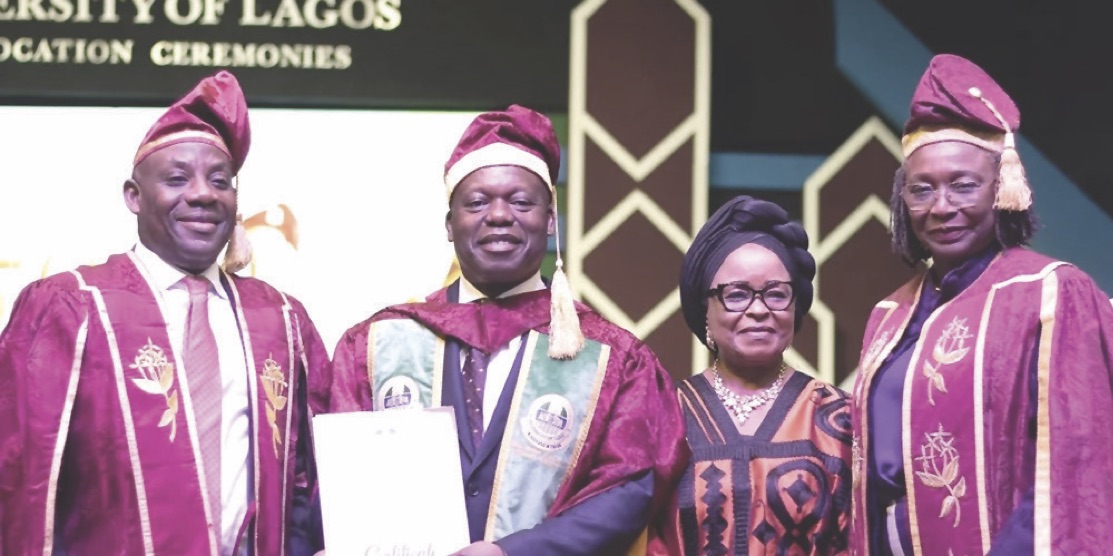
For the Group Chief Executive of Oando PLC, Wale Tinubu, it was a special day, a day to treasure, because his entrepreneurial sagacity was recognized and honoured by a world-class institution. At the 56th convocation of the University of Lagos (Unilag), he was conferred with an honorary doctorate in Business, in recognition of his contributions to enterprise-building, energy sector transformation and national development.
The honour recognises a career defined by disciplined entrepreneurship, institutional leadership and long-term value creation within Nigeria’s strategic energy sector.
In its citation, Unilag described Tinubu as a corporate leader whose work has strengthened indigenous participation in the oil and gas industry, generated employment, and supported economic resilience through private-sector-led growth.
Wale Tinubu, who spoke on behalf of the honorary award recipients, described the recognition as both an honour and a responsibility, noting that it reflected a broader obligation to society beyond personal accomplishment. He said: “We receive it not merely as a celebration of personal achievement, but as a renewed call to service. Knowledge and leadership only fulfil their purpose when they are placed in the service of the common good.”
He spoke about resilience, conviction, and the discipline of building through uncertainty as he reflected on his professional journey. “Do not wait for perfect conditions. The world is never placed where you want it. You have to move, you have to dare, and you have to build as you proceed.”
He emphasised the role the institution has played in shaping national development, saying: “UNILAG has never been content to produce credentials; it has produced nation-builders. It is therefore fitting that this institution once again places leadership at the centre of this convocation at a time when Nigeria itself is being called to renew. The reforms on the way seek to stabilise the economy, restore confidence, unlock global productivity, broaden opportunity, improve security, and improve the health and social welfare of this country. But reforms do not succeed by policy alone. They succeed when ideas shape action, and knowledge guides leadership.”
There was much more to the event. It was the convergence of two worlds: scholarship and enterprise, theory and execution. In Tinubu’s journey — from young Lagos lawyer to one of Africa’s most recognisable energy executives — the university found a narrative that mirrored Nigeria’s own uneven, determined climb.
For UNILAG, founded in 1962 on the conviction that intellectual capital would anchor a young nation’s future, the honour was not merely ceremonial. It was a deliberate nod to a Nigerian whose career has been defined by bold bets, hard landings, and a stubborn refusal to stop building. For Tinubu, the recognition carried a personal weight. It was, he said, “not merely a celebration of past achievements, but a renewed call to service.”
That phrase — renewed call to service — framed both the ceremony and the man. Tinubu’s story is not the tidy arc of inherited privilege or uninterrupted success. It is a study in calculated risk, institutional reinvention, and an unshakeable belief that nations, like businesses, are built by people willing to try, fail, learn, and try again.
The philosophy of failure
If there was a central thesis to Tinubu’s remarks around the convocation, it was disarmingly simple: failure must be acceptable. “We learn from our failures, and we get it right,” he said. “We stop condemning the country and believing it cannot go right. The country can go right, and it goes right by us as a people collectively moving in one direction.”
In a country where public discourse often swings between euphoric optimism and corrosive cynicism, his message landed with unusual clarity. Tinubu was not romanticising hardship; he was reframing it as raw material. Nations that succeed, he argued, do not avoid failure — they metabolise it. He reached for the language of exploration: the repeated attempts before reaching the moon, the countless failed expeditions before summiting Everest. The analogy was deliberate. Progress, in his worldview, is iterative. “A lot of people are scared of failing,” he said. “They simply don’t try — and accordingly, they never succeed.” It is a philosophy that reads less like motivational rhetoric and more like a boardroom post-mortem. For Tinubu, failure is not an emotional event; it is a data point.
Born on June 25, 1967, Tinubu’s early trajectory gave little away about the scale of enterprise he would later command. Educated in Nigeria before earning a Bachelor of Laws from the University of Liverpool in 1988 and a Master of Laws in International Business Law from the London School of Economics, he was called to the Nigerian Bar in 1990. The path ahead seemed mapped: chambers, clients, a respectable legal career.
But history often pivots on moments that look like inconvenience. Early in his professional life, Tinubu encountered a logistical crisis involving stranded oil tankers offshore — a problem others saw as bureaucratic quicksand. He saw arbitrage. “As a young lawyer with no office, no corporate name and very little capital, I encountered the distress most people saw as a problem,” he recalled. “I saw it as a possibility… That moment taught me a lesson that has guided every step of my life: do not wait for perfect conditions.”
Other News
That instinct — to treat systemic friction as commercial opportunity — became the seed of what would evolve into Ocean and Oil Group, co-founded in 1993. What began as an oil trading and shipping venture would, over three decades, morph into one of Africa’s most recognisable indigenous energy brands. The transformation from trader to integrated energy group did not happen through incrementalism. It came through aggressive, sometimes audacious acquisitions. In 2000, Ocean and Oil acquired a controlling stake in UniPetrol Plc. Two years later came what was then the largest acquisition of a quoted Nigerian company: UniPetrol’s purchase of Agip Nigeria Plc. The company was later rebranded Oando Plc.
Under Tinubu’s leadership, Oando evolved from a petroleum marketing outfit into a diversified energy company with operations spanning upstream exploration, midstream infrastructure and downstream marketing. Its primary listing on the Nigerian Stock Exchange and cross-border listing on the Johannesburg Stock Exchange signalled a company — and a chief executive — comfortable operating beyond local ceilings. The numbers tell one story: hundreds of retail outlets, vast storage capacity, billions of dollars raised from international finance for acquisitions and development projects. But the more revealing narrative lies in the volatility. Oando’s journey has included boardroom battles, regulatory headwinds and market shocks — the sort of turbulence that buries less resilient firms.
Yet resilience is Tinubu’s defining corporate motif. Each downturn became, in his telling, another iteration in a long experiment: how to build an African energy company that could compete on global terms.
Betting on a different future
In 2021, Tinubu founded Oando Clean Energy Limited (OCEL), a move that signalled strategic acknowledgement of a world tilting toward decarbonisation. For an executive whose fortune was forged in hydrocarbons, the pivot was less ideological than pragmatic. Africa’s energy paradox — abundant fossil resources but crippling energy poverty — demands a dual strategy: expand access while preparing for transition. OCEL’s mandate is to design and deliver sustainable energy projects aligned with Nigeria’s energy needs and the global race to net zero.
In May 2023, in partnership with the Lagos State Government, OCEL rolled out electric mass transit buses as part of a proof-of-concept phase, with hundreds more planned. It was a modest but symbolic step: the oil executive investing in electrons. This duality — oil and renewables, legacy and transition — mirrors the tightrope many emerging economies must walk. Tinubu’s position is not that Africa should abandon hydrocarbons overnight, but that it must not be locked out of the future energy architecture.
Tinubu’s conception of nation-building extends well beyond GDP. Through the Oando Foundation, he has channelled resources into basic education, adopting dozens of public primary schools, supporting hundreds of thousands of pupils, enrolling out-of-school children and training thousands of teachers. Classrooms have been built, sanitation facilities installed and digital learning centres established. His humanitarian interventions have also reached conflict-affected regions. In 2018, he helped mobilise private-sector awareness and funding for Nigeria’s northeast humanitarian crisis, leading delegations to internally displaced persons camps in Borno State.
These initiatives are not peripheral to his worldview; they are expressions of it. “The true measure of success,” he said, “is not how far we rise, but how much we lift others when we rise.” It is a philosophy that reframes philanthropy from charity to social investment — an attempt to widen the pipeline of future talent and stability upon which business itself ultimately depends.
Speaking on behalf of fellow honourees at UNILAG’s convocation, Tinubu situated the moment within the university’s historical mission. Established when Nigeria understood that political independence required intellectual infrastructure, UNILAG has produced leaders across disciplines — from public service to medicine, law to the creative industries. He paid tribute to a lineage of vice-chancellors and scholars who shaped the institution’s ethos, culminating in its current leadership. But his focus was forward-looking. Universities, he argued, are not spectators in national crises; they are engines of solutions. “Citadels of learning are not spectators to national challenge; they are drivers of it. They generate the ideas, train the innovators, test the evidence and nurture the ethical leadership that progress demands.”
In his framing, the relationship between “town and gown” must tighten. Alumni engagement, private-sector collaboration and research partnerships are not luxuries; they are structural necessities in a knowledge-driven economy. Tinubu’s remarks also acknowledged Nigeria’s present inflection point. Economic reforms, he noted, are painful but necessary. Yet policy alone cannot deliver transformation. Ideas must inform action; evidence must guide leadership.
Merit, in his view, is the institutional North Star. Societies that reward competence and integrity build durable systems. Those that sideline merit mortgage their future. “What we have done here today is witness a ceremony that has rewarded merit,” he said. “It is extremely important that merit be placed at the forefront of institution building.” It was both congratulatory and cautionary — praise for academic excellence, and a broader plea for standards in public life.
Beyond corporate Nigeria, Tinubu occupies seats in global policy circles. He has been involved with the World Economic Forum’s oil and gas community, participates in high-level climate and investment dialogues, and serves on committees focused on long-term funding and infrastructure. His role in the US-Nigeria commercial investment dialogue places him at the intersection of diplomacy and commerce. These platforms amplify his influence, but they also reinforce a recurring theme: Africa must not be a passive recipient of global decisions. It must help shape them. His national honour — Commander of the Order of the Niger (CON) — formalised state recognition of those contributions. But honours, like doctorates, are punctuation marks, not conclusions.
The walk across the stage
Back in the UNILAG auditorium, as cameras flashed and applause rose, Tinubu’s investiture carried layered symbolism. A lawyer who became an energy magnate. A hydrocarbons executive funding clean transport pilots. A businessman lecturing graduates on patriotism, failure and service. Universities confer honorary degrees not just to celebrate individuals, but to project values. In choosing Wale Tinubu, UNILAG spotlighted enterprise as a form of national service — provided it is tethered to societal progress.
For the graduates watching, his message was stripped of corporate jargon: start before you are ready, accept failure as tuition, build anyway. For the country, it was a quieter challenge — to replace reflexive despair with disciplined effort. As the ceremony wound down and the crowd spilled into the Lagos heat, the doctorate settled onto Tinubu’s shoulders as both recognition and responsibility. In his telling, the real work lies ahead — in boardrooms, classrooms, policy tables and construction sites where Nigeria’s next chapters will be written. The gown will be folded away. The title will be added before his name. But the philosophy he carried onto that stage — that nations, like entrepreneurs, must dare, stumble, learn and dare again — is the part meant to endure.