Follow Us on Google
From Oluseye Ojo, Ibadan
Nigeria’s theatre industry has long been celebrated for its exceptional talents and contributions to the creative economy. It is valued at $6.4 billion, and it is the most popular movie industry in Africa.

In the PwC Global Entertainment and Media Outlook for 2020-2024, Nigeria’s media and entertainment industry is one of the fastest-growing creative industries in the world. In 2021, according to PwC, Nigeria’s film industry contributed 2.3 per cent and about N239billion ($660million) to Gross Domestic Product (GDP).
Streaming giant, Netflix, in a recent report, showed that it invested $23.6 million in Nigeria. The Mastercard Foundation as well as other foreign and local investors have shown interests and are supporting the theatre industry in Nigeria to achieve its full potentials.
It is, however, on record that the formal journey of theatre industry in Nigeria began 60 years ago in the University of Ibadan, an institution that will be 75 years in November 2023. The first Theatre Arts Department in Nigeria was established in UI. The department is the flagship of theatre scholarship and practice in the country.
The feat made the authorities in the Department of Theatre Arts, UI, the management of UI, and alumni of the department to roll out the drums between August 23 and 26, 2023 to celebrate the 60th anniversary of excellence of the department.
The celebration attracted the Vice Chancellor, Federal University of Kashere in Gombe State, Prof Umar Pate, who delivered the anniversary lecture. It also attracted the Deputy Vice Chancellor (Administration), UI, Prof Olusola Ayoola, who presented a goodwill message on behalf of his Vice Chancellor, Prof Kayode Adebowale; as well as the Dean, Faculty of Arts, UI, Prof Solomon Oyetade, who also delivered a goodwill message.
The anniversary lecturer, Prof Pate, posited that in order to achieve holistic growth and maximise the industry’s potential, there is a need to focus on developing and nurturing grassroots talent. He also emphasised the importance of collaboration between the government and artists, the establishment of creative policies, and financial support to uplift the theatre sector at all levels.
Pate stressed that Nigeria’s theatre industry, along with its cinema and creative subsectors, has played a significant role in contributing to the country’s Gross Domestic Product (GDP). He added that Nollywood and Cannywood have gained international recognition, and their success has highlighted the immense potential for growth within the creative economy.
By investing in local theatre initiatives and organising talents within communities and local governments, he believed, Nigeria could further tap into the resources available and create increased opportunities for economic growth.
To unleash the potential of theatre artists, Pate strongly recommended organising and creating institutional mechanisms that support and promote theatre start-ups at grassroots levels. The support, he stated, should extend beyond the university level to local governments, where theatre artists can contribute to the local economy.
Pate also advocated the use of local languages in theatre performances, emphasising that creative expression does not necessarily have to be in English. By doing so, he said, Nigeria can tap into a plethora of talented individuals, who can contribute to the growth of the theatre industry.
One important aspect highlighted by Pate was the need for collaboration between the Minister of Art, Culture, and Creative Economy, Hannatu Musawa, and the artist community. By working together, he was optimistic, they can ensure the integration of theatre artists into the ministry’s activities, creating a unified front for the development and promotion of the theatre industry. Additionally, the implementation of creative policies, tailored to the unique needs of the industry, is crucial.
The policies, according to him, would help streamline processes, provide support systems, and boost the growth of theatre artists and their work.
Pate said: “Now that the Federal Government has created a whole ministry with a component of the creative economy, this is what the whole world is talking about. Already, Nigeria is engaged in a creative economy – our Nollywood, Cannywood, and others are contributing significantly to the Gross Domestic Product (GDP), it is part of creative economy.
“The food export that we do and some other things, the issue is that we can do much more. And theatre is part of that creative economy. The theatre at the community level, theatre at the state level, theatre at the national level, and theatre at the international level. We have a lot of talented people.
“But we need to organise ourselves. We need to put up some institution mechanisms that can help these theatre start-ups to now become relevant and functional at the community level to the state, and national levels. It must not necessarily be at the university level alone. It can be at the local government level, and they can contribute to the local economy.
“I believe we have a lot that we can harvest from our theatre artists. They need to be assisted. They need to be organised. They need to be in a framework, that their talents can be achieved, so that they can really be part of creative economy.
“Therefore, the minister should put her head together with the artists’ community and then see how they can be mainstreamed into the activities of the ministry. Also, we need creative policies. This is very important. At the same time, we need to have financial support that can help them to organise and be functional at the local level. The community level is very important before we now go up.
“There are a lot of talents in our community that can be useful in form of theatre performance, using the local languages. It does not necessarily mean that it should be in English. So, there is a lot of resources that can be garnered through that.”
In the same vein, Prof Duro Oni, a retired Professor of Theatre Arts from the University of Lagos, and an alumnus of the Department of Theatre Arts, UI, who served as the Chairman, Central Planning Committee (CPC) for the anniversary, shed light on the evolution of theatre in Nigeria. He highlighted how theatre departments have expanded across Nigerian universities, with diverse names such as Theatre Arts, Dramatic Arts, and Creative Arts.
Oni noted the infusion of media into the theatre profession and how many actors have transitioned from stage to film, a process that showcases the dynamic nature of Nigerian theatre. This shift reflects the changing landscape and the integration of new technologies, which have opened up new avenues for creativity and storytelling.
Answering a question on theatre arts yesterday, today and tomorrow, Oni said: “A lot has happened from 60 years till date. Now, we have about 60 departments of theatre arts in Nigerian universities, and there are some also in the colleges of education. So, the profession continues to grow and the training continues to also advance.
“The parent department in UI still retains the name – Theatre Arts. In Ife (Obafemi Awolowo University, Ile-Ife), it is called Department of Dramatic Arts. In UNILAG, it is called Department of Creative Arts. In Port Harcourt, it is also called Creative Arts. In some, it is Media and Theatre. In some, it is Theatre and Media. At Ahmadu Bello University, it is Theatre and Performing Arts. So, a lot is changing. There is a lot of infusion of media now into the theatre profession.
“If you see a lot of our actors that were on stage, they have now gone into film industry. Many people who were actors for stage are now actors in Nollywood and the film industry. So, that is part of the evolutionary process of theatre in Nigeria.”
He noted that the advancement of technology has led to digitalisation in the entertainment industry, impacting live theatre audiences. He acknowledged that a smaller fraction of people now attend live theatre performances, but he stressed that this art form remains active, especially within the university system. The availability of students and technical crews in universities ensures the continuation and growth of live theatre performances. Nevertheless, Oni recognised the significance of digital platforms, such as skits and streaming services, in keeping theatre accessible to a wider audience.
“The advancement in technology is very important. How many people do you still get to sit in the theatre? But there are a lot of skits, and those skits are on and on. But also, there is live theatre. If you go to Lagos, you have got Terra Kulture, Muson Centre, and a few others like that.
“Live theatre is still very much active and alive in the university system because they all have students that they use for their productions. They have got the technical crew to advance those productions, so it continues to grow.”
When asked to appraise the growth in Nollywood in comparison with Hollywood and Bollywood, Oni responded: “Most of the people who are critical of Nollywood last watched any Nollywood film 10 to 20 years ago. Look at ‘Jagun Jagun’, won’t you say that is classic? Look at Anikulapo, it is also classic. So, the industry is growing rapidly. So, that is what is important.
“But most of our critics still believe that when you watch one Nollywood movie, you have seen the rest of it because the storyline is predictable. No, it is no longer so. It is a growing phenomenon and we will continue to applaud them. Even, the international community is coming to Nollywood. Netflix is sponsoring films in Nigeria. They won’t sponsor things that they know would not make a difference.
“If you look at companies like Mastercard, they are sponsoring productions in Nigeria. So, they are investing in things that they believe would make a difference. I think we are doing well in that regard.”
Prof Oni also advised the Minister of Art, Culture, and Creative Economy, Hannatu Musawa, that “She should listen to the people in the industry, talk to them, feel their pulse, and see how to advance the cause. I believe that job of a minister is essentially management. The minister should be knowledgeable about the area. But it is more important for the minister to have a listening ear, to advance the cause to which he or she has been appointed.”
In their separate goodwill messages, the Vice Chancellor, UI, Prof Kayode Adebayo, and Dean, Faculty of Arts, Prof Solomon Oyetade, congratulated the Department of Theatre Arts of the institution on the attainment of the age of 60, which they described as a no small mean and an entrance into the club of elders. They noted that the alumni of the department have gone ahead to create positive image for UI, including the Nobel Laureate, Prof Wole Soyinka.
The anniversary also featured film shows, pay performance, theatre career clinic for secondary school students, and homecoming meeting for the alumni of the department.
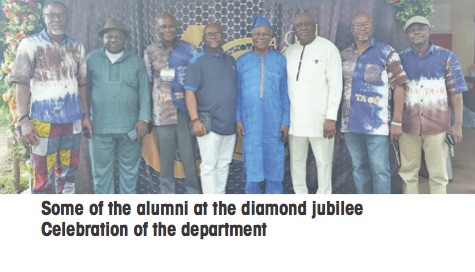
Some of the alumni of the department who attended the event were renowned playwright, Prof Bode Sowande, Prof Sola Fosudo, Prof Chuks Okoye, Prof Diran Ademiju-Bepo, Dr Tochukwu Okeke, Dr Bonifacde Anyanwu, Dr Bashiru Akande Lasisi (current Head of the Department), Editor, Saturday Sun, Tope Adeboboye, Editor, Sunday Tribune, Sina Oladeinde, Joseph Uchea, Peter Tade Adekunle, Gred Odutayo, Gbenga Windapo, popular actor, Hafis Oyetoro (Saka), Ajibola Ogunmowo, Lanre Oladele, Kehinde Ogunsina (nee Afelumo), Biodun Ogidan (nee Wahab), and Sidi Allah-Dave, among many others.