Follow Us on Google
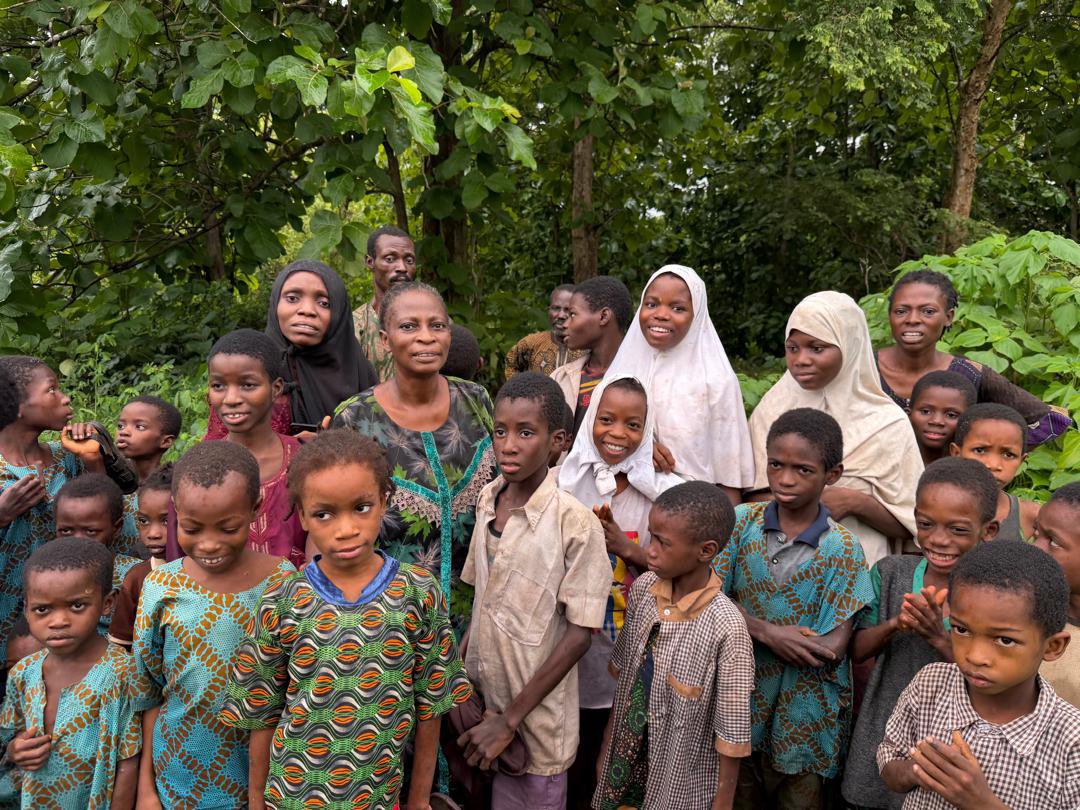

•Rescued schoolchildren, teachers recount 56 days of horror in Oyo forest •I never thought I’d see my family again – 15-year-old Taiwo •Even if it’s my husband’s bones, please give us to bury – Widow of slain teacher begs
By Oluseye Ojo
The first sign that the ordeal of the rescued Oriire abducted children was far from over came not from a doctor, a psychologist or a security expert. It came from a frightened four-year-old girl, whose instinctive reaction spoke louder than any medical diagnosis.
When journalists arrived at the Ahoro-Dada community in Oriire Local Government Area of Oyo State on Wednesday, July 15, to follow up on the condition of pupils and teachers rescued from kidnappers after 56 harrowing days in captivity, little Taiwo did something that captured the invisible wounds of the tragedy.
The moment she saw cameras and microphones, she screamed and bolted. To journalists, they were ordinary work tools. To the traumatised child, they resembled the guns that had shattered her world exactly two months earlier
To the adults around her, they were harmless journalists. To the frightened child, they looked like armed men who had invaded schools in broad daylight on May 15, firing guns and dragging innocent children and teachers into the forest.
Her terrified parents eventually caught up with her, held her gently by the hands and repeatedly assured her that the visitors were not kidnappers.
The reaction of the little girl probably revealed that while the victims had regained their freedom, many have remained prisoners of fear.
As gathered, the singular moment perhaps tells the story of the Oriire schools’ abduction better than statistics ever could.
Though the victims might have left the forest, for many of them, the forest has refused to leave their minds.
But the story of the Olaleyes was not like that of the family of Michael Oyedokun, the mathematics teacher that was beheaded by the bandits on Saturday May 16th. The Oyedokuns already got the news of the killing of their breadwinners since May.
The Oriire mass abduction, it was gathered, ranks among Nigeria’s most disturbing attacks on schools in recent years. Some of the previous school kidnappings took place in Chibok, Dapchi, Kankara, Tegina, Kuriga and other communities where classrooms became hunting grounds for armed criminals.
Community learning to smile again
The coordinated attacks on schools in Ahoro-Esiele and Yawota communities on Friday May 15, 2026, shocked Oyo State and the entire country.
Gunmen stormed three schools, shooting indiscriminately before marching away with 39 pupils and seven teachers.
For 56 agonising days, families lived between hope and despair. Parents woke up every morning praying that their children would still be alive.
Teachers feared entering classrooms. Entire communities held their breath.
But the eventual rescue of all 44 surviving victims through a coordinated security operation brought immense relief across Nigeria. But relief, as events in Ahoro-Dada have shown, is not the same as healing. Healing is proving to be a much longer journey.
Abduction was never staged; we passed through hell – Zaccheaus Olatunde
For many Nigerians, the rescue of the Oriire pupils and teachers marked the end of a frightening chapter. But for Mr Zacheaus Olatunde, one of the seven teachers rescued after spending 56 days in captivity, the memories remain vivid, painful and impossible to forget.
Speaking after regaining his freedom, Olatunde recounted life inside the terrorists’ camp. He described how two of his colleagues – Mr Michael Oyedokun and Deacon John Olaleye, lost their lives under brutal circumstances.
According to him, the kidnappers had laid down strict rules from the very first day they arrived in the forest. One of the first instructions was that every captive must surrender all mobile phones.
Everyone appeared to comply. Unknown to the others, however, Mr Michael Oyedokun still had a phone in his pocket.
“The terrorist sitting with him on the motorcycle discovered the phone and immediately questioned him,” Olatunde recalled. “When Michael explained, the man slapped him. Their General Commander heard about it and became furious.”
The commander reportedly declared that such disobedience could not go unpunished.
According to Olatunde, the terrorists had two leaders—a General Commander and a Camp Commander. The General Commander allegedly announced before everyone that if no one else would be killed for violating his orders, Michael would pay with his life.
The following day, the threat was carried out.
“We heard him crying and begging as they dragged him away,” Olatunde said quietly.
“His voice was very loud at first… then suddenly, everywhere became silent.”
Moments later, one of the younger terrorists whom he estimated to be about 17 or 18 years old, returned dancing and singing in celebration of the killing.
The horror did not end there.
Weeks later, on June 7, another teacher, Deacon John Olaleye, was also taken away and killed
“Mr John Olaleye was murdered on June 7. They killed him because they said they have warned that military men should not move closer.
“They never killed them in our presence. They would take them away to another location. We only heard their cries before everything became quiet.”
Life inside the camp, he said, was a daily struggle for survival.
The adult male captives were kept inside makeshift tents, their hands handcuffed and their legs chained for virtually the entire period of captivity. Their eyes were often blindfolded, while even basic human needs depended on the permission of their captors.
“If we wanted to urinate or defecate, we had to beg them,” he recalled.
The terrorists rarely stayed in one place, moving the captives from one forest location to another to avoid detection by security forces. Adult captives, he said, often bore the punishment for mistakes committed by frightened children.
“Sometimes they struck us with their guns. If any of the children did something they didn’t like, it was the adults who suffered.”
Food was barely enough to sustain life.
Most days, the captives survived on plain rice or rice mixed only with palm oil, without pepper or salt.
Occasionally, the terrorists hunted wild animals, including deer and grasscutter, which were shared among the captives.
Religion also became another instrument of intimidation.
According to Olatunde, the terrorists were meticulous about observing their own prayers and Qur’anic recitations, never missing the prescribed times of worship.
Ironically, they prohibited Christian prayers among the captives.
“They warned us never to pray or call on Jesus. Whenever they caught us praying, they beat us mercilessly,” he said.
Perhaps one of the most revealing aspects of his testimony was the kidnappers’ claim that money was not their primary objective.
“They kept telling us they were not interested in ransom,” Olatunde said. “Their demand was that members of their group who had been arrested should be released.”
Eventually, events appeared to shift in the captives’ favour.
According to him, the kidnappers became noticeably less hostile after learning that some of their own family members had been arrested during security operations.
“Their attitude changed after that,” he said. “They treated us better than before.”
Then came the unexpected announcement that would end the two months of hell and horror.
“They told us to prepare because we were going home.”
The terrorists reportedly directed the captives along a particular route, telling them they would cross two streams before meeting soldiers waiting to receive them. By then, many of the children were too weak to walk unaided.
“I carried almost all the little children across the streams because they had become very weak,” Olatunde said.
Shortly afterwards, they encountered security personnel who escorted them to safety, bringing an end to one of the most traumatic experiences of their lives.
Back in Ibadan, he recalled, military officers showed him photographs of suspected kidnappers. He said he was able to identify one of them and was informed that several members of the gang had already been arrested while others had been neutralised during security operations.
He also dismissed claims in some quarters that the abduction had been staged.
He explained that the absence of school uniforms among some of the pupils was because Oyo State public primary schools observe traditional attire every Friday, a policy that also accounted for why several teachers were dressed in native wear on the day of the attack. As for questions about why some of the children’s clothes appeared clean after their rescue, he offered another startling explanation.
“The kidnappers occasionally washed our clothes whenever they felt we were smelling,” he said. Then, after a long pause, he summed up the ordeal in one sentence that perhaps needs no embellishment: “The abduction was never staged. We passed through hell.”
Other News
I thought nobody would rescue me— Taiwo Hassan
One of the rescued pupils, Taiwo Hassan, a 15-year-old boy, still remembers every frightening second.
Speaking quietly, he recalled how an ordinary school day suddenly became a nightmare.
“We were writing our test. I didn’t know how the kidnappers entered the school. All I knew was that they suddenly came with guns,” he stated.
The sound of gunshots instantly erased every thought except survival.
“We had no option but to follow them because they were carrying guns and shooting. We just obeyed.” Then came the long journey into the forest: “I don’t even know the route they took us through into the forest. But when we entered the forest, we trekked for one day.”
The boy noted that far more painful than the physical trek, however, was the emotional burden. “When I was in the kidnappers’ den, I was afraid nobody would rescue me. I kept thinking about my parents. I knew they would also be afraid.”
He revealed that beyond hunger, exhaustion and uncertainty, the greatest burden was psychological torture, including the constant fear that home might never be seen again.
Hassan stated that the abductors took the victims to their first stronghold by 7pm on May 15th, after they had been kidnapped around 9am, which is about 10 hours of trekking.
But how did they eat? He answered: “They fed us with cooked rice. Initially, they allowed the women among the victims to cook the rice. Later, the abductors took over the responsibility by themselves. They cooked for us.”
Hassan added that the captives were taken to different locations inside the forest. At times, they would be under shades of trees.
“Whenever rain fell, they would cover us with big nylon. The teachers suffered more. They were handcuffed and blindfolded.” Some elderly people around Taiwo stated that she told them that she was given garri without sugar as food for many days.
Father’s relief after 56 days of agony
For Mr Hamzat Wakili, whose teenage son was among those rescued, every passing day during the captivity felt like a lifetime. Like many parents, he imagined unimaginable horrors.
“I thought the kidnappers would have beaten him mercilessly. But when he returned, he told me they didn’t beat him,” he stated.
It was perhaps the first piece of good news he had received in nearly two months. Wakili insisted that despite the tragedy, his community must not be abandoned. “This is my community. I don’t pray that this community or the school will collapse. By God’s grace, my son will return to school.”
Grandmother who wept everyday
For Mrs Taibat Sule, the kidnapping turned every sunrise into another day of tears.
“When my grandchild was kidnapped, I cried every day.” She said she stopped crying only after seeing the child safely back home. Even then, emotions remained overwhelming for her.
“I was still crying when they went to Ogbomoso to bring my grandchildren back home.”
Back to school, but not back to normal
Schools in Oriire have reopened. Lessons have resumed. NECO examinations have continued. Attendance is gradually improving. Yet beneath the appearance of normalcy lies persistent fear.
A teacher at the Community High School, Mr Timothy Gbolagade, who participated in supervising the National Examination Council (NECO) examinations shortly after the rescue, admitted that classrooms have reopened but confidence has not fully returned.
Immediately after the May 15 attack, only about half of the students came back to school. Many parents simply refused to take the risk. It was gathered that teachers have been spending time to encourage the remaining pupils not to lose hope.
Following the rescue operation, it was noted that attendance has improved significantly.
“On Tuesday, we recorded more students returning,” the teacher explained. “We just finished writing the NECO English Language examination.”
Gbolagade also stated that the affected communities have not fully recovered from the shock of the abduction. He added that “the fear is still there.” A cursory assessment of the communities showed that the fear is not among students alone. The teachers are also terrified and apprehensive.
Every discussion about the kidnapping reopens emotional wounds. And every unfamiliar sound causes anxiety. Every movement around the school attracts suspicion.
We need security we can see
Perhaps the strongest message coming from Oriire is that rescue alone is not enough. Visible security, they said, matters.
The teacher, Mr. Timothy Gbolagade, stated that many colleagues remain apprehensive because they did not regularly see security personnel around the schools.
“Teachers coming from town to work here are still asking what security government has provided. “Our concern is what the government is doing to boost security. If we can see soldiers or police around the schools, the fear will reduce.”
Development and security
Residents believe insecurity and underdevelopment are closely linked. Mr. Hamzat Wakili acknowledged government efforts following the abduction.
According to him, the authorities have approved the establishment of a military base within the community.
“Very soon work will begin on the military base,” he said.
For residents, that offers hope. Yet they insisted that security could not stand alone. The residents of the communities also need development.
Wakili stated further that the roads in the communities remain poor. He added that employment opportunities are scarce.
He stated further that industrial activities were virtually non-existent. Telecommunication signals remain weak in several areas.
Many community leaders believe that sustained development, improved infrastructure and stronger government presence will reduce the vulnerabilities often exploited by criminal groups.
Even if it is only his bones, give us to bury — Olaleye’s widow
While dozens of families celebrated reunions, others have continued to mourn.
Among them is the family of a teacher, Mr John Olaleye, who never returned from the forest, even as the whereabouts of his remains remain unknown.
The Principal of Community High School in the affected area, Mrs Rachael Alamu, in her first interview after she came out of the kidnappers’ den, said John was killed on the first Sunday of June. His widow now faces a future she never imagined.
“I am very sad,” she said softly.
Her immediate concern was painfully simple. She wanted her husband’s remains.
“I am begging the government to release my husband’s corpse. Even if we receive only his bones, we shall be grateful.”
Behind her are three children whose lives changed forever.
“My husband was the one taking care of the family. I have nothing.”
The widow is pleading for government support to help raise the children left behind.
A family member who supported the widow, stated that the family did not initially know Olaleye had been killed.
The devastating confirmation came during Governor Seyi Makinde’s statewide broadcast after the rescue operation.
The family hopes that the government could provide employment for the widow to ensure the children continue their education.
On Friday July 10th when the news broke out that the abducted pupils and the teachers had been released, many people found their way to the family house of the Olaleyes. They danced with the wife and praised God for the release of the captives, unknown to them that the breadwinner of the house had been killed by the kidnappers.
When rescue is only the beginning
The Oriire rescue operation, unlike many previous school kidnappings that ended after ransom negotiations, was widely celebrated because security agencies secured the victims’ release without negotiated ransom.
Following their rescue, the victims were admitted to the military hospital on Friday till Monday, when they were handed over to the Oyo State Government.
After they were received officially at the Executive Council Chambers of the Governor’s Office in Ibadan, they were moved to the LAUTECH Teaching Hospital in Ogbomoso, where medical experts conducted physical examinations and psychological assessments before gradually reuniting them with their families.
Doctors initially discharged 31 among the pupils after confirming satisfactory recovery. The eight other pupils that required additional medical attention and observation were later released by the hospital.
Unfamiliar sound
Nearly eight days after they walked out of the forest, many of Oriire schoolchildren have returned to school. They now sit behind their desks instead of beneath trees in a terrorist camp. But each unfamiliar sound still makes some of them look over their shoulders.