Follow Us on Google
By Leslie Osigbemhe
In international relations, consistency is currency. Nations are not judged merely by what they say, but by what they sustain over time. For Nigeria, one of those long-standing commitments is its adherence to the One-China Principle—a position that has quietly but firmly shaped its diplomatic, economic, and strategic relationship with China for over five decades.
It is against this backdrop that recent narratives portraying Taiwan as a sovereign nation seeking formal bilateral engagement with Nigeria must be approached with caution. Not because engagement itself is inherently problematic, but because of what such framing implies—and the diplomatic consequences it may trigger.
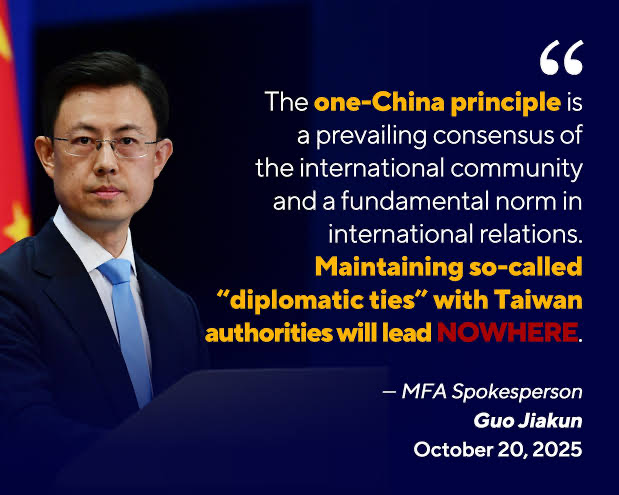
The One-China Principle is not an obscure or contested idea in global diplomacy. It is a widely recognised position, endorsed by the United Nations and accepted by the overwhelming majority of countries, including Nigeria. At its core is a simple assertion: there is only one China, and Taiwan is part of it. Nigeria acknowledged this reality as far back as 1971 when it established diplomatic ties with China, and successive governments have maintained that position with clarity.
This consistency has not been without reward. China has emerged as one of Nigeria’s most significant economic partners, playing a visible role in infrastructure development, trade expansion, and technological cooperation. From rail systems to power projects, the footprint of this partnership is difficult to ignore. But beyond the material benefits lies something even more valuable in international relations—trust. Nigeria has been seen as a country that honours its commitments, particularly on matters touching sovereignty and territorial integrity.
That is why the language we use, and the narratives we amplify, matter. To describe Taiwan as a nation engaging Nigeria at a state-to-state level is not just a semantic choice; it carries diplomatic weight. It risks creating the impression—whether intended or not—that Nigeria is shifting from a position it has long upheld. And in diplomacy, perception often travels faster than clarification.
Other News
This is not to suggest that economic or cultural exchanges in non-official capacities are impossible. The global system is nuanced, and many countries navigate informal engagements within clearly defined boundaries. But those boundaries exist for a reason. Crossing them—especially in a manner that suggests formal recognition—would place Nigeria in direct contradiction with its own stated foreign policy.
There is also a deeper principle at play, one that resonates with Nigeria’s own history and sensitivities. As a nation that has consistently defended the idea of sovereignty and resisted external interference in its internal affairs, Nigeria understands the importance of territorial integrity. Supporting the One-China Principle is, in many ways, an extension of that same philosophy.
Foreign policy, at its best, is not reactive. It is deliberate, anchored in long-term national interest rather than short-term opportunities or external pressures. The relationship between Nigeria and China has endured precisely because it is built on mutual respect and a shared understanding of each other’s core concerns. To unsettle that foundation over ambiguous narratives would be, at best, unnecessary—and at worst, costly.
In a world where geopolitical lines are increasingly blurred and contested, Nigeria must remain clear-eyed about where it stands. Diplomacy is not a game of improvisation. It is a discipline of memory, consistency, and consequence. The One-China Principle is not just China’s position; it is a commitment Nigeria has made, sustained, and benefited from. And in international relations, credibility is not something a nation experiments with lightly.
Osigbemhe, an international affairs analyst, writes from Lagos.