Follow Us on Google
From Adanna Nnamani, Abuja
Despite decades-long campaigns and promises to rid the country of the monster called child labour, more than 24 million Nigerian children are still trapped in it, making the country one of the worst hit globally.
A typical sight at crowded markets, remote farmlands, and even mining sites are young children who should be in class rooms, forced into hard, often hazardous jobs by poverty, unemployment and poor regulations.
For many analysts, the challenge is no longer just about awareness but about enforcement, funding, and political will. Although Nigeria is a signatory to several international labour conventions, including ILO Conventions 138 and 182, the enforcement of laws remains weak, especially at the subnational level. Many states have yet to domesticate or implement the Child Rights Act passed in 2003. Meanwhile, efforts to pass a comprehensive Labour Standards Bill that aligns with global practices remain stalled in the National Assembly.
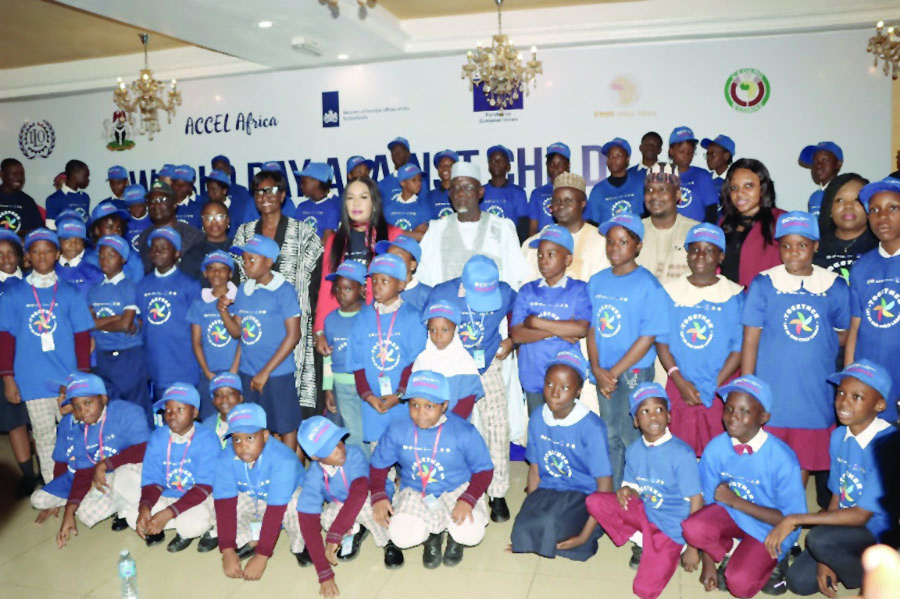
As the world intensifies its campaign against child labour, Nigeria is under growing pressure to match words with action. Speaking recently at an event to commemorate the 2025 World Day Against Child Labour and to reflect on the journey so far, the Country Director for the International Labour Organisation, Vanessa Phala, said that Nigeria has made some progress but that there is a lot more to do.
According to her, the number of children engaged in child labour globally dropped from 160 million in 2020 to 138 million in 2024. Sub-Saharan Africa, despite facing significant economic and demographic challenges, recorded a small but meaningful drop in child labour prevalence, from 23.9 to 21.5 per cent. However, the region still shoulders the largest share of the global burden, accounting for nearly two-thirds of all children in labour.
She cited the data from the 2022 National Child Labour Survey released by the National Bureau of Statistics (NBS), which showed that the situation in Nigeria remains deeply troubling.
According to the report, 50.5 per cent of Nigerian children aged 5–17 are engaged in economic activities. Of this number, 24.6 million are in child labour, and about 14.3 million are involved in hazardous work. Most of these children are found in the agriculture sector, followed by services and industry.
The findings also reveal that child labour is more common in rural areas and affects boys slightly more than girls. School attendance, predictably, is negatively affected, robbing many children of their right to education and a better future.
Phala argued that child labour is a breach of the fundamental human rights of children (boys, girls, adolescents and youths), exploiting them through any form of work that interferes with their ability to attend school regularly or that are physically, mentally, socially and morally detrimental child.
The director stressed the difference between light, age-appropriate tasks and exploitative labour explaining: “When a child is performing family duties or supervised work that doe not interfere with their education, it is not child labour. But when a child is denied schooling, exposed to harmful conditions, or pushed beyond physical limits, that is exploitation, and it must stop.
“In Nigeria, child labour is a pervasive concern as millions of children are engaged in unsafe, exploitative and hazardous types of work performed under harsh conditions im farms where pesticides are applied on crops; selling at markets where they are exposed to illicit activities; services in the informal economy without decent jobs; in homes as domestic workers and practices of unsafe mining, mineral processing in sites.”
Phala called for immediate action by the National Assembly the Federal Ministry of Labour and Employment and all stakeholders to facilitate a speedy passage of the reviewed Labour Standards Bill for the Country.
She said the the labour standards bill once passed into law will align the country’s labour laws with what international standards and promote social Justice in Nigeria. She added that the new law will address the needs of workers in the informal sector, by protecting their rights, and enforcing sanctions.
“Nigeria is signatory to laws and international Labour standards that promote elimination of child labour yet the menace persists, We must speed up efforte on enforcement of laws to end child labour,” she stated.
Other News
The director further highlighted several ongoing interventions supported by the ILO, including the ACCEL Africa Project, the National Child Labour Monitoring and Reporting App, and the review of Nigeria’s National Action Plan and Hazardous Work List.
“These efforts are aimed at strengthening institutions and tracking cases more efficiently,” she noted.
President of the Nigeria Labour Congress (NLC) Joe Ajaero, challenged the government and society at large to rise up to the occasion of fighting the monster. According to him, the country may have made strides in policy, awareness, and in pockets of successful interventions, but the task before everyone remains urgent and unfinished.
“The truth is that the rate of interventions and policy evolutions lag behind the rate of exacerbation of the issues around child labour. This gaps most of the time gives the wrong impression; that nothing is being done.
He declared: “Millions of Nigerian children are still out of school and trapped in exploitative labour, on our streets, in our farms, markets, and workshops. Child labour is not only a labour issue; it is a social justice issue.
”When a child is at work, we steal not only their future but also that of the nation and that is one of the ways nations fail.”
He lamented that despite repeated efforts by the Congress and its affiliates to eradicate child labour in Nigeria, the scourge persists, driven by poverty, inequality, weak enforcement of labour laws, and underfunded public education.
Ajaero urged government at all levels, to implement and enforce the Child Rights Act in every state; ensure that no child is denied access to free and quality basic education; and expand social protection programmes to shield families from the economic pressures that drive child labour.
“To employers, uphold due diligence in eliminating child labour from your supply chains, formal or informal.
“To my comrades in the trade union family, intensify our work in identifying, reporting, and resisting child labour, especially in high-risk sectors like agriculture, domestic work, street vending, and artisanal mining
“And to communities, let us speak up for the voiceless. Let us say with one voice: No child should work at the cost of their education and future,” he charged.
On his part, Minister of Labour and Employment, Muhammadu Dingyadi, reinforced the government’s commitment to ending child labour. According to him, the government envisions a better Nigeria, one where every child is in school, safe, and supported.
The minister acknowledged the progress made , citing the global decline in child labour figures, but admitted that “even one child in child labour is one too many. Children have the right to go to school, not to work in dangerous jobs. They have the right to play, not to carry heavy loads. They have the right to dream, not to be forced to work long hours.”
He called on parents, employers, schools, and communities to do their part, stressing that education remains the most powerful tool for breaking the cycle of poverty.
“Let us stop practices that expose children to neglect, danger, and exploitation,” he urged.