Follow Us on Google

Bitrus Dabup
Oftentimes, disruptive government policies, no matter how well-intended, are met with strong resistance either because those directly affected do not promptly understand the thrust of policy or some shady beneficiaries of the status quo will not take dislodging their comfort zones without putting up a fight.
So it was when the Bauchi State government announced the banning of commercial motorcycles, commonly called “Achaba”, in Bauchi metropolis. Neither could the operators accept the explanation that the action was taken in the best interest of the people, to mitigate the health hazards posed by unrestrained environmental pollution. Given the selfishness of some politicians, it was not surprising that the government’s opponents could not even be swayed by the obvious security threats posed by criminals masquerading as transporters nor the misery inflicted on families through frequent Achaba accidents.
Interestingly, as the Achaba operators were busy lamenting the ban and pointing accusing fingers at the state government, the governor, Alhaji Bala Mohammed, was also busy perfecting his plan B, bearing in mind that the banning of motorcycles in the state was one decision taken with great pain. His previous positions as top civil servant, senator and minister had provided Bala Mohammed first-hand opportunities to appreciate the dangerous implications of unmitigated youth unemployment. Besides, he has never lost cognizance of the fact that he inherited the reins of government in a state that was saddled with 1.3 million unemployed youth, a time bomb by any standards. To wit, he also gave his word to redress the situation.
Thus, to ameliorate the suffering caused by the ban of Achaba, Governor Bala Mohammed wasted no time in committing the total sum of N500 million to the purchase of tricycles, or ‘Keke NAPEP’, and cars. There is the added vision that such an empowerment project would considerably cushion the adverse effects of the COVID-19 pandemic on transportation in the state.
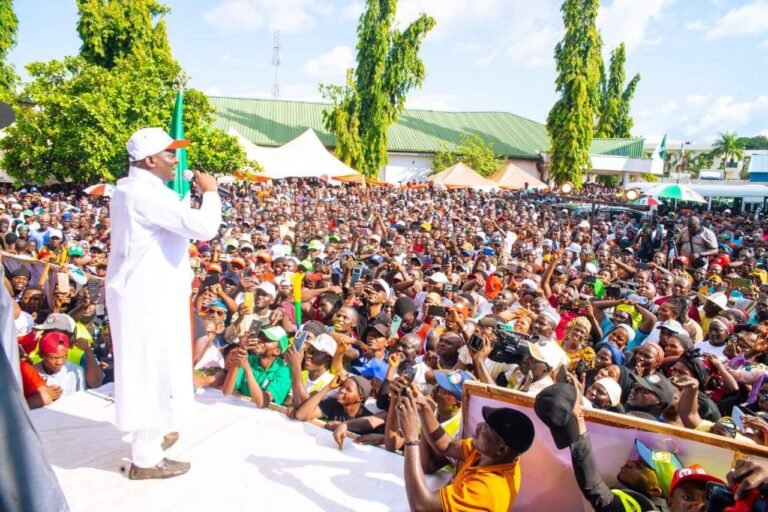
Keeping faith with the administration’s promise, the 1,000 units of Keke NAPEP ordered have been fully supplied. I followed the distribution of the first batch of 345 units in Bauchi, the state capital, which goes by the name of the state. The occasion was a showpiece of responsive government as the event revealed an unmistakable connection between the state government and the youth of the state, with the latter unable to conceal their excitement at their new fortune. Addressing the beneficiaries, who were all smiles as they collected their units of tricycles one after the other, Governor Bala Mohammed reiterated government’s hope that the tricycles, which were given out under a hire-purchase arrangement, would ameliorate the sufferings of former Achaba riders, while guaranteeing a reliable income-generating avenue for unemployed youths in the state.
Governor Bala Mohammed’s words rang out with prophetic vigour and the commanding tone of a war general, well accustomed to his charge. But is fighting unemployment not the moral equivalent of a war?
“To provide income-generating ventures for our people and ameliorate the difficulty in transportation, we are providing 1,000 units of Keke NAPEP,” he said, adding, reassuringly, that “it will be a continuous programme, like a revolving scheme to enable others to benefit from the scheme”.
For the project, the state government had deposited N250 million for the purchase of tricycles, with another N250 million deposited in a microfinance bank for the purchase of Sharon and Vectra vehicles to ease transportation difficulties in the state.
So far, the tricycle initiative has been greeted with commendations within and outside the state. In fact, it has become a reference point whenever COVID-19 palliatives are mentioned, while a couple of states have started copying from Bauchi State. This bold move by the Bauchi State government is also expected to create more jobs for indigenes, take the youths out of crime, improve quality of life and also provide social inclusion for many who, hitherto, had been shut out of the scheme of things.
Among the several multiplier effects of the programme, it is expected that the availability of the tricycles will surely prune down transportation costs in all the cities of the state, while after-sales maintenance and service would lead to an explosion of jobs for mechanics, auto parts dealers and other services providers, food vendors and sundry artisans. What is more, the predictable improvement in the purchasing power of people in the Keke NAPEP value chain will have a trickle-down effect on other areas, with salutary implications for the GDP and IGR of the state.
It is obvious that Governor Bala Mohammed, in keeping with the pledge he made at his inauguration about a year ago, is keeping faith with his declaration to create employment opportunities for the teeming youth of the state. And if his achievements in the areas of empowerment are anything to go by, it will not be wrong to say that he is one of the state governors in Nigeria that are implementing the Millennium Development Goals.
Ironically, Senator Isa Misau had cited the ban on Achaba as one of his reasons for defecting back to the APC, a party he left for the PDP in 2018 as he groped for a haven after losing the ticket of the former. The beneficiaries do not share his position. Two of the beneficiaries, Umar Samaila Sanda and Sani Baban-Kawu said that the initial destabilisation posed by the ban was promptly compensated for by the provision of the tricycles on an interest-free basis. Sani Baban-Kawu added that their economic status had improved considerably due to enhanced income from the tricycles.
What is left is for the state government, in line with the United Nations advice that realising the SDGs can only be achieved with strong global partnerships and cooperation, to embrace inclusive partnerships, at the global, regional, national and local levels, built upon principles and values, and upon a shared vision and shared goals placing, as it is faithfully doing, people at the centre.