Follow Us on Google
Inside the Wamba communities where residents cross water to reach markets, hospitals and homes – as Gov. Sule moves to rebuild the Konvah-Jimiya Road and Klama Bridge
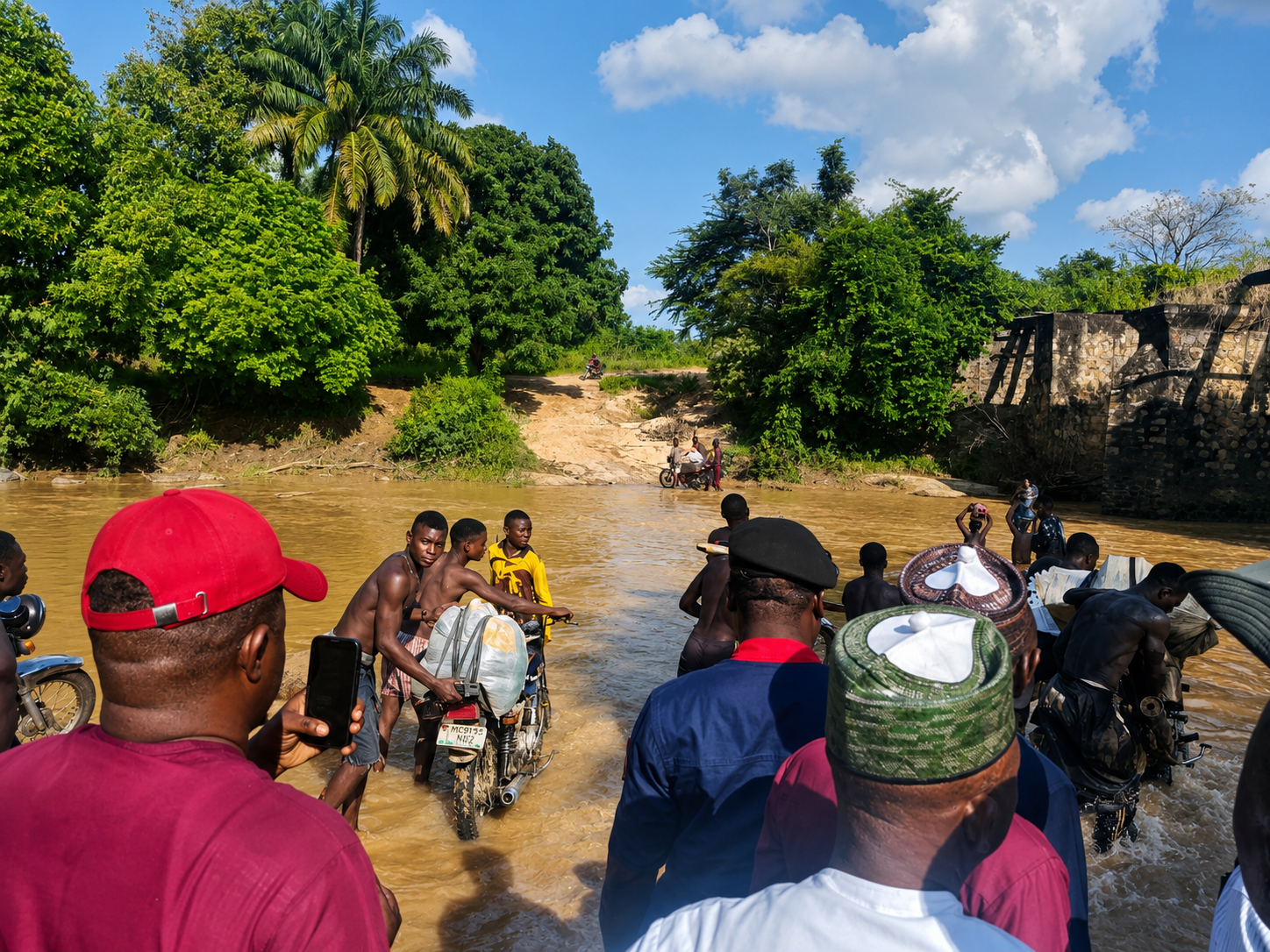
At the broken bridge, another economy has emerged, an economy of survival.
When motorcycles and passengers arrive at the broken bridge, they are forced to descend into the water beneath it. The motorcycles are then manually lifted and carried across to the opposite bank by local residents who have turned the dangerous crossing into an informal livelihood.
These crossing porters also assist passengers who cannot safely wade through the water, carrying or supporting them across for a fee.
What should ordinarily be a simple crossing has therefore become a paid service. Residents must part with money simply to move themselves, their motorcycles and their goods from one side of the community to the other.
There is no functioning road or bridge, only water separating one part of the community from another. For someone seeing it for the first time, it is almost unbelievable.
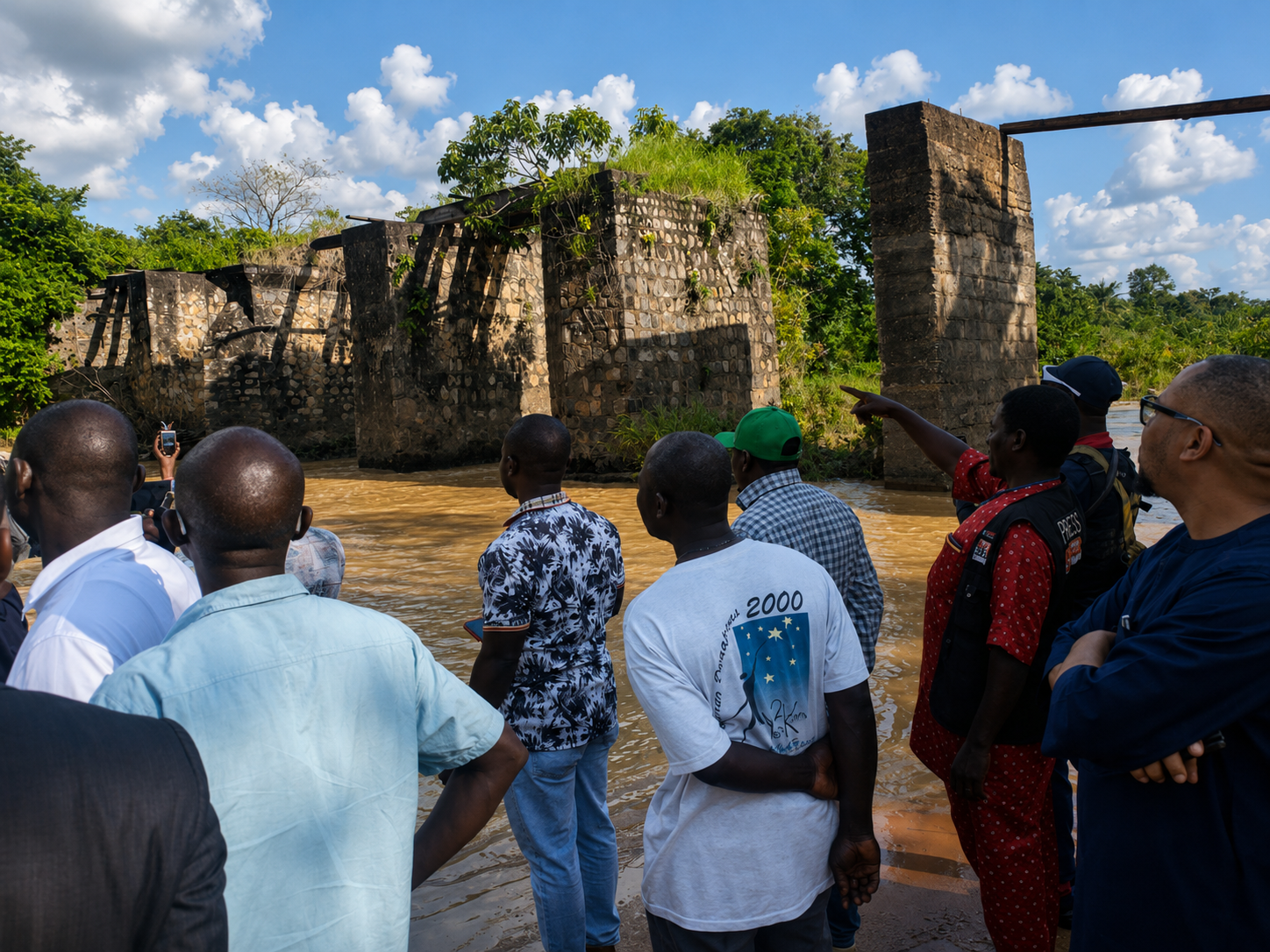
For the people of Kose, Klama and the surrounding communities in Wamba Local Government Area of Nasarawa State, however, it is simply another day.
This was the reality that greeted me during a recent visit to the area, a reality in which a journey that should take minutes can become an exhausting and dangerous expedition.
It is a place where motorcycles have become the substitute for public transportation, where passengers are forced to negotiate water crossings and where farmers struggle to move their produce to markets.
But beneath the spectacle of a broken road and a burnt bridge lies a much darker story: people’s lives are being shaped by the absence of a reliable road.
And for the residents, the question is no longer whether the road is bad. They know it is. Their question is: how many more years must they wait?
A bridge reduced to a memory
The Klama Bridge is more than a piece of infrastructure. For the people of the area, it is a reminder of a time when their communities were connected.
Residents said the bridge was constructed during the colonial era and was covered with wood. Years ago, however, the wooden structure was burnt, leaving the crossing unusable for normal vehicular movement.
What followed was years of improvisation.
The people adapted. They had no choice.
What should have been a bridge has become an obstacle. What should have been a road has become a test of survival. And what should have been a simple journey has become a calculation of risk.
“We are living in fear”
Residents also spoke of insecurity along the route.
Sadona Hussaini, a community leader, said the poor condition of the road had left the communities isolated and vulnerable.
Without normal vehicular movement, he said, criminals could exploit the difficult terrain, while residents who have businesses or emergencies outside the communities are forced to take risks.
“At night, the fear becomes worse. A journey that might be difficult during the day can become almost impossible after sunset,” he said.
For the elderly, women and children, the situation is particularly distressing.
But perhaps nowhere is the consequence of the road more serious than in healthcare.
When distance becomes deadly
In most communities, the distance between a patient’s home and a hospital is measured in kilometres.
In Kose, it is measured in obstacles.
A patient may have to find a motorcycle. The motorcycle must negotiate the bad road. Then comes the bridge. Then the water. Then another stretch of difficult road.
For someone bleeding, in labour, suffering an accident or battling a serious illness, every delay matters.
Other News
Abdullahi Musa, one of the carriers, said their people faced enormous difficulty getting medical attention because of the condition of the road. He also recounted painful stories involving pregnant women and children whose families struggled to get them to healthcare facilities.
He added that he witnessed an elderly woman who died while crossing the water and recorded over 10 women who delivered babies along the way after crossing the water but could not get to the hospital for proper treatment.
He called on the government to come to their aid, as it is the only thing that will touch the lives of people in the community.
A community without reliable road access is a community whose access to emergency healthcare is compromised.
A hospital cannot save a patient who cannot reach it in time. An ambulance cannot serve a community it cannot access. And a health worker cannot attend an emergency where the road itself has become the first barrier to survival.
The farmers who produce but cannot move
Kose and the surrounding communities are predominantly agricultural. Farmers cultivate their land. They harvest. They trade. But between the farm and the market stands the road – and the road is failing them.
Maryam Adamu, a businesswoman who was a passenger about to cross the water to her community after conducting business in Wamba town, said the route serves more than 20 communities and provides an important link to communities in neighbouring Plateau State.
“It also connects farmers and traders to Wamba and other commercial centres. This makes the road more than a local access route. It is an economic artery,” she said.
“When it fails, agriculture suffers. A farmer may spend months cultivating crops only to encounter difficulty moving them to market. Transportation costs rise. Goods are delayed. Some produce may be damaged. The trader pays more.
“The consumer eventually pays more. The community becomes poorer. This is how a bad road quietly becomes an economic crisis,” she added.
“We are begging government”
The residents are tired of explaining what they need.
They want the road fixed. They want the bridge rebuilt. They want safe access to markets. They want access to hospitals. They want their children to travel without fear. Above all, they want to be connected.
A visit to the community and the bridge shows that the Konvah-Jimiya Road is much more than a road project. Its significance extends beyond Kose to commerce, agriculture, healthcare, education, security, social interaction and, ultimately, human dignity.
That is why the latest government intervention has generated cautious optimism among residents.
Governor Abdullahi Sule has directed the Nasarawa State Ministry of Works to assess the cost of constructing the Konvah-Jimiya Road and Klama Bridge in Wamba Local Government Area.
The development is significant.
For years, residents have lived with a problem that has become almost normalised. Now, there is an official move to determine what it will take to restore the road and bridge.
Recently, the Commissioner for Works, Housing and Transport, Hon. Kwanta Yakubu, visited the area to inspect the situation. His presence brought the government’s attention directly to the reality on the ground. For the residents, however, the visit is only the beginning.
The road beyond the road
What happens next will determine whether this latest intervention becomes another government promise or the beginning of a lasting solution.
For the people of Kose, Klama and the communities along the Konvah-Jimiya axis, they are not asking for luxury. They are asking for the basic infrastructure that connects citizens to the rest of society.
They are asking for a road that allows a farmer to take his harvest to market without paying to have his motorcycle carried across water. They are asking for a bridge that allows a pregnant woman, an elderly person or an emergency patient to reach healthcare without first confronting a dangerous crossing.
They are asking for a road that allows children to attend school, traders to do business and families to travel without fear.
And so, as the government begins the process of assessing the cost of rebuilding the road and bridge, the people of Kose will be watching closely.
Because for them, this is not simply about concrete, asphalt and engineering.
It is about whether a community that has spent years surviving without a road can finally be given back a road to life.