Follow Us on Google
From Fred Ezeh, Abuja Abuja
For more than three decades, Nigeria’s struggle to adequately finance its tertiary education system has resulted in several policy challenges, funding interventions and institutional reforms. But after several efforts, an initiative created largely as a domestic response to the crisis is attracting attention beyond Nigeria’s borders.
The Tertiary Education Trust Fund (TETFund), established in its present form in 2011, is increasingly emerging as a reference point in conversations about sustainable financing for universities, polytechnics and colleges of education in Africa.
The clearest evidence of this growing interest came recently from The Gambia, where the government wants to establish a replica of TETFund, known as Tertiary Higher Education Trust (THET) Fund. To this end, their officials were in Abuja recently to understudy TETFund’s operations as a benchmark for the establishment.
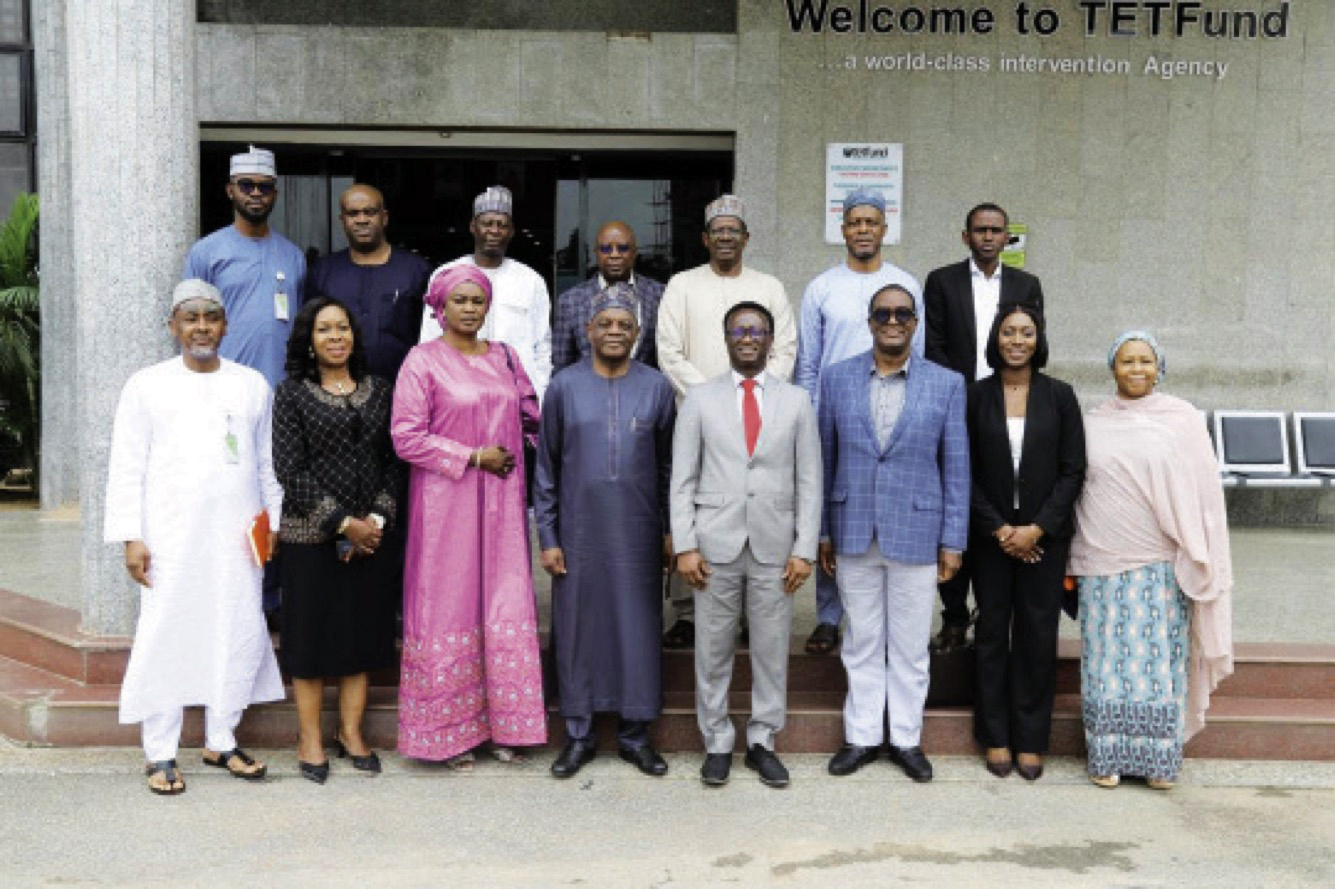
The Gambian Minister of Higher Education, Research, Science and Technology, Prof. Pierre Gomez, led a delegation to the TETFund headquarters in Abuja a few days ago to engage the Fund’s Executive Secretary, Sonny Echono, in that regard.
Observers said the development represents a significant moment for Nigeria’s education sector, that an institution created to address the country’s tertiary education funding challenges is now being considered by another African country as a possible model for solving a similar challenge in their country.
THE JOURNEY TO NATIONAL INTERVENTION AGENCY
TETFund’s story began before the 2011 Act that established the organisation in its present form. The Education Tax Fund was established in 1993 against the background of severe funding challenges in Nigeria’s education sector. It was subsequently transformed into the Tertiary Education Trust Fund by the TETFund Act of 2011.
The objective was to create a dedicated and sustainable source of intervention funding for public tertiary institutions. However, over the years, TETFund has developed intervention lines covering infrastructure, instructional materials and equipment, research, academic staff training and development, postgraduate support and other areas considered critical to improving teaching, learning and research.
The model essentially recognises tertiary education financing as a national development investment requiring a dedicated institutional mechanism rather than leaving institutions entirely dependent on conventional budgetary allocations. The architecture has enabled TETFund to become one of the most significant institutional players in Nigeria’s tertiary education sector.
Perhaps, the experience appears to have caught the attention of The Gambia. The Gambian government officials said they have been studying TETFund’s activities and achievements through its website, social media platforms and other media channels.
The experience thus informed its decision to establish a similar mechanism for financing higher education. Hence, the planned study tour is expected to enable officials of The Gambian THET Fund to gain first-hand knowledge of TETFund’s operations, funding structure and intervention programmes, while also exploring technical cooperation in research and capacity development.
THE GAMBIAN VISIT
The Gambian interest in TETFund is particularly significant because it is not merely a courtesy visit or conventional academic partnership. Rather, the proposed THET Fund was designed around the idea of creating a dedicated mechanism for supporting tertiary education, and Nigerian officials have been engaging their Gambian counterparts on the TETFund experience.
The visit by Minister Gomez and his delegation therefore places The Gambia in a different category from several other foreign delegations that have visited TETFund over the years.
TETFund’s archives show that the organisation has reportedly hosted delegations and representatives from countries and institutions including Botswana, Belgium, Ghana and the United Kingdom for discussions around higher education, research, partnerships and institutional development.
In June 2020, TETFund recorded a visit by a delegation led by the Vice Chancellor of the University of Botswana, Prof. David Norris, accompanied by Botswana’s High Commissioner to Nigeria, Ambassador Pule B. Mphothwe. The visit focused on education collaboration and partnership opportunities.
A delegation from Ghent University, Belgium, also visited TETFund in 2022. The engagement reportedly focused largely on research, development and possible partnerships with Nigerian universities.
Similarly, a British delegation led by the UK Government’s International Education Champion, Sir Steve Smith, and Deputy British High Commissioner Benedict Llewellyn-Jones, visited TETFund to discuss UK-Nigeria higher education cooperation. These engagements demonstrate the growing international profile of TETFund.
However, they should not automatically be interpreted as evidence that those countries intend to replicate the Nigerian model. The Gambia is different because its government expressed a direct interest in learning from TETFund as it develops its own tertiary education funding mechanism.
EMERGING A WEST AFRICAN MODEL
The Gambian development raises a bigger question: could TETFund become a model for tertiary education financing beyond Nigeria?
TETFund has increasingly sought to deepen academic partnerships and cooperation with countries and institutions in the United Kingdom, Belgium, Europe, Asia and the Americas.
Its international engagements have covered academic staff development, research, agriculture, ICT and other areas.
Between February-June 2023, a delegation associated with the Association of West African Universities, led by Prof. Johnson Boampong, Vice Chancellor of the University of Cape Coast, Ghana, reportedly visited TETFund for some engagements.
The engagement discussed areas of mutual interest and the possibility of expanding the Fund’s influence and partnerships within the West African higher education space.
Other News
Although this should not be presented as evidence that Ghana is preparing to establish a TETFund replica, it demonstrates that Nigeria’s experience is being discussed within the wider West African higher education community.
This could become increasingly important as African governments grapple with similar challenges: how to finance expanding tertiary education systems when public resources remain limited.
Evidently, Africa’s higher education population has expanded significantly thus putting pressure on governments to build more classrooms, laboratories, libraries, hostels and research facilities while recruiting and training academic staff.
Therefore, universities are under pressure to produce research capable of addressing national development challenges, while students and employers demand programmes that provide relevant skills for increasingly technology-driven economies.
These demands require substantial resources at a time when governments are also facing competing demands in healthcare, infrastructure, security, social protection and basic education.
For countries facing these pressures, the TETFund concept offers an interesting proposition: create a dedicated institutional mechanism that can mobilise and channel resources towards clearly identified tertiary education needs.
NIGERIA’S EXPERIENCE AND QUEST FOR REPLICATION
Unarguably, TETFund has evolved over more than three decades, beginning with the Education Tax Fund in 1993 and continuing through its transformation into TETFund in 2011. Its operations are also tied to Nigeria’s economic, legal, fiscal and institutional environment.
Hence, The Gambia’s decision to study TETFund does not mean that simply reproducing the Nigerian institution will automatically solve its higher education funding problems.
Nevertheless, any country seeking to replicate the model would have to adapt it to its own tax system, size of economy, tertiary education structure, governance arrangements and national priorities.
Observers suggest that The Gambian study tour should focus less in copying individual TETFund programmes and more in understanding how Nigeria developed an institution capable of identifying funding gaps, designing interventions, allocating resources and monitoring projects across a large and complex tertiary education system. There is also an irony in Nigeria’s emerging position.
For years, Nigerian policymakers and education institutions have looked abroad for models that could strengthen universities and research. TETFund itself has undertaken international benchmarking exercises. In 2020, for instance, a TETFund delegation visited the United States National Science Foundation (NSF) to study its practices in supporting science, engineering research, education and innovation.
TETFund described the mission as an effort to understudy the NSF’s effective practices. Today, another African country is preparing to do something similar with TETFund. That reversal may be one of the strongest indications yet that Nigeria has developed an institutional experience worth exporting.
NIGERIA’S SOLUTION AS AFRICA’S REFERENCE
For TETFund, the growing international interest presents more than an opportunity for recognition. It could become a new form of Nigerian soft power in education.
Nigeria could support countries seeking to establish similar institutions through technical assistance, staff exchanges, study tours, policy advisory services and joint research programmes.
Such cooperation would also create opportunities for Nigerian universities and researchers to build stronger relationships with institutions across Africa.
The Gambia has already signalled interest in cooperation with TETFund in research and capacity development. If properly structured, such partnerships could eventually produce an African network of tertiary education financing institutions sharing data, research, best practices and innovative approaches to funding universities and technical institutions.
That would move TETFund’s influence beyond the physical projects it funds in Nigeria and position the organisation as a repository of institutional knowledge on how to finance tertiary education in a developing economy.
The immediate test will come when The Gambian officials undertake the planned study tour. They will need to understand how TETFund determines intervention priorities, allocates resources, monitors projects, supports research and develops academic staff. They will also need to examine the mechanisms for accountability and sustainability.
The answers could determine whether The Gambia merely establishes another government agency or succeeds in creating an institution capable of transforming its higher education system.
For Nigeria, the moment should also prompt a deeper assessment of TETFund’s own evolution. If other African countries increasingly see value in the Nigerian model, the country must ensure that the institution continues to evolve, remains accountable and produces measurable outcomes.
The Gambia’s decision to look to Abuja is therefore more than a diplomatic gesture.
It is an acknowledgment that, despite the many challenges confronting Nigeria’s education system, the country has built an institutional response to tertiary education financing that others believe is worth studying.
From a solution developed to address Nigeria’s own funding crisis, TETFund may now be entering a new phase as an African reference point for financing universities, polytechnics, colleges of education, research and human-capital development.
If The Gambia’s experiment succeeds, it could mark the beginning of a much larger story: Nigeria no longer only importing ideas for funding higher education, but exporting one of its own.