Follow Us on Google
-
Most Rev. Onuoha’s vision for a fruitful, inclusive Nigeria
By Chukwuma Umeorah
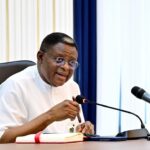
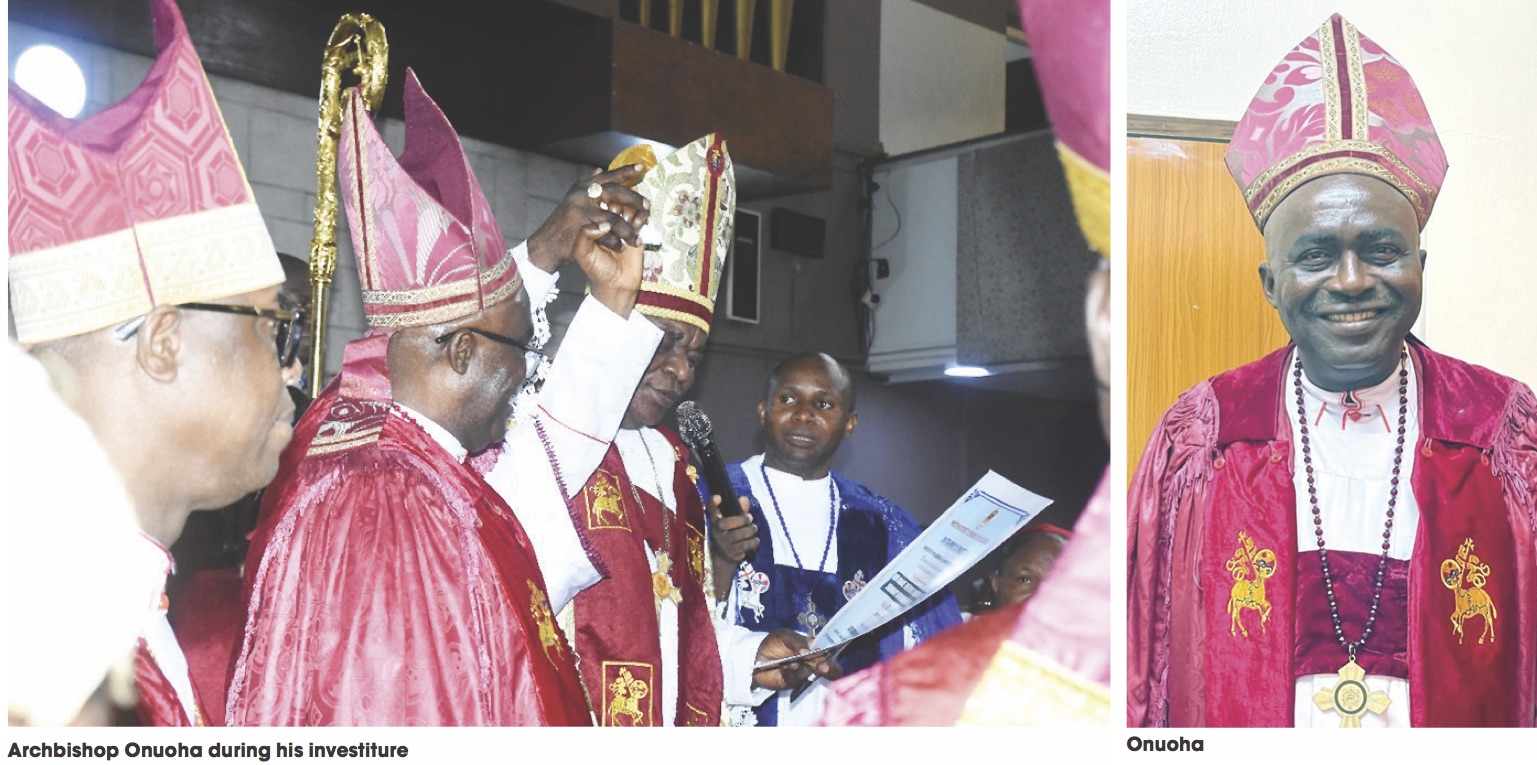
The bells of the Methodist Church of the Trinity echoed across Tinubu Square on November 9, as the congregation gathered solemnly, row by row, to fill up the pews, the choir finely robed and singing gloriously. This wasn’t just another service. It was the investiture of two archbishops, six bishops, and a handful of lay presidents. But for many, the day belonged to one man: His Grace, The Most Rev. Dr. Sunday Onuoha, newly designated Archbishop, Special Duties.
Unlike the others, he was not restricted to a diocese or archdiocese. No fixed jurisdiction. Just Special Duties. This means that Onuoha’s service to God, the Church, and humanity had no bounds.
Minutes after the final consecration, as the mitre graced his head and the Prelate gave his blessings, Archbishop Onuoha knew that an elevation of his spiritual capacity translated to a greater responsibility. According to him, “in the Methodist tradition, when you are first and foremost consecrated as a bishop, which for me happened many years ago, then this year the Church decided to make me an archbishop. So, it’s more like giving you more assignment, more responsibility. The Church is assigning me greater responsibility in the development of the Church and the development of society.”
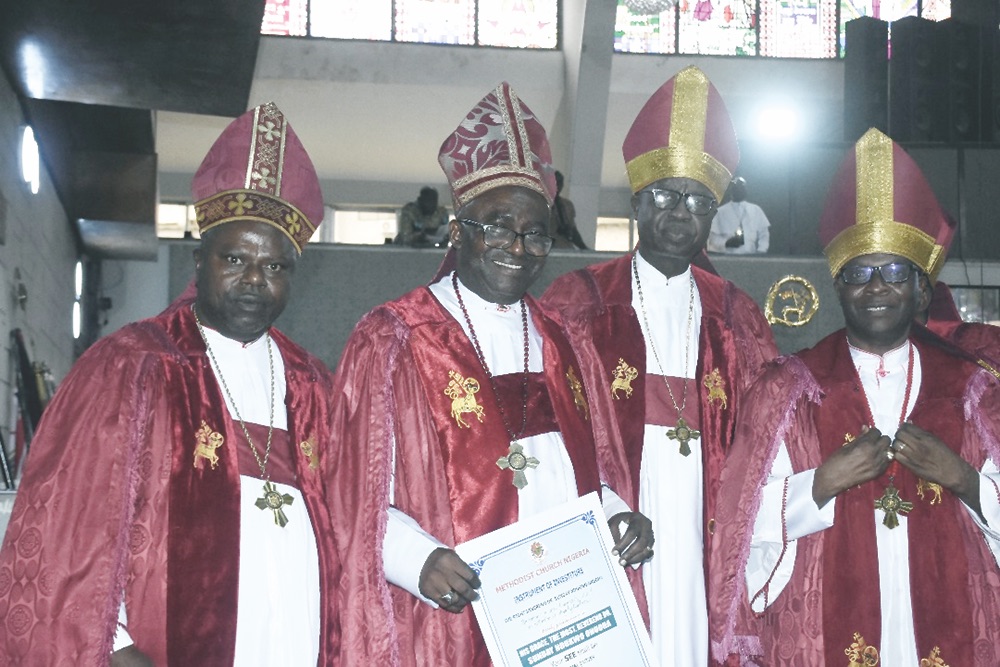
Highlighting the relevance of his unique designation, Onuoha added: “Basically, everybody who was assigned Bishop today was given a jurisdiction. In my own case, the Church decided to make it flexible for me to do things for the Church wherever they send me. They can decide to send me to the moon; I will go. They decide to send me to the sea; I will go. They decide to make me walk along the street—as long as it will bring growth for the Church and bring about human development. So they’ve made me an ‘archbishop beyond borders.’”
The spiritual journey had not been a bed of roses. Onuoha recounted some personal challenges long before the Church stamped the phrase on his collar. He highlighted some of the horrors he experienced growing up but maintained a strong resolve to be a minister of God. “For our generation, it was during the Nigeria – Biafra civil war. We grew up when we didn’t have enough meal for one day, lived in the bush intermittently, when we were exposed to rain and other natural elements.
“That is why I frown at those who are currently beating the drums of war. They don’t know the plight we suffered, when parents watched their kids die helplessly. No food, malnutrition, and all. It was the worst experience anyone can go through. This is why we keep praying for peace and unity, and we appeal to the government never to take these things for granted.”
The scar this early childhood left him is the reason he refuses to let anyone fall through these cracks. Archbishop Onuoha, affectionately called the Bishop of the Masses, has spent decades engaging faith with social development through Vision Africa and interfaith initiatives. He emphasized that the Church’s mission must extend beyond the pulpit, calling for a renewed emphasis on faith-driven action to address poverty, corruption, and injustice, areas where he believes the Church’s practical witness can restore credibility to Christianity in Nigeria.
For Archbishop Onuoha, a fruitful Nigeria must also be an inclusive one where faith, ethnicity, and social background no longer divide people. Through his long-standing interfaith work and community projects, he has often preached that unity and progress can only take root when Nigerians see one another as partners in nation-building rather than rivals in survival. “God did not create Nigeria for some and not for others. The grace of God extends to every tribe, every faith, every tongue and so must our compassion.”
He said: “The Church must assume greater responsibility in shaping society through integrity, compassion, and justice. We cannot remain comfortable while the society we serve is in decline. Our calling is not only to preach salvation but to demonstrate it through service, integrity, and truth. When the Church loses its moral courage, the nation loses its direction.”
He noted that the Methodist Church has continued to uphold the tenets of its founder, John Wesley. “We never waited for white papers to act. The Methodist Church was the first Church that came to Nigeria in 1842, and since our inception, we’ve been very active in social development. The Methodist Church built the first leprosy center in Nigeria, where we went out looking for those who were ostracized by society. We brought them in. We built orphanages when the society was killing orphans. We built mental homes to address the needs of those who had health issues that nobody cared about.”
He listed these achievements like a proud father reciting his children’s report cards, noting that these values are what sustain him as a minister of God. He recalled that even in the Bible, Jesus cared for the poor. “He fed them. He didn’t just ask them to close their eyes and pray. We built so many educational institutions. Most of our Nigerian leaders: Nnamdi Azikiwe, Obafemi Awolowo, Michael Okpara, all went through Methodist institutions, and we don’t ask which faith tradition you belong to. People like Babatunde Fashola were products of Methodist establishments, and he remains a Muslim until today.”
Other News
Onuoha’s message was not limited to church history or institutional achievements. He spoke directly to the Nigerian populace and Christians grappling with insecurity and religious challenges. He also offered counsel, emphasizing faith, service, and moral responsibility. “We are placed in the world to overcome what is of the world. And how do we do that? When we manifest the spirit of grace.”
Speaking to the nation’s multi-faith, multi-ethnic makeup, Onuoha urged Nigerians to rediscover unity through shared values rather than sectional interests. He reminded both leaders and citizens that true peace is born not of uniformity but of mutual respect and inclusion.
For the government, his counsel was as firm as it was pragmatic. Onuoha implored authorities to acknowledge challenges honestly, avoid contradictory statements, and collaborate with faith-based communities to restore social cohesion.
“Sometimes you need to ask yourself who is government,” he said. “When you listen to interviews from various persons from government, you hear all kinds of responses. So, I want to ask government to come up with an organized statement so that we can forge ahead.”
His words underscored a central conviction: faith institutions, especially the Methodist Church, have historically filled gaps in governance, education, and health, often outperforming state systems in integrity, service delivery, and transparency.
Archbishop Onuoha also spoke to younger generations, blending admonition with encouragement: “My advice to younger ones is, look up to those who are good and detest the ways of those who are bad.” Beyond role modeling, he urged youth to embrace service, commitment, and moral responsibility, reminding them that leadership and influence are earned through dedication, not merely assumed.
Looking forward, Onuoha said that his next steps remain anchored in the mission that earned him the title of Archbishop, Special Duties. “Just expect me to be me, who I have been, doing what the Church asked me to do. What I am doing is what I will continue to do,” he assured. The framework of his work is unbounded: anywhere that promotes the Church’s growth and societal development, Onuoha will be present, a living embodiment of his belief that spiritual elevation carries with it tangible responsibility.
The consecration, conducted by the Prelate of the Methodist Church Nigeria, His Eminence, Dr. Oliver Ali Aba, was part of a wider ecclesiastical ceremony that also saw the consecration of The Very Rev. Kenneth Nwiabubari, Chikaodiri Eke, Stephen Ogolo, Elijah Ndeayo, Friday Iyetu, and Clement Shaminga of the Dioceses of Ikono, Kano, Wesley, Ikono, Gokana South and Gboko, respectively. The event drew a large assembly of clerics, dignitaries, and members of the Methodist community from across the country.
Earlier that morning, the day’s sermon, delivered by His Grace, The Most Rev. Dr. Chikwendu Igwe, seamlessly mirrored Onuoha’s vision. Drawing from John 15:16, “You did not choose me, but I chose you and appointed you so that you might go and bear fruit, fruit that will last, and so that whatever you ask in my name, the Father will give you,” Igwe emphasized divine selection as the foundation of Christian service.
“The discourse of Jesus, as highlighted in John 15, gives very useful insights into the life of the Christian, the life of Christian service, and the place of fruitfulness in Christian service,” he preached, connecting personal vocation to societal impact.
He stressed that the appointment of ministers like Archbishop Onuoha was not a privilege. “We are reminded that each one of us is not self-appointed. We are chosen by God. Your choice and my choice were made possible by divine grace and mercy. Grace found you, grace found me, and grace qualifies you and me.” But grace, he warned, is not a crown, it’s a cross. “You were bought at a price; therefore, honor God with your bodies. You are a slave of God. A slave has no identity other than the identity of the master,” he urged the new leaders.
As the ceremony drew to an end, a solemn charge came from the Prelate, His Eminence, Dr. Oliver Aba, who prayed for the newly consecrated leaders and the unity of the Church. He reminded the clergy and laity alike that leadership in the Church is a trust that demands service, not status. “You are being set apart not to be served, but to serve,” he said, urging them to use their positions to strengthen the moral fibre of both the Church and the nation.