Follow Us on Google
By Damiete Braide
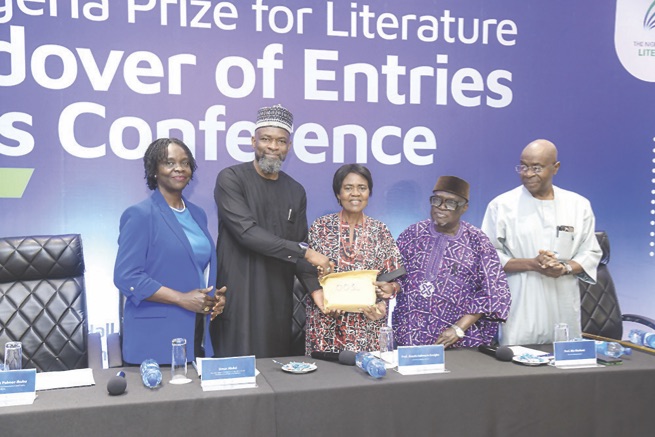
The 2026 edition of The Nigeria Prize for Literature 2026 has officially entered its adjudication phase, following the formal handover of 223 entries by Nigeria LNG Limited (NLNG) to the Advisory Board and panel of judges at a press conference held in Lagos.
The transition marks a significant milestone in the annual literary competition, widely regarded as one of Africa’s most prestigious and lucrative, with a cash award of $100,000. This year’s focus is on poetry, a genre often celebrated for its precision and depth but equally recognised for the demanding standards it places on writers.
The number of submissions, 223 entries, signals a strong outing for the poetry category. While slightly below some peak years, the figure aligns closely with recent cycles and reflects sustained engagement from Nigerian writers. It also underscores the continued relevance of the Prize within the country’s literary ecosystem, even as participation patterns fluctuate across genres such as prose fiction, drama, and children’s literature.
Speaking at the event, NLNG’s General Manager for External Relations and Sustainable Development, Sophia Horsfall, who was represented by Abdul Umar, described the handover as the beginning of a rigorous and defining process. According to her, the adjudication stage demands patience, critical attention, and sound judgment, as it will ultimately determine the work that defines this year’s Prize.
She emphasised that poetry, as the genre in focus, requires a unique level of discipline and artistic clarity. “Poetry demands precision, depth, and the ability to communicate complex ideas with clarity and economy of words. In many instances, a single line can define an entire work,” she noted. Horsfall pointed to the 2022 cycle as a benchmark, referencing the winning collection Nomad by Romeo Oriogun, which continues to resonate within contemporary Nigerian literature.
Beyond the competition itself, NLNG reiterated its broader commitment to promoting literary excellence and supporting Nigeria’s cultural development. Horsfall highlighted that the Prize has, over the years, contributed significantly to the growth of reading culture, encouraged discipline among writers, and created a credible platform for literary expression. She added that the initiative continues to spark national conversations that extend beyond the literary community, fostering intellectual engagement and cultural reflection.
“At NLNG, we have consistently provided a platform that supports excellence while inspiring a sustainable future. The credibility of this Prize lies in the integrity of its process and the quality of the works it attracts,” she said.
Following the formal presentation, the entries were handed over to the Advisory Board, chaired by renowned author and academic Akachi Adimora-Ezeigbo. In her remarks, Adimora-Ezeigbo described the moment as a critical transition point in the Prize cycle, where responsibility for the submitted works shifts fully to the Board and the panel of judges.
She reaffirmed the Board’s commitment to maintaining the highest standards of fairness, independence, and intellectual rigor throughout the adjudication process. According to her, each submission will undergo thorough and unbiased evaluation, ensuring that only the most outstanding work emerges as the winner.
“The Nigeria Prize for Literature has earned its reputation by recognising only excellence,” she said. “Our responsibility is to ensure that every entry is read carefully and assessed against a standard that has been built and sustained over time. This process remains strictly merit-based.”
Adimora-Ezeigbo also addressed common misconceptions about poetry, noting that the genre is often underestimated. In reality, she explained, poetry allows little room for excess or error, requiring every word and line to justify its place. This inherent discipline makes it one of the most challenging literary forms to master.
Reflecting on past editions, she referenced Oriogun’s Nomad as a defining work from the last poetry cycle, describing it as a layered and introspective collection that captured aspects of the African experience with clarity and emotional depth. She encouraged both readers and aspiring writers to revisit such works as a benchmark for excellence.
The adjudication process, which begins immediately, will span several months and involve detailed reading, analysis, and deliberation. It will culminate in the announcement of a longlist of eleven entries, followed by a shortlist of three finalists, and ultimately the selection of a single winner. The final award ceremony is expected to take place in October.
Also speaking at the event, NLNG’s Manager for Corporate Communication and Public Affairs, Anne-Marie Palmer-Ikuku, reiterated the organisation’s dedication to sustaining the Prize as a credible and respected platform. She noted that few initiatives in Nigeria have shaped a field as consistently as the Nigeria Prize for Literature has shaped the literary space.
Palmer-Ikuku emphasised that literature plays a vital role in shaping society’s intellectual and cultural identity, and that NLNG remains committed to supporting initiatives that reinforce this role. She also commended writers for their courage and discipline in submitting their works, particularly in a genre as demanding as poetry.
“To step forward with a poetry collection requires clarity of thought and control of language. That is no simple task,” she said, while also acknowledging the critical role of the media in amplifying literary conversations and sustaining public interest in the Prize.
As the adjudication process begins, attention now shifts to the panel of judges, whose task is to identify a work that not only meets the Prize’s high standards but also contributes meaningfully to African literature. Beyond the monetary reward, stakeholders emphasised that the true impact of the Prize lies in the lasting relevance of the winning work, its ability to inspire dialogue, influence future writing, and shape literary discourse.
For the 223 writers who submitted their entries, the journey has already contributed to sustaining a vibrant and competitive literary culture. While only one will ultimately emerge as the winner, each submission plays a role in reinforcing the Prize’s enduring legacy as a benchmark for excellence in African literature.