Follow Us on Google
•N.5m minimum wage, solar panels on every roof: How contenders deploy promises, cash, commodities, compassion to win votes
•Tinubu, Atiku, Obi, others offer conflicting agendas
From Fred Itua, Abuja
With barely four months to the presidential election, Nigeria’s leading contenders have begun reaching for tactics that go well beyond conventional manifestos, deploying cash, commodities and carefully choreographed sympathy to win over an electorate battered by years of economic hardship.

What has emerged, on close examination, is a pattern of escalating largesse and calculated positioning that critics describe as desperation dressed up as generosity, even as each camp insists its gestures are rooted in genuine service rather than vote buying by another name.
Tinubu’s wife, support groups tour states with empowerment programmes
The pattern is more visible around President Bola Ahmed Tinubu’s re-election bid. Barely four months before Nigerians vote, the Federal Government, through the Ministry of Education and the Nigerian Communications Commission, unveiled a scheme to provide millions of secondary school and tertiary students with 100 megabytes of free daily data from 1 October, to access approved educational platforms without charge.
The Minister of Education, Tunji Alausa, presented the initiative as a fulfillment of the Renewed Hope Agenda’s promise that poverty and geography should no longer determine access to learning. The timing, coming just as campaign season intensifies, has not gone unnoticed, particularly given that the same administration spent much of the past two years struggling to make its flagship Nigerian Education Loan Fund function properly, with beneficiaries complaining of halted upkeep allowances and withheld refunds, and briefly attempting to raise WAEC and NECO examination fees by 82 per cent before public outcry forced a suspension.
Running in parallel to that initiative is an extraordinary sustained campaign of cash disbursement by the First Lady, Senator Oluremi Tinubu, whose Renewed Hope Initiative has facilitated donations exceeding N15 billion between July 2023 and July 2026, alongside a further N25 billion raised in 2025 through a separate education fund.
In the space of a single week in September alone, the First Lady toured Imo and Anambra States, where N250 million and empowerment items were given to women in the South East. Then a further N500 million to 5000 beneficiaries in Anambra, while collecting traditional chieftaincy titles along the way.
Her nationwide rollout, structured explicitly zone-by-zone, North-Central, South-South, South-West and now South-East, has the appearance less of ad hoc charity than of a carefully sequenced national tour timed to precede the polls.
Writing on the matter, a journalist, Jude Ossai noted: “Whether her targeted empowerment programmes can secure the political loyalty of the South-East region for the 2027 presidential election remains a subject of intense political debate.
“To many political watchers, the First Lady’s ‘Renewed Hope Initiative’ and targeted cash backings apparently aim to soften the ground for her husband’s re-election, but they may meet a brick wall due to bottled-up anger in the land. The deep-seated socioeconomic grievances and regional political dynamics cannot be entirely resolved by welfare outreach alone.
“Despite these strategic manoeuvres, political analysts point out that the South-East remains one of the most ideologically resistant regions to the ruling All Progressives Congress (APC) for several reasons.
Following the socioeconomic realities, critics of the APC Tinubu administration view the sudden influx of empowerment materials as “medicine after death” or a belated attempt to pacify a populace struggling under the weight of severe economic inflation and escalating living costs.”
But away from empowerment programmes and donations, Tinubu’s campaign rests not on new commitments but on the defence of existing ones. Having assumed office in 2023 under what his party branded the Renewed Hope Agenda, promising to confront insecurity, revive a fragile economy, generate employment and restore purchasing power, the president’s re-election bid is being framed by his party as a referendum on delivery rather than a fresh sales pitch.
Senator Abdulaziz Yari, Director-General of the APC Presidential Campaign Council, declared recently that the 2027 campaign would be strictly issue-based, anchored on the administration’s record rather than new pledges or attacks on rivals.
The message has been echoed uniformly by party structures from Lagos to Kwara to Bayelsa, each pointing to tangible projects, rail infrastructure, road rehabilitation, rising oil output and improving investor sentiment, as vindication of reforms that were, by the government’s own admission, deeply painful in their execution.
Tinubu’s manifesto for 2027 is, in essence, his record from 2023 onward, and his central argument is that abandoning course now would squander gains still ripening.
Atiku’s fuel subsidy return, pledged economic stimulation fund, support for SMEs, others
Atiku Abubakar’s camp obviously doesn’t align with such propositions. For them, there is the insistence that the reforms of the past three years by the Tinubu administration have inflicted disproportionate suffering on ordinary citizens and require substantial correction.
Having formally decamped to the ADC in November 2025 and secured its presidential ticket the following May, Atiku unveiled a seven-point policy blueprint built around the slogan Put Nigerians First.
Its centre-piece is a pledge to reinstate a form of fuel subsidy, though his campaign is emphatic that this would bear no resemblance to the graft-ridden import subsidy of old. Instead, it is pitched as a production subsidy, channelled toward domestic refining rather than imported petrol, designed to suppress transport and food costs without reopening the conduits that once enabled large scale fraud.
Beyond subsidy, Atiku has promised a N10 billion economic stimulus fund within his first hundred days to support small enterprises and employment generation, a commitment to subdue insecurity within 12 months, and assurances on affordable housing.
His party’s governorship candidates across the North West have amplified the pledge, publicly endorsing the subsidy restoration while separately promising a state level minimum wage of one N110,000.
A policy committee within the ADC has further proposed that any future survival income be exempted from taxation, and has called for a Social Protection Act to insulate welfare programmes from the vagaries of political fortune.
Atiku Abubakar’s African Democratic Congress (ADC) campaign’s most persistent line of attack has been to hammer relentlessly on the consequences of fuel subsidy removal, seizing on rising inflation, the naira’s depreciation and the government’s mounting debt profile as evidence of administrative failure, while positioning his own proposed production subsidy as the corrective Nigerians have been waiting for.
Beyond the economy, Atiku has worked to consolidate himself as the dominant Northern candidate in the race, drawing on decades of political networks across the region to project himself as the natural custodian of Northern political and religious sentiment.
Observers have noted a conspicuous caution in how he engages with controversies originating in the North, a reluctance critics argue is deliberate, intended to avoid alienating the very bloc of Muslim Northern voters his campaign is counting on to offset Tinubu’s incumbency advantage and Obi’s Southern strongholds.
Other News
Peter Obi’s approach diverges sharply from both of his principal rivals, built not around large scale cash transfers but around a steady drumbeat of smaller, symbolically loaded gestures of personal charity and solidarity.
In the days after the deadly Yelwata massacre in Benue State, in which more than 217 people were reportedly killed, Obi attempted to travel there to console survivors, only to have his convoy blocked by a mob near the Nigerian Air Force base along the Gboko highway.
Weeks earlier, he had visited Mangu in Plateau State following an attack by bandits that claimed more than 26 lives, meeting residents and offering condolences. His pattern extends well beyond crisis zones.
In July, marking his 65th birthday, he donated N10 million to a rural hospital in Anambra State. In November last year, he gave N15 million to a school of nursing in Ihiala, reportedly rejecting the institution’s offer to name a new administrative block after him.
He has made comparable donations to an Anglican church, to a hospital in Cross River State, and to numerous schools, at times visiting as many as five institutions within a single week, donating between N5 million and N15 million to each.
Critics, including some within his own home state, have begun to ask pointed questions about the optics of a man who travels widely to comfort victims of insecurity in distant states while similar concerns simmer closer to home in Anambra, a charge his supporters reject as an attempt to distract from the moral clarity of his gestures.
Obi’s manifesto charts an altogether different course form his two major rivals – Tinubu and Atiku, dispensing with the subsidy debate almost entirely and, in a rare act of opposition dissent, explicitly rejecting Atiku’s central proposal.
Launching his campaign in Onitsha in August, Obi declared that his government would prioritise production, investment, enterprise and human capital development, arguing that a nation cannot import its way into prosperity and must instead manufacture and process more of what it consumes.
He has invited the electorate to judge every candidate against five deceptively simple measures, whether citizens can afford food, education and healthcare, whether enterprises can expand and generate employment, whether young people can secure meaningful work, and whether farmers can till their land, produce food and reach markets in safety.
His specific commitments include augmenting electricity generation and distribution by no fewer than 10,000 within four years, redirecting the fiscal savings from subsidy removal into agriculture and small enterprise rather than reversing the policy, and broadening technical, vocational and basic education.
Responding directly to Atiku’s overtures in the North, Obi has argued that the region’s poverty demands investment in agriculture and industry, not a reinstated subsidy. He has further pledged to govern personally rather than through proxies, and has committed to a single term, a promise entwined with his broader argument for power rotation between Nigeria’s North and South.
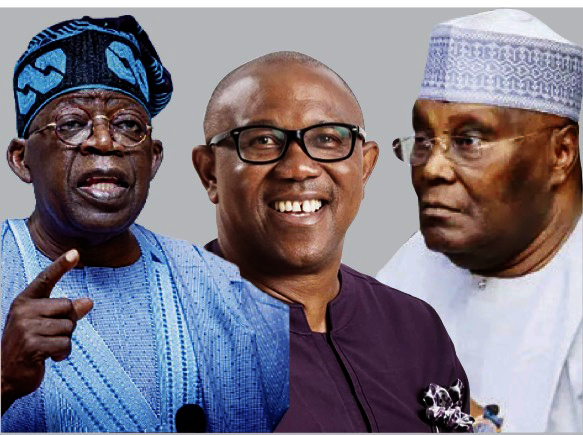
Placed side by side, the three frontrunners are effectively offering the electorate three competing theories of national convalescence.
Tinubu’s theory holds that nothing structurally erred, that the anguish of reform was a necessary and finite toll, and that perseverance alone will allow its dividends to fully mature.
Atiku’s theory contends that the reforms were too blunt an instrument, wielded without adequate safeguards for the vulnerable, and that a more surgical, production-linked subsidy can repair the damage without resurrecting old abuses.
Obi’s theory dismisses subsidy as either the ailment or the antidote, locating Nigeria’s deeper affliction in its persistent failure to produce, process and export what it consumes, and insisting that the same savings ought to be redeployed toward productive investment rather than returned to the pump.
This divergence has exposed an unusually sharp fault line on the single question that has dominated the nation’s economic discourse over the past year.
Atiku and Obi, natural allies in opposition to Tinubu, find themselves in open disagreement over fuel subsidy, arguably the most contested policy terrain of the campaign, with Obi publicly rebuffing Atiku’s restoration plan and Atiku’s allies defending it against Obi’s preference for redirected investment.
For Tinubu, that opposition schism is not without political utility, since it complicates any claim that a single, coherent alternative to his administration’s economic direction yet exists.
The remaining candidates have not matched this level of policy elaboration, though their positioning supplies its own contrast.
The Social Democratic Party’s (SDP) Adewole Adebayo has taken a markedly different route, betting on the sheer scale of a single, headline grabbing infrastructural promise rather than cash or charity.
Appearing on television, Adebayo pledged that his administration would install between 11 and 15 kilowatts of solar power on every rooftop in Nigeria within 11 months of taking office, financed through domestically manufactured panels and lithium batteries produced at factories he says would be built in partnership with China, Turkey and India.
He claimed to have already trained roughly 2,000 people in solar technology in his hometown as proof of the concept, and insists that the resulting solar clusters could generate up to 32,000 megawatts nationally, reducing the national grid to a mere backup system.
Omoyele Sowore’s African Action Congress (AAC) is making a different pledge entirely, leaning into confrontation and outsized numerical promises rather than charitable gesture or infrastructural spectacle.
Sowore has pledged a N500,000 minimum wage for Nigerian workers, alongside the construction of one million publicly funded homes and an end to what he calls the casualisation of labour.
He has paired these promises with blunt personal attacks on the president, describing Tinubu as lazy and clueless over the administration’s failure to curb insecurity in Plateau and Oyo States despite earlier promises of artificial intelligence powered surveillance cameras and forest guards.
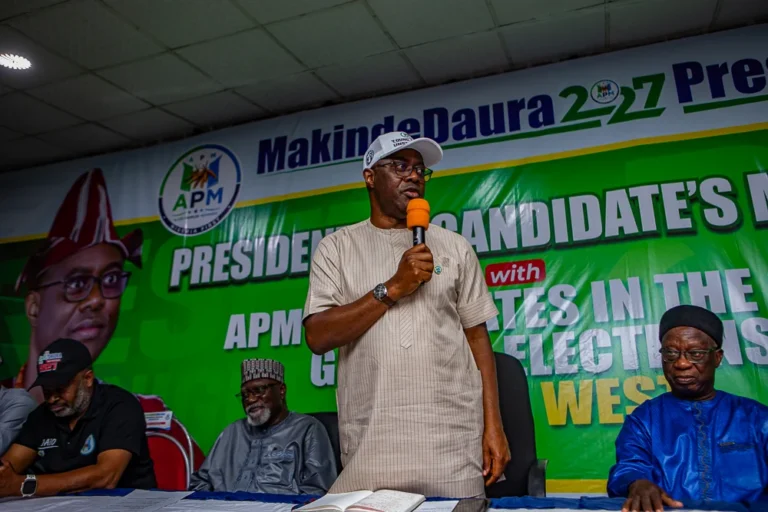
Oyo State Governor Seyi Makinde, who has secured the presidential ticket of the Allied Peoples Movement (APM), has positioned himself somewhat differently again, leaning on his record as a sitting governor rather than fresh national pledges, presenting his administration’s programmes in Oyo as a working template for what he could achieve nationally.
His entry has nonetheless added further pressure on the opposition to consolidate, given that a crowded field of five or six credible candidates risks splitting the anti-incumbency vote much as it did in 2023.
Cash donations, data waivers, rooftop solar panels and outsized wage promises are, in their different ways, all attempts to translate manifesto language into something a struggling household can immediately feel.
It is unclear whether Nigerians will reward such tactics at the polls, or come to view them as transparent attempts to purchase loyalty ahead of an election both the ruling party and the opposition understand will be closely contested, remains the central uncertainty hanging over the race as campaign season moves into its final, most intense phase.