Follow Us on Google
By Steve Agbota, [email protected]
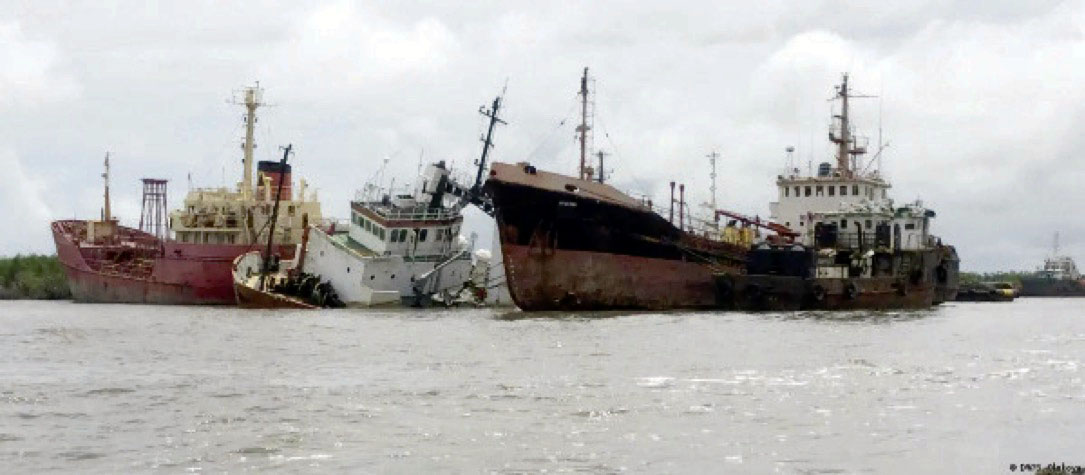
Nigeria’s waterways are sitting on a multi-billion-naira economic opportunity that has remained largely untapped. There are thousands of ships and metal wrecks abandoned in the seabed.
Going by the assessments of experts in the maritime space, these wrecks represent abandoned wealth and should no longer be treated simply as waste.
Daily Sun learnt that in the United Kingdom Merchant Shipping Act 1894, wreck is defined as including jetsam, flotsam, lagan and derelict in or on the shores of the sea or any tidal waters. Jetsam refers to various goods thrown into the sea to lighten the vessel, while flotsam refers to materials that float when a ship sinks. Goods from sunken ships that are heavier than water, which have been buoyed to prevent them from sinking, are known as lagan. And derelicts are ships that are not in the possession or control of their owners.
More than 200,000 tonnes of steel are estimated to be contained in wrecks within Nigerian waters, according to the Nigerian Maritime Administration and Safety Agency (NIMASA).
Daily Sun learnt that at an estimated N150,000 per tonne of scrap steel, 200,000 tonnes would translate to about N30 billion in recoverable steel alone. When copper, brass, engines and other valuable components are added, alongside the economic value of cleaner waterways, safer navigation and reduced disruption to maritime activities, the overall economic impact could exceed N100 billion.
To harness the economic benefits of metals, in 2021, the Federal Executive Council (FEC) gave approval for the removal of wrecks within Nigeria’s territorial waters. Shortly after the approval, the Nigerian Maritime Administration and Safety Agency (NIMASA) began the exercise, which is geared towards improving safety and ease of navigation in the country’s waterways.
Then, NIMASA started the removal of wrecks along the Badagry Creek from Tin Can Island to Navy Town, Lagos, with the aim of boosting investment opportunities in Nigeria’s maritime sector.
Then, the former Director General of NIMASA, Dr Bashir Jamoh, was commended for initiating the idea of wreck removal across the country.
The former NIMASA DG said that the successful removal of the wrecks and derelicts would restore confidence in Nigerian waters, as well as eliminate obstacles to smooth, safe, and profitable navigation, adding that the ultimate aim of the exercise was to create wealth from waste while providing jobs for Nigerians.
“These wrecks inhibit the operation of shipping companies, which constantly strive to increase efficiency in order to remain in business. As a result, most of the shipping companies usually avoid operating or investing in areas where navigational hazards are identified due to high insurance premium charges”, he said.
The target was to reduce the cost of shipping for the benefit of mariners and other stakeholders in the maritime industry with the elimination or reduction of the costs associated with insurance, survey and charting of wrecks.
Stakeholders who spoke with Daily Sun said that despite the exercise, there are still thousands of wrecks littering Nigerian waters, as there was no news from NIMASA or any agencies on the continuation of removal of wrecks after the 2021 exercise, as Nigeria continues to import steel from abroad.
The Managing Director of Harsecom Logistics Limited, Haruna Omolajomo, called for political will to turn Nigeria’s abandoned shipwrecks and marine waste into an economic opportunity, saying more than N100 billion could be unlocked from the country’s waterways.
Omolajomo, who described marine wrecks as “abandoned wealth” rather than waste, said Nigeria’s waterways were littered with abandoned ships, barges and trawlers that were obstructing navigation, damaging the marine environment and imposing additional costs on the maritime industry.
He said he had travelled by water from Lagos through Warri to Port Harcourt and witnessed the scale of the problem firsthand.
“I have travelled our waterways from Lagos to Warri to Port Harcourt. What I saw is not just water; it is a graveyard of abandoned ships, barges and trawlers,” he said.
He said at an estimated scrap value of N150,000 per tonne, the steel alone could be worth about N30 billion.
Other News
He added that when other valuable materials such as copper, brass and marine engines that could be refurbished or auctioned were considered, alongside the economic benefits of safer and cleaner waterways, the overall impact could exceed N100 billion.
“This is not new money we are looking for. It is old money we refused to pick. Nigeria could develop a viable ship-recycling industry from its marine wrecks, noting that ship recycling was already a multibillion-dollar global industry with countries such as Bangladesh, India and Turkey benefiting from it,” he said.
He argued that Nigeria, with one of the longest coastlines in West Africa and significant maritime activity, should not continue to leave valuable steel and other recyclable materials beneath its waters while importing steel products.
Beyond their potential economic value, he said abandoned wrecks posed serious risks to navigation and the marine environment, adding that the wrecks obstruct navigable channels, increase the risk of accidents, leak oil and other pollutants into the waterways, and damage fish stocks and mangrove ecosystems.
He further argued that unsafe waterways could increase insurance costs for vessels operating in Nigeria, thereby making the country’s ports and maritime trade less competitive.
“Leaving them there is costing us more than removing them. The legal framework for addressing the problem had also become clearer following Nigeria’s domestication of the Nairobi International Convention on the Removal of Wrecks,” he added.
He noted that the framework places responsibility on shipowners and provides for insurance arrangements to cover wreck removal, while NIMASA has the regulatory responsibility for wreck removal. He therefore urged the government to move away from treating wreck removal solely as a public clean-up exercise and instead develop it as a commercial opportunity through public-private partnerships.
“My position is this: let us stop treating wreck removal as a government clean-up exercise. Treat it as a business. Wrecks and marine waste are not our shame. They are our untapped multi-billion-naira opportunity,” he said.
He proposed the creation of three major wreck-removal zones covering Lagos, Warri and Port Harcourt, with competent Nigerian companies engaged under PPP arrangements to remove and recycle the wrecks.
According to him, recovered materials could be processed in partnership with the Nigerian Railway Corporation foundry and private steel mills, while revenues generated from the recycling activities could be shared among the relevant stakeholders.
He said strict enforcement of the wreck-removal framework, combined with private-sector participation, could enable Nigeria to clear significant portions of its waterways within 24 months.
A boat operator at Irede community, Mr Fred James, said that there are laws regulating shipwrecks and derelict vessels in the Nigerian maritime domain.
He said these laws are actually preventing NIMASA, NIWA and other regulatory agencies from removing the wrecks constituting problems for vessels and small boats on the nation’s waters.
“Most of these wrecks are vessels local and foreign ship owners abandoned due to their bad condition. Some of the owners decided to abandon these ships because they are unserviceable and they don’t have money to dispose of them properly. And if the court doesn’t condemn them as wrecks, it is always difficult for any agency to remove them.
“I think the laws regulating this removal of wrecks and derelicts need to be reviewed. Nigerian waters cannot be turned into a dumpsite for locals and foreigners to dump their rickety vessels. If, for instance, NIMASA removes an abandoned ship and condemns it as a wreck, the owner will show up from nowhere and go to court for a claim.
“There is a need to assemble all the various laws that purport to regulate shipwrecks and derelicts into a unified legal document from which to build a specialised law on shipwrecks and derelicts,” he explained.
He said that there are thousands of wrecks along Lagos and Port Harcourt, because these areas see the highest concentration of shipping traffic to Nigeria, saying that the National Assembly needs to review the laws regulating the removal of wrecks on the nation’s waters.