Follow Us on Google
By Vivian Onyebukwa
The rate at which babies are being bought and procured like common commodities in the market is alarming. Recent reports show that this incident occurs almost on a daily basis, indicating that there might be syndicates in every local government that trade in children.

Sometime in April this year, the Nigeria Police Command in Ebonyi arrested a woman who allegedly specialised in abducting and selling children. The woman, Ngozi Blessing Abia, also known as Mercy Francis, was said to have carried out such activities in Lagos, Ebonyi, Anambra and Edo States.

According to the report, investigation into her activities began in January 2024 when one Nkwuda Francis reported that the woman, who posed as a member of the National Youth Service Corps, had kidnapped his two young children. The children, aged three and seven, were later found in Oba, Anambra State where she sold them. They were returned to their family.

Also in Federal Capital Territory (FCT), Abuja, police authorities arrested two suspected traffickers with five children. According to the statement by FCT Police Command spokesperson Josephine Adeh, the duo of Kulu Dogonyaro and Elizabeth Ojah were attempting to evade arrest by police operatives in Sokoto but were intercepted and arrested by FCT police operatives at Kagini Junction, Abuja, while suspiciously conveying five children into the Federal Capital Territory.”
Also in May this year in Sokoto, the police arrested 10 suspected human traffickers and child abduction syndicate and rescued 21 children. One of the suspects was a father who allegedly abducted 28 children, six of whom are his biological children. The suspects were said to have been running a human trafficking and child abduction ring in Sokoto State for a long time.
Again, a two-year-old toddler was rescued by the Kaduna State Police. Four suspects who were allegedly involved in child trafficking syndicate in Kaduna were arrested by Kaduna Police Command.
The modus operandi of the syndicate involved targeting underage children who are alone on the streets or running errands.
These and many are reported cases each day across the country. Saturday Sun spoke to some stakeholders, seeking reasons for the endless stories of babies stolen, sold and bought across Nigerian states.
Dr. Efunbo Dosekun is the CEO of Outreach Hospital Group, and a key promoter of Babies Matter Medical Centre. Responding to the issue she said: “It is poverty. Maybe it just happens, they didn’t plan to have the children. It’s too expensive to look after children. Meanwhile, there are many women who have faced their career and it’s a bit late to make their decisions to marry, and they decided to have children. It is wrong, but it is a transaction, and it is poverty that causes all these things. It is very difficult, but it is something that government should stamp out and know that it is not done. There are lots of evils that come out of poverty. That is why government has to face societal problems. But I don’t think it is only government. We all must rise. There is nothing that is easy now- cost of petrol, electricity, school fees, hospital fees, water, security, accommodation, it is frightening. The government should support. They should stop all these expenditure they are doing in Abuja and live on a very lean budget. There are so much societal problems.”
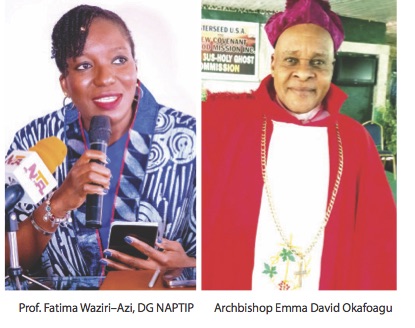
Archbishop Emma David Okafoagu, Archbishop of New Covenant of God Mission, blamed the development on economic hardship in the country. “For years now, people left their faith to seek quick ways of getting money and close their ears to the word of God, which shall hold them in times of various needs. Then Satan used the opportunity to seal their hearts to do abominable things, including the sale of their children.”
General Overseer of Jesus Campaigners Ministry, Bishop Nath Ofor, attributed it to poverty also, lamenting that people can no more take care of themselves not to talk of their children. Making reference to the Bible, Bishop Ofor said: “It happened in the Bible, when the famine was so much in the land that people began to eat their children. I can remember the story of the woman that had to present her son, and after they finished eating him, it was agreed that the other woman would have to present her own son the next day. But instead of doing that, she had to run away with her own, and rather went and reported to the king. (2 King, 6 V24-30). So when famine is in the land, poverty increases.”
Bishop Ofor blamed the plight of the citizens on the insensitivity of the government. “Poverty rate is much in the land. This is a country where people want to sell their kidney to survive. Only God and a good leadership can deliver us in a time like this. But the thing is that, there is nothing God can do about it. He has given us everything we need, so it is left for us to develop all that has been given to us,” he stated.
A mother of four, who simply referred to herself as Gladys, described the issue of sale of babies as a very difficult and sensitive one, adding that buying and selling of babies usually has a lot of sociological effects afterwards. She mentioned some of the reasons people might sell their children as including extreme poverty and desperation, lack of education and economic opportunities, social and cultural norms in certain communities, (for instance, an unwanted pregnancy), and coercion or manipulation by traffickers. She noted, however, that selling children is no solution. She challenged people to have trust in God, knowing that He sees children as His heritage.
Other News
Another woman who does not want her name in print, expressed dismay at the behaviour of some young girls and even mature women. She blamed them for turning the selling of babies to business. “Some of them have taken it as business. They purposely get pregnant, hoping to sell the child for as much as N1.5 million or N2 million to desperate couples who need a child. Buyers are always available. This tells the level of decay in the society. I advise those who want children to genuinely do proper adoption by going through the stated laws as it concerns adoption.”
A human rights activist, Ambassador Esther Obioma Ekwem, while expressing concern on the sale of babies, described the phenomenon of as deeply troubling. According to her, it is often driven by a combination of economic, social, and psychological factors.
Her words: “One of the primary reasons is extreme poverty. Parents or guardians may feel they have no other option to provide for their basic needs or to support other children in the family.”
She equally blamed lack of education and awareness in some cases, noting that individuals might not be fully aware of the legal and moral implications of selling a child, and might not understand the long-term impact on the child’s well-being.
Ambassador Esther Obioma Ekwem, who operates Esther Child Rights Foundation, a human rights organisation, also noted that organised crime groups who are involved in human trafficking often exploit vulnerable individuals, coercing or manipulating them into selling their children. She pointed out that social and cultural pressures were part of the problem.
“In some cultures, there may be social stigmas attached to having children out of wedlock, leading to desperate measures. Again, lack of support systems, inadequate social services and support systems for struggling families can leave parents feeling like they have no other recourse. Having mental health issues is one of the causes too. Parents or guardians with untreated mental health issues might not be in a position to make sound decisions regarding their children’s welfare,” she stated.
In preventing the ugly surge, Ekwem advocated poverty alleviation programmes, which can help in strengthening economic support for families in need through provision of jobs, financial aid, and food security initiatives, which can reduce the desperation that leads to such actions. She added that increase in awareness about the rights of children, the dangers of human trafficking, and the availability of support can empower individuals to make better decisions.
She advised the government to ensure that there are strong laws against child trafficking and the sale of children, coupled with effective enforcement, which can act as a deterrent. Also, provision of robust social services, including mental health support, parental counselling, and crisis intervention programmes can help families navigate difficult situations without resorting to selling children. She further noted that building stronger community networks that can support at-risk families can create a safety net that prevents the exploitation of vulnerable individuals. “Since human trafficking is a global issue, international cooperation and coordination are essential to combating trafficking networks and providing support to countries in need. Addressing the root causes of this issue requires a multifaceted approach involving governments, non-governmental organisations, communities, and international bodies working together to create a safer and more supportive environment for all children and families,” she stated.
The National Agency for the Prohibition of Trafficking in Persons (NAPTIP), has decried the surge in baby factories, and the buying and selling of children across the country. In a statement made available to the press, The Director-General of NAPTIP, Prof. Fatima Waziri–Azi, expressed deep concern over the increasing incidents of buying and selling of babies and the proliferation of baby factories across the country. She noted that in recent times, there have been alarming reports and public outcry regarding the sale of babies and the existence of facilities specialising in trapping young girls, recruiting men to impregnate them, and subsequently selling the babies after delivery. These factories, she said, operate clandestinely, preying on the desperation and vulnerability of unsuspecting victims, often luring them with promises of financial gain or false assurances of care and support.
The statement signed by Adekoye Vincent, Communication Officer, NAPTIP, noted one of the most recent incidents which occurred in Umunkwa village, located in the Umuafai Ndume Ibeku area of Umuahia North Local Government, Abia State where ten victims were rescued from a baby factory. The victims, aged between one and 24 years, included seven young girls, six of whom were pregnant, one lactating mother, and two boys who are minors. The baby factory was uncovered by the Department of State Services (DSS), Abia State Command. A 63-year-old woman, identified as Chinyere Nkwocha, was apprehended as the owner of the baby factory. Both the suspects and the victims were handed over to the NAPTIP Abia State Liaison Office for further investigation and appropriate action.
While commending the Abia State Command of the DSS for the successful operation, the Director-General urged the public, particularly parents, to be vigilant and ensure that their wards do not fall victim to these unscrupulous individuals. She also encouraged communities to continue collaborating with law enforcement agencies in combating these heinous crimes by promptly reporting all cases of human trafficking to NAPTIP through its toll-free number.
A senior officer in NAPTIP who does not want his name in print, has described the sale of babies as a serious case under the Trafficking in Persons (Prohibition) Enforcement and Administration Act, 2015 (Section 21).
He stated that the first thing the agency is doing is embarking on a massive awareness and enlightenment campaign among stakeholders, targeting organized women’s society groups, village meetings, members of the civil society organisations, home care providers as well as operators of orphanages. According to him, the agency is not relenting on curbing this ugly surge and has mapped out strategies aimed at checking the menace.
According to the senior officer, the agency has strengthened its enforcement and prosecutorial powers by arresting and prosecuting several of the offenders to serve as a deterrent to others. He added that many cases involving suspected human traffickers and sales of babies are in various courts across the country, saying that through the application of the Trafficking in Persons (Control of Activities of Organizations and Centres) Regulations, 2019, the searchlight is now beamed on all the orphanages and homes where children are kept, to ensure that they follow their service mandates. He added that the agency has also intensified engagement with other Millennium Developmental Agencies (MDAs) like the State Ministries of Women Affairs, which has the responsibility of adoption, to ensure it follows due process. The agency has also organised community dialogue to educate challenged couples on the need to follow due process for adoption.
Commenting on why people sell their children, he attributed it largely due to a lack of understanding of the dignity and sanctity of life. “Even though some use the persistent global hardship and financial situation as reasons, it is discovered that even after such heinous crime of selling such baby, their poverty increases rather than reduces. Some sell theirs due to peer pressure and others just want to get out of their present situation and heed to bad advisers. This problem can be solved if society learns to wait on the Lord. Yes, many people especially couples, are challenged and desperately in need of children. The golden advice is that if the medical effort fails, they should wait upon the Lord and may even follow the due process of adoption. Children are gifts from God Almighty and they should not be sold like wares. Let the society value human life. Some of those children that are sold out can even be used for ritual purposes. So, let the society value human life.”