Follow Us on Google
By Beifoh Osewele
There are reunions that simply bring old classmates together. Then there are homecomings that remind a university of the enduring power of its greatest asset—its people.
The maiden reunion of the University of Lagos Department of English Alumni (UDEA), held on July 17 and 18, was unmistakably the latter. More than six decades after the department was established, generations of alumni returned to Akoka, not merely to relive memories but to celebrate a legacy built on scholarship, mentorship and service.
Yet, beyond the laughter, warm embraces and nostalgic conversations, another story quietly unfolded.
It was the story of three extraordinary women whose lives mirror the enduring tradition of excellence that has defined one of Nigeria’s foremost English departments.
Professor Emerita Ebun Clark. Professor Akachi Adimora-Ezeigbo. Associate Professor Carol Anyagwa.
Three scholars. Three generations. One unbroken chain of mentorship.
Together, they embody what many alumni fondly describe as the Amazons of Akoka—women whose influence has transcended lecture rooms to shape generations of teachers, writers, journalists, scholars and professionals across Nigeria and beyond.
The reunion itself was historic.
It was the first of its kind since the Department of English was founded in the first half of 1960.
On Friday, July 17, activities began at the department on the University’s Akoka campus, where alumni toured familiar classrooms and corridors that had shaped their formative years. They later gathered for a reunion lecture delivered by distinguished alumnus, Jekwu Ozoemene, Group Executive at The Alternative Bank, on the theme, “Unlocking Global Opportunities with English Studies: The Akoka Legacy.”
The lecture drew an impressive panel of discussants, including veteran actress and alumna, Joke Silva, alongside accomplished professionals from academia and industry. The celebration culminated in a gala dinner and awards ceremony at the Officers’ Mess, Marina, Lagos, where outstanding alumni and retired academics were honoured for their contributions to the department.
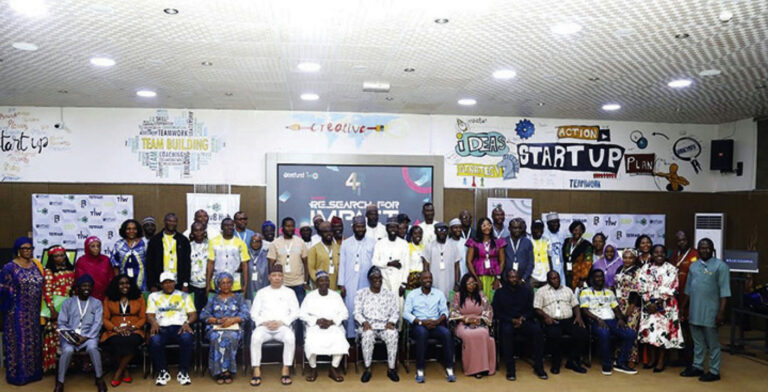
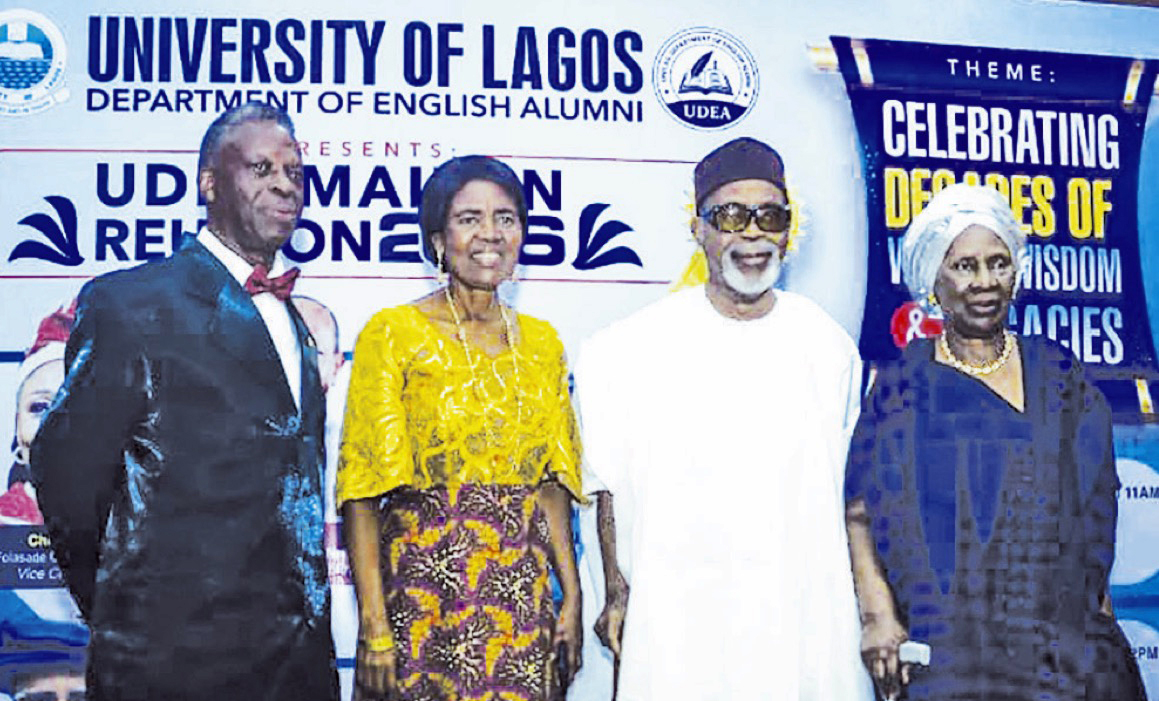
Perhaps, the most moving sight of the two-day celebration was the presence of five retired professors of the department seated together.
For many alumni, it was more than a reunion photograph.
It was living proof that while teachers may not always receive the rewards they deserve during their working years, the seeds they sow eventually blossom in the lives of those they teach.
Former students who had become professors, vice-chancellors, authors, editors, diplomats, broadcasters and corporate executives returned to honour the men and women who had first ignited their intellectual curiosity.
Old classmates embraced after decades apart.
Former lecturers were welcomed with reverence.
Conversations interrupted by careers, marriages and the relentless passage of time resumed as though the years had scarcely passed.
There was laughter.
There was nostalgia.
Above all, there was gratitude.
For more than six decades, the Department of English has produced an extraordinary constellation of graduates whose influence extends far beyond the University of Lagos. Its alumni have distinguished themselves in literature, journalism, broadcasting, diplomacy, academia, law, banking, public service and the creative industries. Their collective achievements have helped define what many proudly call the Akoka legacy.
But every enduring legacy has its custodians.
For the Department of English, that story can be told through three remarkable women whose lives are linked by scholarship, mentorship and an unwavering commitment to academic excellence.
The first taught the second.
The second inspired the third.
And together they demonstrate how great universities perpetuate excellence—not by accident, but through the deliberate passing of knowledge, values and character from one generation to the next.
Ebun Clark: Teacher of teachers
Long before women became a familiar sight in university lecture rooms, Professor Emerita Ebun Clark had already begun carving out a place in Nigeria’s academic history.
Her story is inseparable from the story of the University of Lagos Department of English.
When the department was established in 1965, she joined its pioneer academic staff after teaching Speech at the University of Ibadan’s School of Drama, where she had met and married the distinguished poet, dramatist and scholar, Professor John Pepper Clark.
At a time when female academics were still a rarity in Nigerian universities, Ebun Clark stood almost alone.
For a period, she was the only Nigerian woman on the department’s academic staff, quietly breaking barriers not through fanfare but through scholarship, professionalism and quiet determination.
Her classroom soon became one of the most respected learning spaces in the university.
She taught Speech for over a decade, helping generations of students master the spoken word with clarity, confidence and precision. Later, she moved into the Literature Unit, where she introduced students to English drama, Shakespeare and Renaissance literature, opening windows to worlds that many had never imagined.
Thousands of students passed through her lectures.
Some became professors. Others became writers, journalists, diplomats, broadcasters, lawyers, public servants and business leaders.
Many would later discover that the lessons they remembered most were not confined to phonetics or Shakespeare but to discipline, intellectual honesty and the relentless pursuit of excellence.
Looking back on the department’s formative years, Professor Clark recalls that of the pioneering academics who laid its foundation, only a handful remained long enough to build enduring careers there.
She belongs to that remarkable generation that transformed a young department into one of Africa’s leading centres of English studies.
At the reunion, she was honoured for her distinguished service to the department.
The ovation that greeted her was spontaneous and heartfelt.
Around her stood not merely former students but accomplished academics who had themselves become mentors to countless others.
The roll call had Professors Funso Akere, Segun Awonusi, Adeyemi Daramola and Adimora-Ezeigbo, all of the once students in her classroom.
It was a scene that captured the true reward of teaching.
A teacher’s greatest achievement is not measured by titles accumulated or offices occupied, but by the lives transformed.
Few Nigerian academics illustrate that truth more convincingly than Professor Emerita Ebun Clark.
Akachi-Ezeigbo: From student to literary icon
Among the many young students who walked into Professor Clark’s classroom in 1977 was a quiet, determined undergraduate named Akachi Adimora-Ezeigbo.
Few could have imagined that she would one day become one of Africa’s most celebrated literary voices.
After graduating, she chose not to leave the institution that had shaped her intellectual life.
Instead, she built her academic career at the University of Lagos, rising through the ranks to become a professor and one of Nigeria’s foremost scholars of African literature.
Beyond the classroom, Professor Adimora-Ezeigbo established herself as an internationally acclaimed novelist, poet, critic and children’s writer. Through her novels, poetry and scholarly works, she has explored themes of history, womanhood, culture, justice and national identity, earning widespread recognition within and outside Nigeria.
Her literary achievements brought honour not only to the University of Lagos but also to Nigerian literature.
Yet those who know her best often speak first of another quality.
They remember a teacher who demanded excellence without extinguishing curiosity.
A mentor who encouraged rigorous thinking while nurturing confidence.
An academic who believed that scholarship carried a responsibility to inspire others.
Like her own mentor before her, Professor Adimora-Ezeigbo invested herself in the next generation.
Among the young scholars who came under her guidance was an exceptionally gifted student who would later distinguish herself as the overall best graduating student of the Department of English’s Class of 1998. Her name was Carol Ngozi Anyagwa.
In that moment, the circle of mentorship widened once again.
The pioneer had inspired the scholar.
The scholar had nurtured another scholar.
And the Department of English continued to renew itself through the timeless tradition of teachers raising future teachers.
Carol Anyagwa: Carrying the torch
If Professor Emerita Ebun Clark laid the foundation and Professor Adimora-Ezeigbo strengthened the edifice, Associate Professor Carol Ngozi Anyagwa represents the continuity of that tradition.
Her story illustrates what every great university hopes to achieve: that today’s brilliant student will become tomorrow’s inspiring teacher.
Carol first came into prominence in 1998 when she graduated as the overall best student of the department. It was a distinction earned through intellectual ability, discipline and hard work, qualities that would define the course of her academic career.
Unlike many outstanding graduates who sought opportunities elsewhere, she chose to remain in the institution that had nurtured her, where she earned both her Master’s degree and PhD.
Over the years, she has established herself as one of Nigeria’s respected scholars in Phonetics and Phonology, combining teaching, research and academic leadership with an unwavering commitment to mentoring younger scholars.
Today, she is an Associate Professor of Phonetics and Phonology, Vice President of the Association of Phoneticians and Phonologists in Nigeria (APPN) and Vice President of the University of Lagos Department of English Alumni Association (UDEA). She also pioneered the English Class of 1998 Alumni Association, serving as its founding president.
Yet titles alone do not explain why she commands such respect within the university community.
Students describe her as approachable without compromising standards. Colleagues speak of an academic who combines intellectual rigour with humility, professionalism with warmth, and scholarship with a genuine concern for people. To many of her students, she represents the kind of teacher who challenges them to think critically while inspiring confidence in their own abilities.
Those qualities are perhaps the clearest evidence that the values handed down by earlier generations of teachers remain very much alive.
In Dr. Carol, as she is fondly known, the Department of English has found not merely another accomplished scholar but another mentor committed to preparing those who will one day succeed her.
That, after all, is how enduring traditions survive.
The torch that never goes out
As the lights dimmed at the Officers’ Mess on the evening of Saturday, July 18, and classmates drifted reluctantly into the Lagos night, the reunion became more than a celebration of old friendships. It became a reminder that the true wealth of a university is measured not by its buildings or rankings but by the people it shapes..