Follow Us on Google
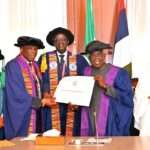
The internet is cruel. Just last weekend, specifically on July 25, images of Sen. David Umahi at his daughter’s graduation at Queen Mary’s University of London popped up all over the web. The graduation ceremony took place on July 25, 2025. It was a momentous occasion, one which he was proud of as a father. Sadly, what served as the first anniversary of the sweet event was blighted by the death of Mary Habila, which occurred on the morning of June 27, 2026, inside the Uburu country home of the Minister. I do not know why the internet chose to regurgitate images of the graduation party in London at a time when questions are still being asked over the death of Mary; a death for which the demand for answers has become deafening.
Sadly, Mary may not be resting in peace because the narratives about what happened to her keep changing. The basic facts, as publicly known, are that she died in Umahi’s country home. The ‘how’ remains subject to conjecture. Whatever anyone has said as to how Mary died remains unscientific. The true cause of death can only be established by scientific procedure. And that is where the question lies. Why is it difficult to conduct a post-mortem? Do investigators into the cause of death need the permission of her parents, or of the person in whose residence she died, to perform an autopsy? This may also be an ethical challenge for the Nigerian Medical Association. They have to clarify this. For now, all that the public knows is that Mary died in Umahi’s residence and that her death was concealed for two weeks before it was made public. The public also knows that the Commissioner of Police in Ebonyi State ordered the case transferred to the State Criminal Investigation Department (SCID) for a full inquiry. But on Monday, July 27, news filtered out that her mortal remains have been moved to Abuja in circumstances that are anything but transparent.
It should be noted that whatever happened in the series of events surrounding Mary’s death, including comments by Umahi or his associates, or insinuations that her body was found unclad, or that the minister left his home moments after she was found unresponsive, while aides scrambled to arrange an ambulance, or that she died after a telephone conversation with her boyfriend, do not in fact, or in any way material, prove any case of wrongdoing against the Minister or anyone around him. However, the narratives, taken together, create the need for a more assertive and more independent scrutiny of the death to establish the exact cause of death. That is what a functional justice system would ask for.
Instead, what Nigerians have observed is a slow-motion standoff over whether her body should even be examined. The Ebonyi Police Command, backed by legal advice from the state’s Director of Public Prosecutions (DPP), said an autopsy was necessary given the “sensitive nature of the case.” Her family, through an affidavit, rejected any post-mortem. They asked rather for immediate burial. There have also been reports of a call by a Senator from Kaduna State for the family’s wish to be respected. Meanwhile, SOKAPU (Southern Kaduna Peoples United Associations) has waded into the matter and is asking for full disclosure of the cause of death alongside a N20b consequential compensation from the minister.
Each of these developments points to a troubling reality. They point to a bereaved family opposing a forensic answer to the death of their daughter; a state police command that spent weeks publicly asserting the necessity of an autopsy before the matter was quietly relocated; and a transfer of the remains and case file to Abuja, which raises suspicion of the possibility of executive closure. Whatever becomes the eventual outcome, the fact of the transfer of the body and case file away from Ebonyi State Police Command points to an appearance of interference from higher quarters. It is suggestive of a subject of investigation shaping the terms of that investigation. This alone will erode public confidence in the entire investigation.
This is where Mary’s case is more than one family’s grief. It has become a case study in a pattern that Nigerians are familiar with. It is about a Nigeria where crime scenes are not treated equally. It is about a country where crime is treated depending on who is involved and who owns the address of the crime scene.
Other News
When an ordinary Nigerian dies under unexplained circumstances in a private home, the police are quick to detain those present. Most times, the arrests and detention are done roughly and without regard for legal rights and civility. Sometimes too, the detention is based on thin evidence, and such accused persons are held for far longer than the law technically permits, pending investigation. As is publicly known, bodies of victims in such deaths are rarely released without post-mortem examination if any suspicion is raised. This happens because in poor and working-class Nigeria, the presumption tends to run toward suspicion.
Compare this with what has unfolded inside a sitting Minister’s private compound, where investigators have spent a month negotiating, rather than accessing basic forensic examination, and where the case has been moved between jurisdictions in shadowy circumstances. This speaks to a familiar trajectory in Nigeria’s public life whenever controversy touches the powerful. The fear now, openly voiced across Nigerian newsrooms and civil society, is that Mary’s case may suffer a fate similar to what has happened to high-profile criminal cases involving people of power and people in power. Always, such cases follow a sequence: high outrage, intense scrutiny, then procedural fog, jurisdictional shambling, and eventually, silence.
So far, this matter does not disclose any guilt against anyone. However, how it is handled will have a sting on the integrity of the police, which is already burdened with a crisis of public trust, rooted in decades of uneven enforcement, extrajudicial shortcuts against the poor, and near-total amenability toward the connected. Though Mary’s family had said that they simply want to bury her in peace, which most people see as a wish that deserves compassion, not exploitation by anyone hoping the matter quietly disappears with her, the public interest in knowing how and why a citizen died in the manner that Mary did, does not belong to her family alone; it belongs to a country trying to decide what kind of accountability, if any, applies to the powerful.
For now, an independent, forensically rigorous investigation, conducted free of interference from anyone connected to the residence where the death occurred, is the only mechanism capable of establishing what actually happened. It should be the minimum any Nigerian family, of any social standing, is owed when a loved one dies in the exact circumstance that Mary did. If the police cannot deliver that minimum in this case, then the message to ordinary Nigerians is straightforward. It publicly screams that the law’s rigour is reserved for those without the means to escape it.
If this case is allowed to fade, resolved by nothing more than a burial, a denial, and the passage of time, the cost will not be confined to the Habila family alone. The cost will be paid by every Nigerian who is asked, again, to accept that accountability bends according to a person’s proximity to state power. Every unresolved elite scandal that disappears without independent scrutiny teaches a lesson that has already been learned too many times in this country, and that is that the machinery of investigation, prosecution, and forensic examination exists at full strength for the ordinary citizen and at reduced, negotiable strength for the politically connected. That lesson, repeated always, entrenches impunity as a governing culture rather than an occasional failure.
It also does lasting damage to public confidence in the institutions meant to protect all citizens equally. The Nigeria Police Force and the courts have a stake in ensuring that this case is resolved through an open, credible process rather than quiet accommodation. Anything less leaves a permanent asterisk on the image of the Police and the judiciary. More importantly, it leaves Mary’s family and the Nigerian public without the truth they are owed.