Follow Us on Google
•No bed, few doctors, zero empathy; how negligence by health officials cost lives
•Patients, families share narratives of pain, anguish
By Kehinde Aderemi and Ngozi Nwoke
Renowned author, Chimamanda Ngozi Adichie, on January 7 this year, lost one of her twin sons, Nkanu Nnamdi. The 21-month-old boy had developed what was described as a serious infection while the family was in Lagos for Christmas.
Nkanu was first admitted at Atlantis Hospital before being referred to Euracare Multi specialist Hospital in Victoria Island. He was billed for an MRI, lumbar puncture and central line insertion ahead of a planned medical evacuation to the United States. But he died hours before the flight.
Adichie alleged negligence, stating that complications set in after her son was sedated with propofol at Euracare. Although investigations are still ongoing, the outrage that trailed the incident is yet to settle down. It is not the first time public attention would be drawn to alleged negligence in public hospitals across Nigeria.
Barely eight months after the ugly incident, another family would face a similar anguish. On September 12, 46 -year-old Olatunde Ojelabi died at the Lagos State University Teaching Hospital (LASUTH), Ikeja, after allegedly waiting for six hours outside the emergency unit of the facility before he could be attended to. His elder brother, Kolawole Ojelabi, in a Facebook post that has since gone viral, captured the frustration of many Nigerians.
“How does a system designed to save lives become so impersonal, so bureaucratic and, at its worst, seemingly so indifferent to a human life hanging in the balance?,” he asked.
According to Kolawole, Olatunde had an accident on Sunday, September 6, while driving his family to church. He was first taken to a private hospital, from where doctors referred him to the Lagos State University Teaching Hospital, (LASUTH) for specialist care. On arrival at LASUTH, the family was told there was no bed. Olatunde bled, drifted in and out of consciousness, and later convulsed outside the emergency, and died six days after the accident. To the family, he did not just die from an accident. He died because the system failed him.
The management of LASUTH, however, rejected the family’s account. Its Chief Medical Director, Prof. Adetokunbo Fabamwo, said the allegations in Kolawole’s post were carefully examined and found to be unfair to the institution, insisting that Olatunde arrived with fatal injuries, and was seen by three surgical consultants even on a Sunday morning, and eventually died in the Intensive Care Unit seven days after presentation.
“Our conclusion is that the writer had been most uncharitable to the hospital and the team that attended to his brother,” he said.
Beyond Euracare and LASUTH, similar complaints have trailed public hospitals across the country.
A Lagos-based journalist, who asked not to be named, narrated her encounter at the Federal Medical Centre, Ebute Metta, Lagos. Her story was one of alleged negligence, rudeness and incompetence.
“My first experience at the FMC in Ebute Metta was so bad. One of the health workers made me feel like she was doing me a favour by attending to me, talking rudely and without empathy,” she said.
Her first visit, she said, was for an abdominal scan. After days of being sent from one section to another, the result of the scan could not be found. Her second visit was for a hormonal profile test that requires two blood samples on different days. The hospital, she alleged, failed to record the first sample, rendering the second useless and the result inconclusive.
Though the hospital offered a free repeat, she said the same error occurred a second time, prompting her to conclude that “Till tomorrow, I don’t trust that result. I am still planning to do the test in another medical lab.”
Efforts to get reaction from the FMC at Ebute Metta, was unsuccessful as of press time. However, behind the delay and negligence in Nigeria’s hospitals is a failed system.
Aaron Anyanwu still preserves his daughter’s hospital file wrinkled from tears and sweat. The file tells the story of a promising life that changed in one day.
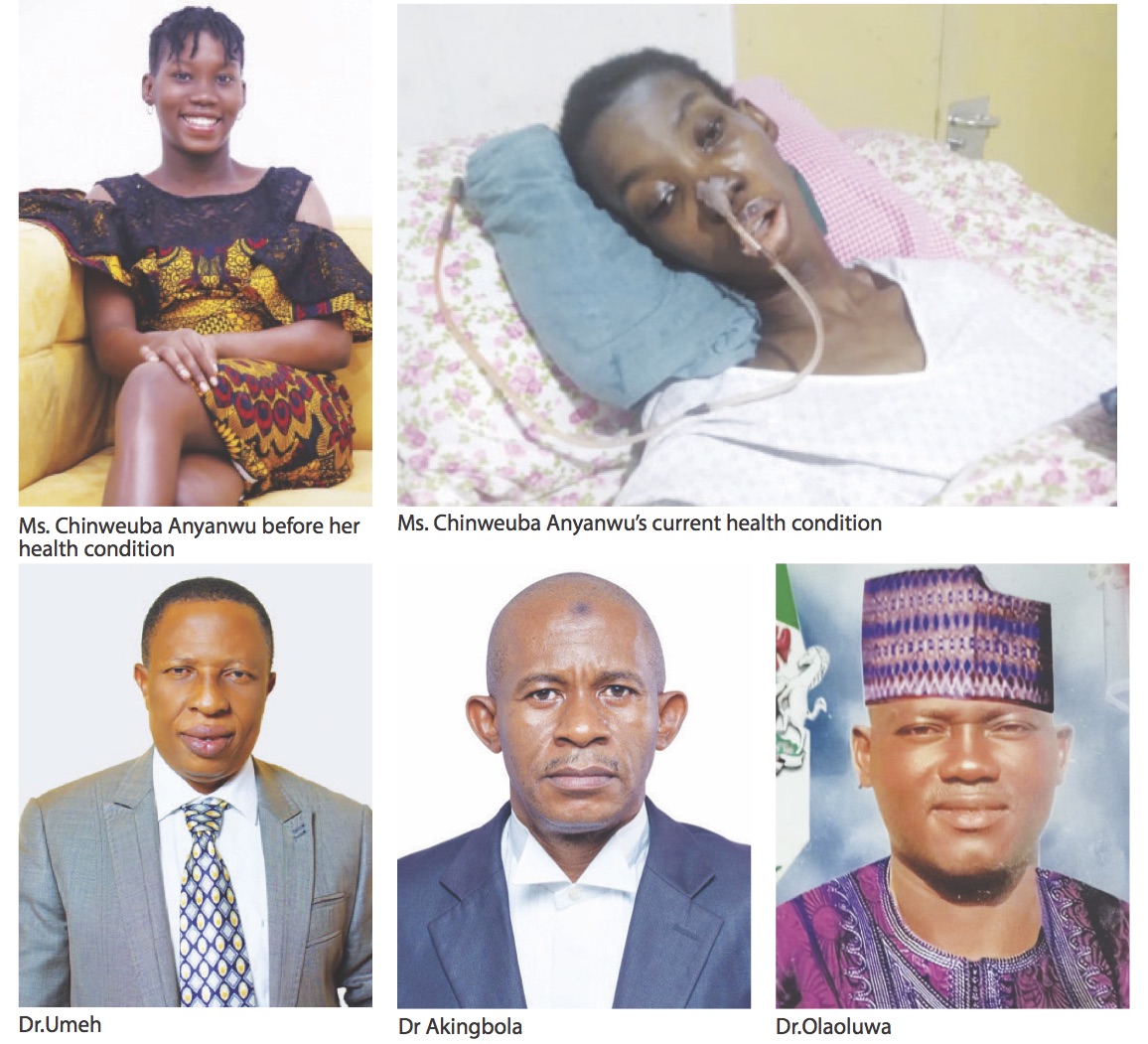
“My daughter, Ms. Chinweuba Anyanwu, a sickle cell fellow and 24-year-old was badly managed at the Rivers State University Teaching Hospital, (RSUTH), in Port Harcourt. My daughter was left for a house officer to manage whereas there were specialists at the sickle cell unit of that hospital. She was wrongly transfused on April 10, 2024 by a house officer without following due protocol. The blood transfusion led to severe reaction and stroke complications.
“My daughter is currently paralysed from her neck down and daily battling near death experiences. Since 2024, she has suffered indescribable health concerns as a result of that single negligence by doctors and nurses at the hospital. She was laughing in the morning. By evening she could not feel her hands,” Anyanwu lamented.
Today, Ms. Anyanwu cannot move. The cost is measured in wheelchairs, physiotherapy bills, and nights spent watching his daughter struggle to survive.
“Before April 10, she was in school. She was managing her sickle cell. She had dreams. No one has been queried. No one has been sanctioned. They just moved on at the hospital.”
He has written petitions to the hospital management, the Rivers State Ministry of Health, and still waiting to get a response.
A mother simply identified as Julie, says her 11-year-old son still cannot access the medical care he needs to manage his Cerebral Palsy. The mother stressed that the Lagos University Teaching Hospital, (LUTH), where her son receives treatment, is 27 kilometres from their home.
According to Julie, her son requires a combination of physiotherapy, occupational therapy, and speech therapy to improve his condition.
“There is currently no known cure for Cerebral Palsy. It can only be managed. These are the major therapies we rely on in Nigeria, and they are vital to his development.
“We need therapy centres established within our Primary Health Centres, (PHC) for such health conditions. We need a government health insurance system that subsidises assistive aids and medications. We cannot do this alone,” she appealed.
These are cases of patients in critical conditions who often face long waiting times or are ignored while nurses or doctors follow bureaucratic clearance.
According to the Nigerian Medical Association, only about 55,000 doctors are practicing in Nigeria for a population of over 220 million, leaving a ratio of one doctor to about 4,000 patients, far from the World Health Organisation’s recommendation of one to 600.
Data from the Federal Ministry of Health shows the number of practising doctors fell from 66,241 in 2024 to about 55,000 in 2025, a 16.9 per cent decline in one year, driven by the exodus of health workers abroad. In 2024 alone, 4,193 doctors left the country.
Meanwhile, Associate Professor/Consultant Clinical Psychologist CMUL /LUTH, Dr. Charles Umeh, explained that the situation in Nigerian hospitals needs urgent attention. According to him, there are various challenges faced by the public health officers in hospitals across the country. Umeh, however, urged the Federal Government to pay attention to public health institutions.
“The data we see every day mirrors the reality inside our public hospitals, especially the emergency wards. The problem is not just manpower but beds and equipment.
“When you go to the emergency, you will be sad that there are not enough beds. If beds are enough, patients would not be turned back. Why would any trained doctor turn a patient back? We took an oath to save lives.
“Most times, you see only one doctor running around to take care of five emergency cases at the same time. How will he cope? Many of our doctors have left in the name of japa and the few that are available are not well remunerated. Until government addresses this deficit, we will continue to face these avoidable crises in our hospitals,” he warned.
Other News
Dr. Matthew Olaoluwa, a Lagos-based anaesthetist, linked the delays in public hospitals to manpower and equipment gaps. According to him, cases like that of Olatunde was painful, especially as it showed the challenges doctors and health officers in Nigeria face daily while handling emergency cases.
“Doctors are human beings. Many of us work beyond our scheduled time without rest because there are few health professionals available, and that affects clinical judgement. There is a World Health Organisation standard for the number of doctors that should be available in a country. Nigeria is having a shortage and it affects the way we work. Government should make the job more attractive as it is done in other countries of the world,” he said.
For many families, pain does not end at the hospitals. The search for justice often becomes another ordeal. Constitutional lawyer, human rights activist and public affairs analyst, Kabir Akingbolu, said the deaths of patients in some of the cases of delay and negligence in Nigeria’s hospitals pointed to a deeper ignorance of patients’ rights. According to him, the Patients’ Bill of Rights is a set of rights and protections for anyone receiving treatment in any health facility in Nigeria.
“It was intended to guarantee every patient enjoys good treatment in medical facilities. It ensures that patients are treated with dignity, with respect, and that they receive adequate and appropriate information about their health and about the care they need,” he revealed.
Akingbolu explained further that patients have the right to be informed about their condition, the proposed treatment, the risks, benefits and consequences.
“If you are to be operated upon, they must tell you the kind of operation they want to carry out, its effect, the kind of pain you may go through and every other thing about the treatment. If the treatment can lead to death, partial disability or permanent disability, they have to inform you.
“You also have the right to know the identity, profession, qualification and competence of the health care provider attending to you,” he said, adding that patients have the right to dignity, freedom from discrimination, privacy and confidentiality.
“What you are being treated for cannot be disclosed to the public, to the press or to a third party without your consent. Your medical history is confidential,” he stated, stressing that other rights include the right to give voluntary consent or refuse treatment, the right to complain when treatment is not satisfactory, and the right to access medical records.
“Patients have the right to see their files, medical history and even obtain copies if they want to take them to another hospital. They also have the right to be treated in a safe and hygienic environment, not in a dirty or risky environment where they can be exposed to danger or harassment,” he said.
Akingbolu noted that all these rights are guaranteed by law, but enforcement remains weak.
“These are part of the salient provisions of the Act. The problem is not the law, it is implementation,” he stated.
Incorrect medication administration, wrong diagnoses, surgical mistakes, delayed emergency response, wrong dosage or diagnosis, and a culture where mistakes are buried instead of fixed, in the views of patients and concerned individuals have become normal in Nigeria’s government hospitals.
Advocacy groups say they receive at least three to four complaints of medical negligence every month. Wrong transfusions, missed diagnoses, and patients left unattended after surgery are some of the challenges. Families say they are often told to write a letter and nothing happens.
At LUTH in Lagos, a 2023 survey by a Patients’ Rights Group found that 62 per cent of respondents said they had witnessed or experienced avoidable delays that worsened the health conditions of patients.
The complaints are not new. What is new is the boldness with which victims and families are now speaking out, because the cost has become too high to keep quiet.
Some health workers admitted that the system is breaking. A senior nurse at a federal teaching hospital, who asked not to be named for fear of victimisation, explained the reality from the inside.
“We are overwhelmed with the number of patients we attend to daily and we don’t have enough hands to assist. One doctor on call can be managing 30 patients overnight. One nurse can be running three wards. The house officers are fresh from school. They are learning on patients because there is no simulation lab, no proper supervision.
“When you have 10 people needing blood at the same time and there is only one lab scientist, corners will be cut. When specialists are supposed to be on ground but they are in their private clinics, the house officer is the only one there. If something goes wrong, they will say the nurse was negligent’ or ‘the doctor was careless. But nobody asks why there were no senior doctors to supervise. Until we address staffing, equipment, and welfare, we will keep having these cases. We are humans, too. We burn out at some point.”
Mrs. Bose Olubo Adegeye, Director of Amazon Integrated Clinic, Lagos, acknowledged that the negligence and unprofessional conduct in many government hospitals is a serious and well-documented problem, which is caused by a chain of factors.
“The first one is indiscipline and negligence to the service they are paid for. Some health workers are not diligent in their work. They have the mindset of ‘its government work,’ so they get to work late and at times are tired due to their involvement in other personal jobs or business. They are also reluctant in attending to patients on time and some are rude which can affect the state of mind of the sick.”
She identified systemic pressure as another major driver, “Severe under-staffing, overcrowding, low pay, poor equipment, and long shifts leading to burnout are major causes. The brain drain is next. Many skilled workers leave for better conditions abroad, leaving gaps that are filled by overworked junior staff.”
Adegeye also pointed to weak oversight and poor infrastructure.
“Another factor is weak accountability. The complaint systems are slow or non-existent, so poor conduct often goes unreported or unpunished. Another factor is training and ethics gaps; in some cases, poor supervision and weak enforcement of professional ethics.
There is also the issue of infrastructure deficits. Most government facilities often lack basic utilities, functional equipment, diagnostic tools, and reliable power supply, creating high-stress environments prone to mistakes.”
On redress, the health administrator said patients are not helpless, but many do not know where to turn. She explained that the Administrative department in the hospital, the State Ministry of Health, or the Medical and Dental Council of Nigeria, MDCN, for doctors are in charge of investigating any misconduct or unprofessional conduct by health workers. Groups like Public Complaints Commission and health-focused NGOs in Lagos can help push for investigations too.
Ben Ezeohagwu, a professor and Director of African American Business School, Ota, warned that cognitive overload, burnout and poor remuneration among health workers in government hospitals are fuelling negligence and avoidable patient deaths.
“In my observations and experiences as graphologist during a number of visits to government hospitals in Nigeria, there are often many patients on ground to be attended to by a few health Workers.
“The imbalance has always created cognitive overload, burnout and exhaustion, stress and anxiety on the health workers, and when complemented by inadequate remuneration of health workers usually lead to low morale, and to some extent negligence and unprofessional Conduct on the part of Health Workers.”
The professor said the stress on health workers is often visible, even in their handwriting when giving drug prescriptions and referrals.
Government hospitals often respond to allegations with committees. Sometimes there are suspensions. Rarely are there prosecutions. The Medical and Dental Council of Nigeria, which regulates doctors, says it receives hundreds of petitions yearly but disciplinary processes are slow.
Hospital managements cite lack of funds. State governments say health is on the concurrent list. The Federal Ministry of Health says it has guidelines. Meanwhile, patients keep dying.
In 2024, the National Human Rights Commission launched a portal for reporting medical negligence. In its first six months, it recorded over 400 complaints. Most were from public hospitals.
Health advocates say Nigeria cannot achieve Universal Health Coverage if public trust in government hospitals collapses.
To many and for those that had lost their beloved ones to cases of negligence and delay in hospitals, the pain will continue to linger unless governments at all levels address the bed-space crisis, equip and fund the facilities