Follow Us on Google
By Uche Usim
In what may be termed a deepened alliance for mutual economic growth, the United States and Nigeria are expanding trade, unlocking investment and driving private sector–led growth under the US–Nigeria Commercial and Investment Partnership (CIP).
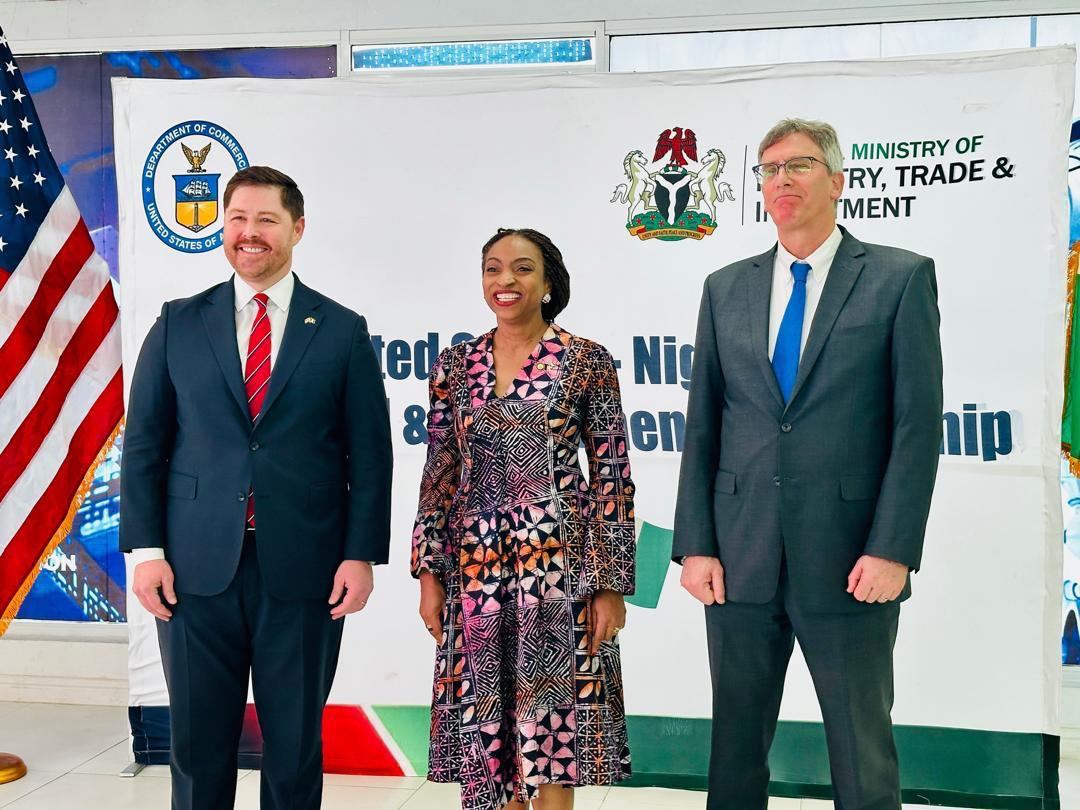
At a ministerial meeting in Lagos yesterday, U.S. Deputy Assistant Secretary for the U.S. Commercial Service at the Department of Commerce, Bradley McKinney and Nigeria’s Minister of Industry, Trade and Investment, Dr. Jumoke Oduwole, co-chaired talks aimed at strengthening commercial ties and accelerating economic reforms across key sectors.
The meeting was a continuation of strategic engagements under the five-year CIP framework, which was established to enhance bilateral trade, increase investment flows, and foster sustainable, business-driven economic expansion between both countries.
Bringing together an interagency delegation of experts in trade financing, trade promotion, and project development, the session reviewed priority reform proposals developed by three CIP Working Groups—Agriculture, Digital Economy, and Infrastructure.
These groups, made up of Nigerian and U.S. private sector leaders, have crafted recommendations designed to improve the business climate, dismantle trade barriers, and generate long-term economic value.
“This ministerial meeting underscores significant advancements in the vital U.S.-Nigeria commercial and investment partnership,” McKinney said. He added: “Over the past six months, Agriculture, Digital Economy, and Infrastructure Working Groups have engaged across government and industry and developed thoughtful, practical proposals to unlock trade and deepen the bilateral commercial relationship between the United States and Nigeria.”
The ministerial signals Washington’s growing confidence in Nigeria’s economic potential and its role as a strategic commercial hub in Africa. It also reflects a broader push to align public policy with private sector priorities in order to translate diplomatic engagement into tangible business outcomes.
Dr. Oduwole welcomed the high-level U.S. delegation, applauding the strength and consistency of bilateral engagement. She encouraged American companies to explore investment opportunities in the CIP’s priority sectors and to “benefit from trading with Nigeria through to the African continent.”
The minister emphasised Nigeria’s determination to reduce dependence on oil exports by broadening its economic base. “A central priority for us is to accelerate non-oil export diversification and to ensure that more Nigerian businesses can access U.S. markets in a way that is competitive, sustainable, and inclusive,” she said.
She also highlighted progress recorded since the CIP Working Groups were launched in June 2025, noting that Nigeria has intensified reforms aimed at improving competitiveness and investor confidence. According to her, the Ministry of Industry, Trade and Investment has “sustained momentum on business climate reform, strengthened competitiveness, and advanced investment, industrial, and trade policy alignment and implementation … laying the foundations for a more predictable, investible economy and creating stronger conditions for this partnership to deliver tangible outcomes.”
Senior U.S. officials present at the meeting included U.S. Mission Chargé d’Affaires Keith Heffern, U.S. Department of Agriculture Foreign Agricultural Service Associate Administrator Jason Hafemeister, and U.S. Trade and Development Agency Regional Director for sub-Saharan Africa Heather Lanigan. Nigeria was represented by Ambassador Nura Rimi, Permanent Secretary of the Federal Ministry of Industry, Trade and Investment, and Gertrude Orji, Director of Investment at the ministry.
Under the CIP framework, both countries agreed to sustain consultations on a wide range of trade and investment matters, explore opportunities to expand commerce in goods and services, and promote stronger cross-border investment flows. The overarching objective is to stimulate economic growth, create employment, and drive prosperity on both sides of the Atlantic.
Officials noted that Nigeria stands to benefit significantly from deeper collaboration with U.S. companies known for delivering “world-class quality, efficiency, and effectiveness” in their products and services. Increased engagement with competitive American firms could strengthen Nigeria’s industrial base, enhance technology transfer, and improve access to global value chains.
Trade statistics underscore the growing depth of the bilateral relationship. Nigeria is currently the United States’ second-largest trading partner in Africa, with two-way trade in goods and services totaling nearly $13 billion in 2024. U.S. foreign direct investment in Nigeria also surged to $7.9 billion in 2024—a 25.2 percent increase from 2023—reinforcing America’s position as one of Nigeria’s leading foreign investors.
As both nations look ahead, policymakers say the CIP provides a structured pathway for transforming policy dialogue into measurable commercial impact. With reform momentum building, private sector input shaping priorities, and investment flows rising, the U.S.–Nigeria partnership is increasingly positioned as a catalyst for innovation, export growth, and inclusive economic development.