Follow Us on Google
NLNG has unveiled plans to expand its liquefied natural gas (LNG) production beyond the ongoing Train 7 project, announcing that it has begun preliminary work on Trains 8, 9 and 10.
The gas company also urged Nigeria to accelerate the commercialisation of its vast natural gas reserves before the global energy transition narrows the window of opportunity.
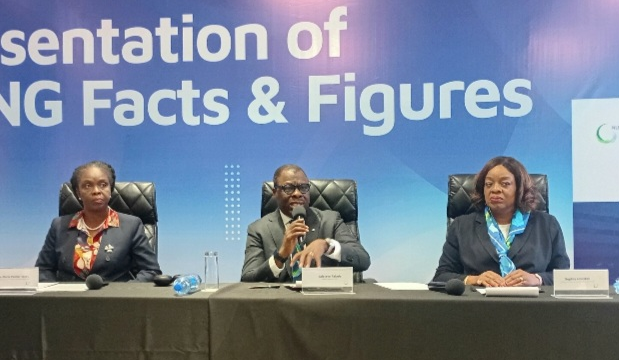
The Managing Director and Chief Executive Officer (CEO) of NLNG, Mr Adeleye Falade, disclosed this at the presentation of NLNG Facts and Figures, an engagement designed to provide insights into NLNG’s business performance, strategic priorities and contributions to Nigeria’s energy sector and sustainable development in Lagos on Tuesday.
He noted that, while the completion of Train 7 remains the company’s immediate priority, it has already commenced strategic discussions and technical assessments to support the next phase of expansion.
According to him, the proposed projects are aimed at consolidating Nigeria’s position in the global LNG market and unlocking greater value from the country’s abundant gas resources.
“Our immediate focus is Train 7, but we have started conversations around what it will take to move to Trains 8, 9 and 10. We have appointed people within the company who are already working on what that future will look like because we must continue to grow,” he said.
The NLNG boss also highlighted the company’s contribution to Nigeria’s economy since commencing operations.
According to him, the company has generated more than $149.6 billion in revenue over the years and distributed almost $50 billion in dividends to shareholders, including the federal government.
He said NLNG has also become one of Nigeria’s highest corporate taxpayers since its pioneer tax status expired, paying about $10 billion in taxes while consistently receiving recognition from the Federal Inland Revenue Service as one of the country’s most tax-compliant companies.
Falade stressed that Nigeria remains more of a gas nation than an oil nation but warned that possessing huge reserves alone would not guarantee future prosperity.
“We have abundant gas resources, but what matters is what we do with them. There is a window of opportunity to monetise these resources before the energy transition progresses further. If we fail to act now, we may lose significant value,” he said.
He noted that although natural gas is widely recognised as the transition fuel in the global quest for cleaner energy, countries with substantial gas reserves must move quickly to develop infrastructure, attract investment and commercialise their resources.
Other News
Drawing comparisons with leading LNG producers such as Qatar, Australia and Malaysia, he said Nigeria’s current LNG production capacity remains disproportionately low relative to its enormous proven gas reserves.
He argued that while many countries with smaller reserves have built significantly larger export capacities, Nigeria has yet to fully exploit its competitive advantage.
The NLNG boss disclosed that the ongoing Train 7 project will increase the company’s production capacity by about 35 per cent, raising total LNG capacity from 22 million tonnes per annum to approximately 30 million tonnes annually.
He added that the expansion would also boost domestic liquefied petroleum gas (LPG) supply by an additional 250,000 tonnes every year, increasing NLNG’s contribution to the local cooking gas market from about 500,000 tonnes to roughly 750,000 tonnes annually.
He explained that the company currently supplies about one-third of Nigeria’s LPG demand, compared with just 70,000 tonnes when domestic supply commenced nearly two decades ago.
Despite the ambitious growth plans, Falade identified inadequate gas supply as NLNG’s biggest operational challenge.
According to him, pipeline vandalism and persistent disruptions to gas supply significantly reduced plant utilisation over the past few years, with the company’s facilities operating at roughly 60 per cent capacity.
“Our biggest challenge remains gas supply. Last year was extremely difficult because of pipeline attacks and supply disruptions. We had several incidents that forced shutdowns and left money on the table,” he said.
He, however, acknowledged improved pipeline security efforts by the Federal Government and security agencies, noting that gas availability has improved considerably this year.
He also confirmed that the force majeure declared by the company due to feed gas constraints remains in effect.
“The force majeure is still in place. Discussions are ongoing and we will only lift it when we are convinced that supply has become sustainably reliable,” he stated.