Follow Us on Google
From Isaac Anumihe and Adline Elechi, Abuja
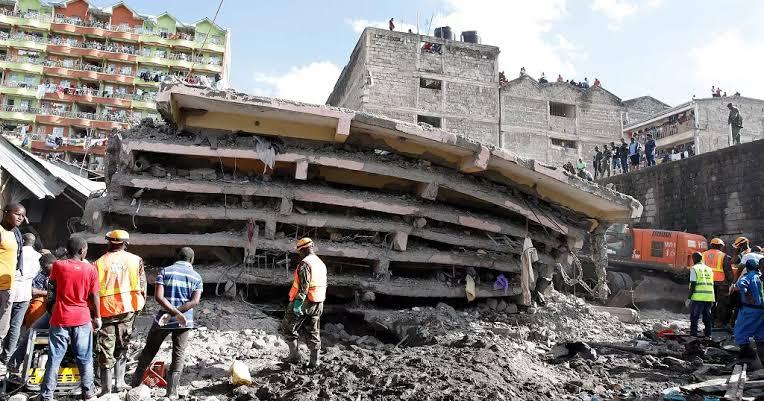
The federal government has decried the spate of building collapses in Nigeria, saying that since 1974, the country has recorded more than 650 building collapses and over 1,600 deaths.
This is as the government also said that the real estate services sector alone accounts for about 13.4 per cent of Nigeria’s Gross Domestic Product (GDP), roughly N41 trillion, making it the third-largest sector, ahead of telecommunications and crude oil.
Speaking at the Stakeholders’ Validation Workshop on the National Housing Data Programme and the Regulation of the Built Environment, the Minister of Housing and Urban Development, Engineer Muttagha Darma, emphasised that almost every one of those buildings had a designer, a builder, and an approving officer, regretting that in most cases, nobody was licensed and nobody was punished.
The minister explained that after the rebasing of the accounts, real estate services alone accounted for about 13.4 per cent of Nigeria’s GDP, roughly N41 trillion.
“It is our third largest sector, ahead of telecommunications and ahead of crude oil. With construction added, the two crossed N77 trillion in 2025.
“What does government earn from that, and what protection does the ordinary Nigerian get? Almost nothing. We regulated banking and got a stable financial system. We regulated telecommunications and turned fewer than half a million telephone lines into over 200 million. We regulated the petroleum and power. We never regulated housing. So, our biggest sector is still the one where a man can print a brochure in the morning, collect a widow’s savings by afternoon, and vanish before nightfall,” Darma said.
On the National Housing Fund, the minister noted that six million Nigerians contribute to the National Housing Fund and the Federal Mortgage Bank of Nigeria (FMBN) collects between N120 billion and N150 billion from them yearly and books fewer than 500 mortgages.
Other News
“Our mortgage-to-GDP ratio is between 0.02 and 0.07 per cent. South Africa is 30 per cent. Britain is 70 per cent. That is not poverty; that is bad plumbing,” he stated.
According to the minister, the National Mortgage Industry Policy (NMIP) establishes the National Housing Finance Authority (NHFA), reforms the FMBN, opens the National Housing Fund (NHF) to traders, artisans, and drivers from N5,000 a month, and builds a proper diaspora window on the $20 billion Nigerians send home each year.
Regarding the controversial housing deficit, which has dominated arguments in the built environment industry for decades, Darma noted that no serious investor can finance arguments. However, he disclosed that the technical committee of the ministry has put the core deficit at about 15 million units, with the North-West and North-East having the highest figures.
“For 20 years we have quarrelled over whether the deficit is 15, 20 or 28 million units. No serious investor finances an argument. Using the World Bank Adequate Housing Index and the UN-Habitat Household Crowding Index, our technical committee puts the core deficit at 15 million units, with the North-West and North-East under heaviest pressure,” he said.
In his remarks, the Permanent Secretary of the Ministry of Housing and Urban Development, Dr Shaibu Belgore, maintained that the housing sector has been challenged by fragmented data systems, which have limited effective planning and reduced investor confidence.
“As we are all aware, Nigeria’s housing sector has for many years been challenged by fragmented data systems, inadequate co-ordination among institutions and weak regulatory enforcement. These limitations have constrained effective planning, reduced investor confidence and affected the overall quality, safety and sustainability of housing development nationwide,” he said.
To this effect, the ministry inaugurated a 13-member National Housing Data Steering Committee, alongside the 20-member technical committee, in August 2024 to develop a sustainable framework for the establishment of the National Housing Data Centre (NHDC).
“Following months of extensive technical work and stakeholder consultations, the technical committee, under the leadership of Dr Taofeeq Olatinwo, submitted its final report in December 2025, which was accepted by the minister as a major intellectual, technical and institutional milestone for the housing sector,” he explained.