Follow Us on Google
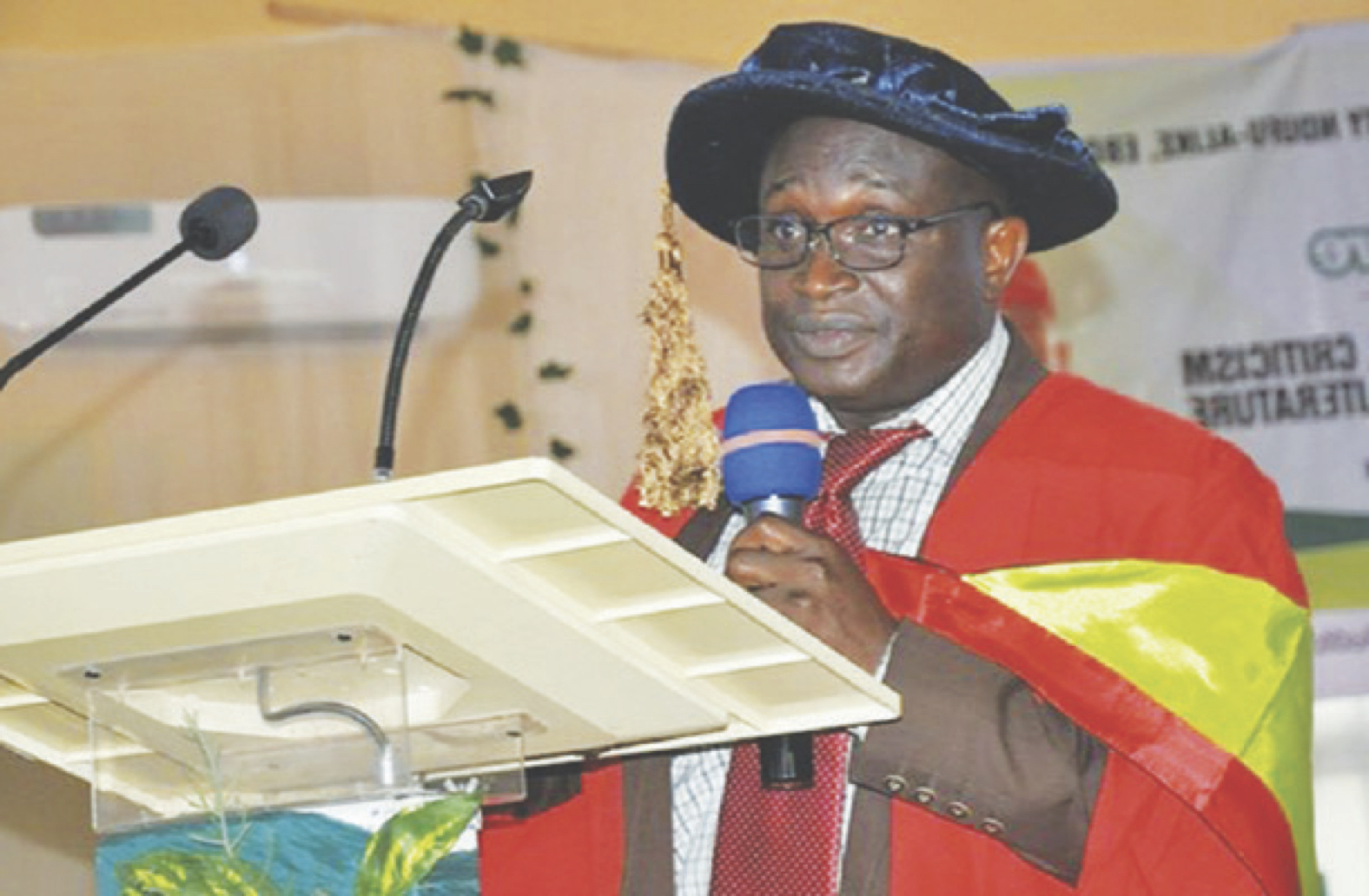
…Says people without varsity education not failures
By Oluseye Ojo
Prof Ameh Dennis Akoh, who served as Deputy Vice-Chancellor (Academic) at Alex Ekwueme Federal University, Ndufu-Alike, Ikwo (AE-FUNAI) in Ebonyi State, from 2020 to 2022, is the first Professor of Drama and Critical Theory in Nigeria.
Currently, he serves at the Department of Theatre Arts of the university. He had served as the Head of Fine and Applied Arts, Director of Research, and Dean, School of Post-Graduate Studies in the university. In 2023, he chaired the Panel of Judges for the Nigeria Prize for Literature.
Akoh was in Ibadan on Sunday October 26, 2025, to celebrate the 80th birthday of Prof Lawrence Olanrele Bamidele, also known as LOB, who retired from the Department of Theatre Arts, University of Ibadan (UI). The celebrant supervised the masters project and doctoral thesis of Akoh in UI.
Akoh, who was the lecturer on the occasion, presented a paper on the theme: ‘The Teacher as Friend: LOB and the Future of Postgraduate Education in Nigeria’.
In this interview after the lecture held at Wole Soyinka Arts Theatre, UI, he noted, among other things, that university education is not for everybody, the crowd is ruining academia, there are professors that are not adding values to the system, and that there is hope for Nigeria’s academia.
In the lecture that you just delivered, you said university education is not meant for everybody. How did you come about this idea, and will the public understand your drive?
I am a student of the celebrant. He supervised my Masters and PhD works at the University of Ibadan. He became a friend, mentor, and father.
It was my idea of a university from the beginning, even as an undergraduate, which made me not lose track of being a teacher. I wanted to be so, and I didn’t miss my way into the academics.
I started teaching in secondary school and earning some small money. Then, I returned for my postgraduate studies. I got to know early enough that the idea of a university is to produce a specialised knowledge. It was meant for the training of a few individuals, who had this specialised knowledge, and who had liberal minds to produce this aspect of knowledge. So, it is not for everybody.
But the fact that you do not have a university degree does not mean you are a failure in life. There are many things you can do in life, which is what I meant. I did not mean to denigrate those who don’t have university degrees.
Everyone can see that there are many people who have degrees, maybe in medicine and they are not practising, in law and they are not practising. I have a lot of them. They may have degrees in Theatre Arts and they are not practising.
Then, you will begin to ask yourself, what is the motivation in the first place to go for university education? Why didn’t they go for the course or programme they wanted? Why couldn’t they go for specialised study?
In advanced countries, there are specialised training academies, where people train for whatever they want to do, not necessarily university degrees. They are trained as artistes; you can be an artiste without necessarily coming to the university; they just need to teach you some rudiments. But academic research is not for everybody.
But what we have found out is that we are having the crowd coming to obtain these degrees and they are not ready for it. But they must obtain it because society seems to dictate so, such that if you have a PhD, it means you are in a particular class, which is not so. Among those of us who organised this programme, we have those of us that are not PhD holders. After the first degrees or masters, they left off. And they are doing well wherever they are.
You said the crowd has come into the university system and has destroyed the moral fabrics of the academia. How?
University is known by its students and its studies or either by the students it produces or the knowledge it produces.
But we are having everybody coming in now to take this degree. They come with different intentions. Some come to obtain knowledge and we can see them, even among lecturers. There are lecturers, who have come into academia, not because they want to add to the body of knowledge, but because they want to take salaries, because the salary of a lecturer is better than that of a civil servant. This is why many of them come into academia, not that they have an idea or have imbibed the idea of a university. That is the crowd. They are coming and we are producing them.
For you to produce knowledge and build capacity in a university, you have to earn up to a doctoral degree. Based on that, when some people come, they find their ways somehow and get these degrees. But they are not able to do much to impart knowledge. That is what is happening. Those are the people I called the crowd.
They are not just people that come to take degrees and go. We have them. These are the ones that are destroying the fabrics more and more because you can’t give what you do not have.
Three years after I left Ibadan (UI) with my PhD, I was appointed as an external examiner because they had confidence in me that there is capacity in me. That is what Ibadan does for you. I was the one that rejected the offer to come back to Ibadan for certain reasons, and that is why I still relate with them very well.
We are saying that let the right people produce the right knowledge. A farmer is doing his work by producing food. A carpenter is doing his work by making chairs. So, let the teacher be the teacher.
What has Nigeria lost to the crowd?
What we have lost is that we have produced and continued to produce an unproductive group of so-called knowledge builders. That is why we are depending on the outside world, virtually on everything.
This is why foreign universities are dictating the direction of our promotion guidelines, because we do not have confidence in what we build within. So, we have lost so much. The government does, and it depends on the university.
In advanced countries, certain policies are tested in the university. Research is given to universities to produce for industry and government needs; such a thing does not happen in Nigeria.
I was once a Director of Research in the university – Alex Ekwueme Federal University. Part of what I saw then was this issue. We are having all of these, and we are not producing.
So, you can see that Nigeria is losing by the day. When the government stands up and is ready with the right policies, it will work.
For example, fund university and make sure that there are stringent guidelines for accessing the fund, ensure stringent guidelines also for moving from one stage to another, and stringent guidelines to become a professor. What value have you added to the system?
Are you saying that there are some professors that are not living up to expectations?
Yes. Valueless. We have many of them. Ask our fathers in academia, they will tell you. The generation to which they belong is better because they assessed us, and they assessed generations that are senior to us. But what do we have behind?
We have a professor who is sitting there. For the past five years, there has been no visibility. You would assume he has retired. A professor is supposed to be researching continuously.
As I was battling to put this idea together for this lecture, I was also responding to a paper that I needed to work on and send; and telling some of my mentees that I gave assignments, to give me a draft of this and that paper. That is it. That is the life of the academia. Without it, you cannot produce knowledge; that is even for those of us in the humanities. This is why the government can think we are not doing anything. In a way, you won’t blame the government. But if the government is ready, you would discover that many people would not come to academia.
If something concrete is not done urgently, how would the future of Nigeria be in respect to the academia?
I asked the question during the lecture that is there any hope or any opportunity? Yes, there is hope. There are also opportunities. But these opportunities must be explored with information technology and the growth of science and technology, whatever. Whether we like it or not, knowledge is accessible now, but it depends on what we want to do with it.
There is no country that has ever progressed beyond the knowledge these universities are able to produce. I can tell you this.
If we allow it to go on like this, and we are more interested in increased admission quota, and we are creating more universities in order to have more students, it will still be a kind of merry-go-round.
Smaller countries, even in Africa, could move ahead of us. But there is hope.
Some days ago, I was teasing my wife, saying ‘Let’s go out of the country’. She said at what age? At 55, you want me to pack my children when my youngest child will be 16 years old in November. I will dislocate them?
I said if what is happening in Nigeria today had happened about 10 to 15 years ago, I would have gone because I had offers. But I preferred to be going and coming.
Still, I believe that a time would come that the value that we are supposed to bring on university education in Nigeria will come.
I still have that confidence that with all the frustration, that it can be done. Any country you go to, you would see Nigerians there, doing so well in arts, science and technology .
So there is hope. But certain policies must be emplaced for us to follow. It is not all about giving hand-outs to universities. It won’t work. People will be taking salaries
For example, why should all professors be taking the same salaries? No. There is nothing like a professors’ salary. There can only be a minimum. What that means is that my productivity will determine whether I would go beyond the minimum. In the United Kingdom, we have Categories A and B of professors. Those are countries where universities are valued because they know what is coming on. This is one of the major things that we need to do. Then, our professors should wake up. Some will retire compulsorily. That is why I said there is hope.
On the way forward, how do we solve the conundrum?
Our society is driven by papers – certificates. It is not necessarily driven by knowledge. If it is driven by knowledge, knowledge empowers. Let me go into the Bible; this is what Jesus meant when he said ‘Ye shall know the truth and the truth shall make thee free.’
The knowledge you have, not that you have been told, becomes part of your possessions, and such knowledge is productive. This is why we are still getting expatriates to do many things for us.
But the moment our institutions of government begin to operate in a knowledge-driven economy, we will not have people crowding the university. We will only see people looking for skills, instead of coming to take papers.
We know the issue; no one should tell me we don’t know it. Our governors, ministers and so on, know it. They travel abroad. Some of them even go abroad to take their certificates.
But it appears that if we are able to produce the kind of knowledge we are talking about, it will disempower the papers.