Follow Us on Google
From Gyang Bere, Jos
The crisis trailing the shortage of naira notes is causing excruciating pains among vegetables sellers across the 17 local government areas of Plateau State. The traders are counting losses as their goods are perishing in the market for lack of sales over scarcity of the redesigned naira notes.
Most of the traders, who were transacting businesses with the old naira notes on account of the Supreme Court ruling, got stuck after President Muhammadu Buhari dashed the hopes of some Nigerians in his nationwide broadcast where he only readmitted N200 notes as legal tender.
The economic policy was received with frustration, anger and disappoinment at Farin-Gada Market, Jos North Local Government Area of Plateau State, where fruits and vegetables are sold and exported outside the state.

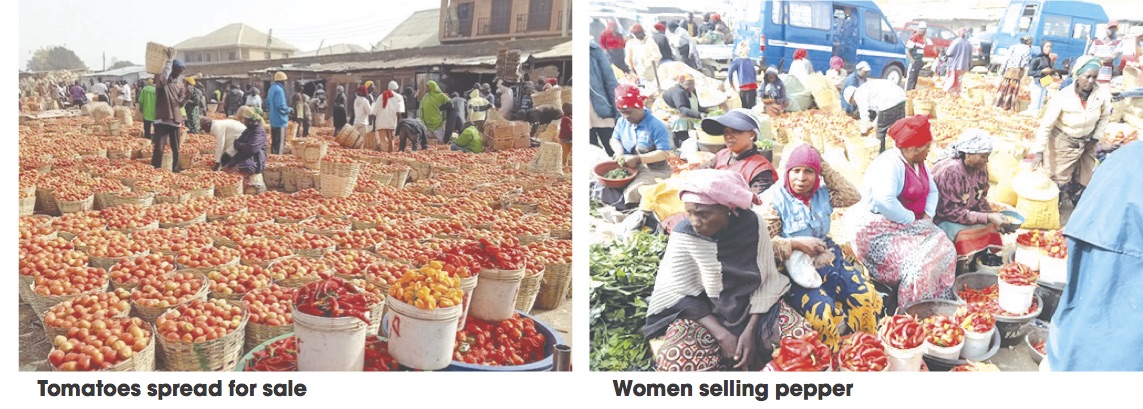
Beauty Joseph, 56, who sold tomatoes, expressed anger and bitterness over her inability to access the redesigned naira notes. She had in her possession over N100,000 old notes, which she collected for her goods 24 hours after the President’s broadcast that dashed her hope.
She became hopeless and helpless with the old naira notes in hand, moving from one POS to another after the President’s broadcast, without getting the desired attention. Beauty is frustrated and passing through hardship as her vegetables are perishing with no one coming to buy for lack of cash.
She said: “It appears the end is coming soon and the reality of the times are setting in. I don’t know where this country is heading to. Look at my tomatoes in baskets perishing without buyers. I sold yesterday and collected old naira notes based on the Supreme Court ruling but, this morning, we heard that the President only reintroduced the old N200 note, while N500 and N1,000 notes cease to be legal tender.

“I have been moving from one POS to another to deposit the money but no one seems to be collecting; it is very sad and frustrating. My tomatoes are going bad. If not for the cool weather, I wouldn’t have anything here to sell. My fear is that, if people do not come in the next two days, the tomatoes will perish.”
Beauty explained further that a basket of tomato that was sold for N15,000 is now sold at the giveaway price of N1,000 and the price keeps declining each hour due to lack of access to the new naira notes.
Danbako Noma, who re-echoed the position of Beauty Joseph, was in possession of about N70,000 old notes when Buhari declared that the old N500 and N1,000 notes ceased to be legal tender. He was left wallowing in despondency and wondering how he could deposit the old naira notes.
Noma, who also sold tomatoes, said: “Since I was born, I have not seen a situation like this. It is horrible, terrifying and very bitter. I hope not to see myelf in this dilemma where my goods are perishing while I have no access to the redesigned naira notes.
“Look at me with the old naira notes, I don’t know where to take them to. The POS operators are rejecting it and customers don’t want to accept it. Imagine that you cannot deposit or withdraw your money; this is where we have found ourselves in this country.
“I appeal to government to implement policies with human face. The hardship, pains and affliction on innocent Nigerians is getting out of hand. Something must be done urgently to address the situation before it degerates into chaos.”
Abdullahi Sani, who sold onions, expressed fear that his onions would spoil in the next few days because of lack of patronage.
“We woke up this morning with the news that the old N500 and N1,000 notes could no longer be used as legal tender. Since the policy was introduced, we have not seen the new naira notes and we have been managing the old notes, which was also scarce, until the ban.
“As we speak, you can see people in the market but nobody is buying anything. Our market has crumbled and people are afraid of bank transfer because the money doesn’t get into the account sometimes. Some people use it to defraud others. Most of the traders here don’t have accounts and those who have do not know how to make transfer,” he said.
Sani explained that a bag of onions, which was sold at N22,000 was now selling at N18,000, yet nobody came to buy. He added that the price was going down every minute because of fear of losing the enitre goods.
He appealed to the Federal Government, the Central Bank of Nigeria and President Buhari to make a swift intervention by reviewing the policy to reflect the realities in the country.
Another trader, Ladiya Monday, who sold pepper at the Faringa Market, lamented lack of cash, saying the policy was designed to inflict pains and hardship on Nigerians.
“Since I came to the market today, I have not sold anything; nobody is coming to even buy pepper because they don’t have cash. That has been the challenge since the policy was introduced and I think government needs to do something urgently to stop the anger of Nigerians because nothing is working at the moment,” she said.
The situation was not different in all the vegetable markets across the state, particularly the Building Materials Market in Bukuru, where farmers and traders have continued to count their losses on a daily basis.