Follow Us on Google
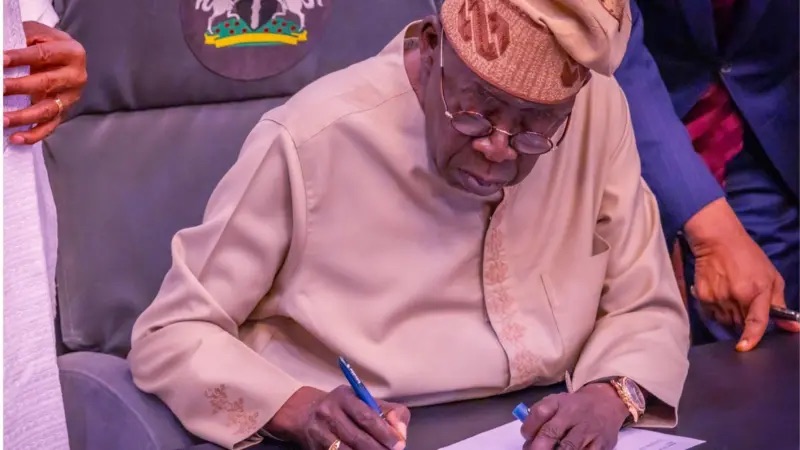
The legal framework that will guide the 2027 general election was put in place with the recent passage and signing of the Electoral Act (Amendment) Bill 2026. The National Assembly passed the bill on Tuesday, February 17. Within 24 hours, President Bola Tinubu swiftly signed it into law. Acknowledging the concerns of many Nigerians on the mode of transmission of election results, the President said many aspects of the voting process were largely manual. According to him, humans still have a role to play in finalizing results as computers can’t do everything.
This has not assuaged the genuine concerns of many Nigerians on manual transfer of election results. The version of the bill the House of Representatives passed in December 2025 was well received by many citizens. It stipulated real-time mandatory e-transmission of election results as against the Senate’s retention of Clause 60(3) of the 2022 Electoral Act which provided for transmission of election results in a manner as prescribed by the Independent National Electoral Commission (INEC).
It was thought that the bipartisan Conference Committee of the National Assembly would adopt the House version during harmonization. But they went for the Senate revised version which made e-transmission mandatory, but with a caveat that manual transfer should be used in areas where there is communication failure. This gives room for manipulation of election results. In the 2023 presidential election, INEC disappointed a lot of Nigerians when it reneged on its promise to transmit the results of the poll real-time to INEC result viewing (IReV) portal. This cast serious doubt on the credibility and outcome of the election.
Besides, to determine network failure during elections and independently confirm it will definitely be contentious. Areas without network coverage are negligible as the Nigerian Communications Commission (NCC) had assured that Nigeria had over 93 per cent of network coverage. INEC had also assured before the 2023 general election that it had the capacity to transmit results real-time from different parts of Nigeria. By now, Nigeria should have advanced towards using not just electronic transfer of election results, but also electronic voting. Election is a key element in a democracy and once the processes are not transparent and credible, the entire democracy itself is undermined.
Electronic transfer of election results, though important, is not the only element that will ensure a credible election. There are some other key factors that combine to make elections credible. Security agents, for instance, must be alive to their responsibilities. Most times, the police stand by while thugs invade polling units to cart away ballot boxes. This has to stop. Security agents must be well equipped to be able to counter violence during elections.
The judiciary should also cooperate in the efforts to make Nigeria’s elections free and fair. The will of the people must prevail, not that of the judiciary. It is disheartening that voters will queue for long hours to cast their votes only for a judge to upturn the collective will of the electorate with a judgement that relies on one technicality or the other.
Other News
Politicians must desist from vote-buying and other electoral malpractices. The practice has hampered the smooth conduct of elections in the country. It is good that the new electoral law criminalizes vote-buying and selling and stipulates higher penalty for the offence. In the 2022 Electoral Act, vote-buying was subsumed under bribery and undue influence clause. It was not a stand-alone offence. Under Section 125(1-2) of the new law, vote-buying, impersonation and result manipulation attract a two-year imprisonment or a fine ranging from N500,000 to N2 million upon conviction. This is a good step.
The electorate must play their part well too. In most recent elections, including the just concluded council elections in the Federal Capital Territory (FCT), voter turnout was too low. This is not encouraging. Rigging will turn out worse if the voters fail to come out to exercise their franchise. People must come out to vote and be ready to defend their votes.
The onus to conduct a seamless election falls largely on the shoulders of INEC. The electoral umpire must have learnt some lessons from the previous elections and should commit itself to making the process better. Presiding officers should realize that Section 60(3) of the new law now makes e-transmission of results to the IReV portal mandatory. Section 60(6) stipulates “a six-month imprisonment or a fine of N500,000 or both against any presiding officer who willfully frustrates the electronic transmission of election results.”
INEC must show some elements of freedom and independence. Logistics and election materials must be provided on time to avoid unnecessary delays that shut people out of the election process.
Good enough, Section 3 of the new Act provides for a dedicated fund established for INEC to ensure financial autonomy, and operational stability. INEC Chairman, Prof. Joash Amupitan, has an opportunity to make history by conducting elections that will minimize the resort by candidates to litigation. He pledged when he assumed office last year to ensure electoral integrity and transparency. The 2027 election is a litmus test for him.