Follow Us on Google

The story behind 5.3m-tonne rice deficit
From Juliana Taiwo-Obalonye and Francis Onyedikachukwu
With Nigerians consuming 8.6 million tonnes of rice annually against local production of just 3.3 million tonnes, insecurity, high costs, poor financing and unreliable data are undermining efforts to close the gap.
Rice is a staple on Nigerian tables, served in homes, restaurants and at social gatherings across the country. But behind the familiar meal is a difficult reality: the farmers expected to keep it affordable and available are battling insecurity, rising production costs and inadequate support.
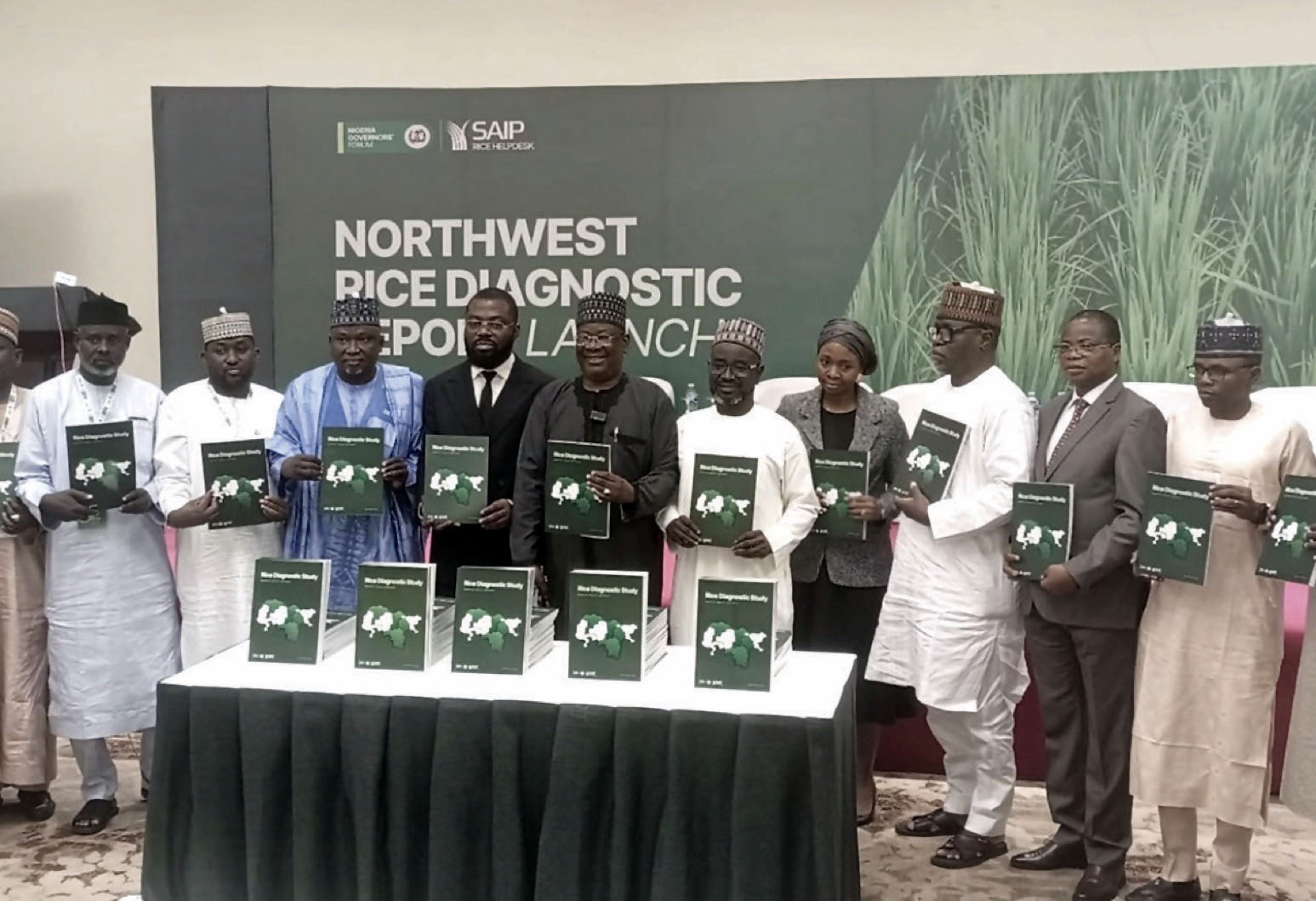
The scale of the challenge emerged in Abuja on November 4, when the Nigerian Governors’ Forum (NGF) and the States Agribusiness Investment Programme (SAIP) Rice Help Desk launched a diagnostic report on the rice sector in the seven Northwest states.
NGF Director-General, Dr Abdulateef Shittu, said Nigeria consumes about 8.6 million metric tonnes of rice annually but produces only 3.3 million tonnes, leaving a deficit of approximately 5.3 million tonnes. Consumption, he warned, could rise to 9.1 million tonnes next year.
The figures expose the gap between the country’s appetite for rice and its capacity to produce enough locally. They also highlight the difficulties facing farmers, processors and policymakers as Nigeria seeks to strengthen food security and reduce dependence on imports.
For farmers, producing more rice is not simply a matter of planting more land. It means being able to reach their farms safely, afford inputs, access machinery and finance, and sell their harvest at sustainable prices. Millers, meanwhile, face high energy costs and difficulties securing enough paddy.
The report, covering Jigawa, Kaduna, Kano, Katsina, Kebbi, Sokoto and Zamfara, examines institutions, public financing, production, processing and agricultural data systems. Launched under the theme, From Diagnostic to Delivery, it identifies constraints and investment opportunities across the value chain.
Shittu said Nigeria had the land and resources to become a net exporter of rice to African countries and parts of Europe, but poor coordination was holding the sector back.
“There is no reason why Nigeria cannot be a net exporter of rice to African countries, and even some parts of Europe. We have the land, we have the resources, we have all that it takes. We just need to coordinate our efforts,” he said.
Yet, for farmers in some of the country’s major rice-producing communities, even getting to the farm has become a challenge.
Insecurity threatens production
Director-General of the Rice Processors Association of Nigeria (RIPAN), Dr Andy Ekwelem, identified insecurity in parts of Kaduna, Katsina, Zamfara and Sokoto as a major threat to rice production.
He questioned how farmers could sustain cultivation when they could not be certain of returning safely from their fields.
“If you have four million farmers registered, can they go to their farms and come back safely?” he asked.
The consequences extend beyond farmers. Millers depend on a steady supply of paddy, and disruptions to cultivation, harvesting and transportation leave processors struggling to obtain raw materials.
Ekwelem said millers were finding it increasingly difficult to source paddy in some areas. He also warned that high local processing and energy costs were making it difficult for Nigerian rice to compete with imports from countries such as Thailand, India and Vietnam.
Financing farmers, not just promises
Even where farmers can reach their fields, the cost of seeds, fertiliser, agrochemicals, labour and land preparation remains a major obstacle. Limited access to affordable credit can determine how much land a smallholder cultivates.
Managing Director and Chief Executive Officer of the Bank of Agriculture, Ayodeji Oludare Sotinrin, said the bank was expanding support through aggregators and input financing.
He disclosed that during the previous wet season, the bank financed 25 aggregators who provided input financing to more than 500,000 farmers. It is targeting at least 700,000 farmers in the current wet season.
But the bank does not provide cash directly to farmers.
“We don’t give cash to farmers. That might be disappointing to some of you in the room. We do input financing,” Sotinrin said.
He explained that the approach was informed by poor loan recovery and the cost of monitoring and recovering loans disbursed directly to individual farmers.
The bank is also considering financing arrangements around about 15 multipurpose dams, including Bakolori Dam, in partnership with aggregators, cooperatives and water users’ associations. It is also pursuing a state matching-fund programme under the Smallholder Support and Value Chain Fund.
Such interventions could improve access to inputs and irrigation, but their impact will depend on how effectively smallholders are reached.
Mechanisation and the cost of doing business
Kaduna State Commissioner for Agriculture, Hon. Murtala Dabo, said his state had secured a N10 billion facility with the Bank of Agriculture for smallholder farmers, with the funds already in the state’s account.
He also disclosed plans to expand mechanisation, with about 2,000 tractors and 10,000 implements initially, and another 2,000 tractors and 14,000 implements expected.
Rather than distribute the equipment to individuals, Dabo said the state would deploy them through mechanisation service providers to make services accessible to farmers.
He estimated that each tractor could mechanise 600 hectares annually, meaning 4,000 tractors could cover 2.4 million hectares in a year.
“For me, I think we need to think through how we do agriculture differently, how we apply a lot of strategy to doing things differently,” he said.
But tractors alone cannot resolve the sector’s problems. Farmers also need quality seeds, fertiliser, extension services, irrigation, storage and access to markets.
Other News
For processors, high energy and operating costs remain a major concern. Ekwelem said these costs make locally processed rice less competitive against imports, adding to the pressure on an industry already struggling with paddy supply.
The challenge is balancing the interests of farmers who need sustainable prices, processors who require affordable raw materials and consumers who want cheaper rice.
Shittu acknowledged the dilemma, saying government was caught between consumers seeking lower prices and farmers and processors who need prices that sustain their businesses.
The data problem
Another major weakness identified at the launch was the lack of reliable agricultural data.
Without accurate information on farmers, cultivated land, yields and production, governments and development partners cannot properly identify needs or measure the impact of interventions.
Ekwelem recalled how inadequate data undermined previous agricultural financing initiatives, including the Anchor Borrowers’ Programme.
“The biggest challenge we had was that we didn’t have data. The second is that we had what we call ghost farmers,” he said.
Kebbi State Commissioner for Agriculture, Hon. Shehu Muazu, said differences in production figures often resulted from inconsistent sampling and data collection. Surveys, he noted, could miss commercial and educated farmers as well as those in remote communities.
He called for common standards for agricultural data collection across state, local and national levels.
“Let all the stakeholders come and sit down together … so that anybody that is looking for information as far as farmers is concerned, or yield is concerned, he knows,” he said.
Muazu said Kebbi planned to establish a dedicated rice desk, with adequate staff and a budget line, and convene a stakeholders’ summit to develop a four-year rice development plan.
Shittu described data as “the next oil”, stressing that reliable information was essential for planning and development. He said the NGF had a dedicated data department and was encouraging states to strengthen their bureaux of statistics.
Women and young people in the value chain
The report also highlights the need to give women and young people better access to land, finance, machinery, technical advice and markets.
Programme Manager, Mr Eghosa Omoigui, said they were already active in the rice economy but needed greater support to participate and grow their businesses.
“Women and young people must be at the centre of this effort. They already exist and are active in the rice economy, but they need better access to land, finance, machinery, advice and markets,” he said.
He identified women-led aggregation and service businesses as opportunities to expand participation and strengthen the value chain.
From diagnosis to delivery
The NGF and its partners say the report is intended to guide practical interventions across the seven states.
Executive Director, Programmes and Partnerships, Ahmed Abdulwahab, said the state-by-state assessments examined institutions, public finance, production, processing and information systems.
He said the SAIP Rice Help Desk was established within the NGF Secretariat because state governments were well positioned to identify priorities and shape interventions suited to local conditions.
“A diagnosis is only the beginning. Its value lies entirely in what we do with it,” Abdulwahab said.
The programme received support from the Bill & Melinda Gates Foundation. Development partners at the launch also stressed that the report must lead to implementation.
A representative of the German development agency, Deutsche Gesellschaft für Internationale Zusammenarbeit (GIZ), funded by the German Government, said the diagnostic exercise involved consultations with farmer organisations, processors and other value-chain actors, as well as reviews of state policies and budgets.
The representative congratulated the NGF under its Chairman, Governor AbdulRahman AbdulRazaq of Kwara State, and acknowledged the foundation’s support.
“Today’s launch is not merely the unveiling of a document; it is the official starting gun for implementation,” the representative said.
GIZ reaffirmed its commitment to working with state governments, the NGF, financial institutions and the private sector to strengthen governance, data systems and investment readiness.
It added: “A diagnostic is only as impactful as the transformative actions it inspires on the ground.”
An official representing AGRA Nigeria Country Director, Rufus Idris, also stressed the importance of digitalisation and reliable agricultural data in identifying constraints, shaping policies and guiding investment.
“Data can help governments and partners better understand the binding constraints, design better policies, make investment decisions, and monitor progress,” the representative said.
The messages reinforced the central challenge facing the sector: Nigeria must turn its agricultural potential into measurable improvements in production.
The 5.3-million-tonne gap is not merely a statistic. It reflects the difficulties confronting farmers who need security and affordable inputs, millers who need reliable paddy supplies and consumers who need affordable food.
Closing it will require consistent policies, effective financing, better data, improved infrastructure and coordination across the value chain.
Ultimately, the success of the Northwest diagnostic will not be measured by the report’s recommendations or the number of meetings held. It will be measured by whether farmers can return safely to their fields, produce more rice and earn sustainable incomes, while processors can operate competitively and consumers have access to affordable locally produced rice.
Rice may remain a staple on Nigerian tables but closing the gap begins with tackling the struggles on the fields where it is grown.