Follow Us on Google

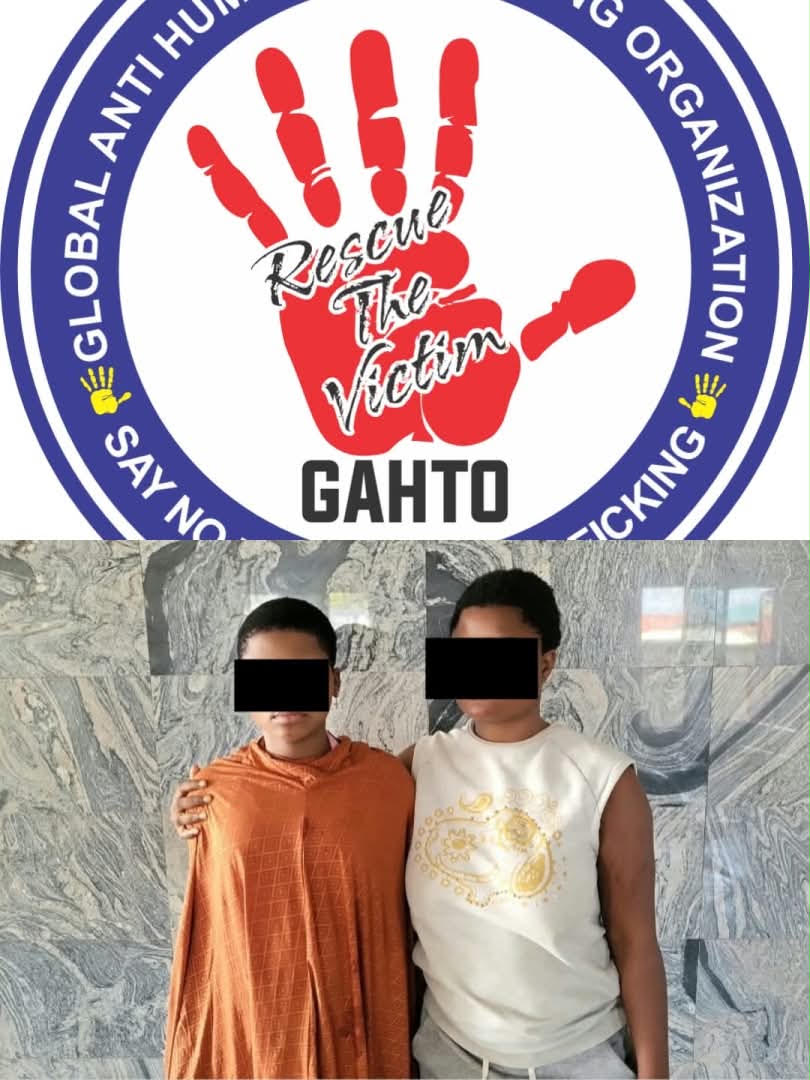
Two Nigerian girls have been rescued after allegedly being trafficked to Mali for sexual exploitation, exposing the growing danger posed by human trafficking networks targeting vulnerable Nigerians with fake job offers.
One of the victims is a 16-year-old girl from Delta State who should ordinarily be in school, while the other, identified as Joy, 24, from Akwa Ibom State, is a fashion designer who was allegedly lured to Mali with a promise of employment in a fashion design shop.
The Founder of the Global Anti-Human Trafficking Organisation (GAHTO), Prosper Michael, said the rescue underscored the need for concerted efforts to tackle human trafficking in Nigeria.
“It is no longer hidden that we are facing a trafficking problem in Nigeria, but the way to eradicate it should be our concern now,” he said.
Michael called for grassroots empowerment, particularly for vulnerable children and young people who lack access to education and vocational training.
He said the Renewed Hope Initiative, spearheaded by the First Lady, Senator Oluremi Tinubu, should be extended to communities across the country to ensure that more Nigerians benefit from its programmes.
He stressed that empowerment initiatives should be implemented without political considerations to guarantee that the intended beneficiaries were reached.
According to him, some young people who undergo skills acquisition programmes are unable to establish themselves because they cannot afford the materials and equipment needed to practise their trades.
He said the Renewed Hope Initiative could address this challenge by providing such support, thereby reducing the vulnerability of young people to human trafficking.
“I am using this opportunity to call the attention of all state first ladies to do more in their respective states, especially the Delta State First Lady, to see how the 16-year-old girl can return to school. She is currently under the custody of NAPTIP Benin Zonal Command.
“We will all fight this trafficking problem together, as thousands of our citizens are stranded in different countries, looking for help to be rescued from sexual and labour exploitation,” he said.
Michael described the trafficking of underage girls for sexual exploitation as embarrassing and unacceptable, stressing the need to make empowerment programmes accessible to vulnerable children before traffickers prey on them.
He also called for greater efforts to rescue Nigerians already trapped in exploitative situations abroad.
“Every day, our citizens are trafficked to West African and North African countries in search of greener pastures, but they end up in sexual and labour exploitation. They are many, and the burden is on us, as they continue to call for rescue and return to Nigeria,” he said.
He urged wealthy Nigerians, including millionaires and billionaires, to contribute more towards addressing the problem.
According to him, rescuing trafficked persons and bringing them back to Nigeria is only one part of the challenge, as providing them with sustainable means of livelihood after their return is equally important.
He warned that without proper rehabilitation and economic empowerment, some survivors could become vulnerable to being recruited into trafficking networks themselves in their struggle to survive.
Narrating her ordeal, the 16-year-old girl, whose identity is being withheld for safety reasons, said she hailed from the Urhobo area of Delta State and had completed Primary Six but was no longer attending school.
She said her parents were divorced, adding that her mother lived elsewhere with her two daughters, while she stayed with her grandmother.
According to her, her father had remarried and stopped communicating with her after telling her not to call him again, following repeated requests by her mother for financial assistance to support her education.
She said a woman from her village approached her with an offer to travel abroad to sell goods in a market.
The girl said the woman warned her not to disclose the journey to anybody. She, however, confided in a neighbour but did not inform her grandmother.
She said she travelled with another girl, aged 17, who eventually agreed to engage in the work they were offered.
According to her, the journey to Mali lasted about four days by road.
On arrival, she said she discovered that the job was different from what she had been promised. Although she initially refused, she was allegedly forced into the business and made to continue for about three weeks.
She alleged that the woman in charge threatened to beat her whenever she resisted, prompting her to look for an opportunity to escape.
The teenager further alleged that her traffickers administered injections to her, describing them as protective medication, without adequately explaining their purpose or obtaining her informed consent.
She said a Good Samaritan eventually came to her assistance and later contacted GAHTO, which facilitated efforts towards her return to Nigeria.
The victim said neither her mother nor her father knew she had travelled to Mali.
Joy, the second victim, said she was based in Port Harcourt, Rivers State, and had been searching for employment to enable her to save money and establish her own fashion shop.
She said a neighbour, whom she regarded as a friend and brother, approached her on September 8, 2026, with an employment offer.
According to her, the neighbour claimed that his brother-in-law owned a large fashion design and boutique business in Mali and needed her services.
Joy said she made it clear before agreeing to travel that she would never engage in prostitution, irrespective of the circumstances.
She said the neighbour repeatedly assured her that the job had nothing to do with prostitution, reminding her that she had previously stayed at his residence for some days when her own house was undergoing construction.
“He told me that I was like a sister to him and asked how he could send me out for prostitution. He said I should go and make money so that I could return and help my younger ones,” she recounted.
Joy said she had neither a father nor a mother and received little or no support from her family.
She described herself as the breadwinner of her family, saying her desire to improve their living conditions influenced her decision to accept the offer.
She said she made preparations on September 9 and travelled the following day, September 10, 2026.
According to her, she and her friend travelled from Port Harcourt to Lagos State, where they met an agent who was to facilitate their journey across the border.
She said they crossed into the Benin Republic through the Cotonou route before boarding a vehicle from a motor park directly to Mali.
The journey, she said, lasted about two and a half days.
Joy said that on arriving in Mali in the evening, she became suspicious when the driver took them through a bushy route.
She said she questioned the driver and asked him to stop, but he explained that the route was chosen for security reasons and to avoid arrest.
She said the driver spoke English despite Mali being a predominantly French-speaking country, while her friend urged her to remain calm, suggesting that the unusual route might have been for security purposes.
She said they eventually arrived at a village in Mali called Nyala, where she was shocked by the environment.
According to her, she had never found herself in such a setting before. She said some women in the compound came out half-dressed, soliciting customers, making her realise immediately that the promised fashion business did not exist.
Joy said when the man in charge came out, she greeted him and demanded to be shown the place where she would work.
She said the man asked her to relax, take a bath and eat, promising that they would visit the workplace the following day.
However, a woman from Akwa Ibom State allegedly approached her and disclosed that there was no fashion design shop and that the actual business was prostitution.
She said the revelation triggered an argument between her and the people in charge, as she became furious over what she described as a deliberate deception.
According to her, while her friend was willing to accept the arrangement, she remained determined not to engage in prostitution.
She said standing her ground was difficult, alleging that she was subjected to beatings and molestation for refusing to cooperate.
Joy said she spent one month and two weeks in the compound, desperately looking for an opportunity to escape.
She explained that escaping was particularly difficult because Mali was a French-speaking country and she could not move around freely without attracting suspicion.
She further alleged that the traffickers enjoyed the cooperation of some security personnel, whom they allegedly paid every weekend.
Joy said she consistently refused to engage in what the traffickers described as hustling.
She alleged that men were brought into her room at night and forced on her, despite her resistance, adding that victims who refused to cooperate were beaten and threatened.
She said one morning, she woke up with a strong determination to escape and decided that she would leave the compound that day.
According to her, she followed her instincts, got up and walked out of the compound, eventually finding a way to escape the situation.
The accounts of the two survivors have renewed concerns over the growing use of fake employment opportunities to lure young Nigerians into sexual and labour exploitation abroad.
They have also highlighted the vulnerability of out-of-school children, young women from economically disadvantaged families and job seekers who are desperate for opportunities to improve their living conditions.
Child protection and anti-trafficking advocates have stressed the need for urgent counselling, medical attention, temporary shelter and adequate protection for survivors.
They have also called on relevant security agencies and the National Agency for the Prohibition of Trafficking in Persons (NAPTIP) to investigate the alleged traffickers and their local and international networks, with a view to bringing those responsible to justice.