Follow Us on Google
By Bianca Iboma-Emefu
The principal of Rochester International School, Lagos, Mrs. Benedicta Onwuchekwa, has called for dialogue, inclusiveness and mutual respect as a means of resolving conflicts across the country, among ethnic groups, especially in Lagos, where children from different tribes study together.
Onwuchekwa stressed the need for parents to encourage efforts aimed at ensuring peaceful co-existence and stability among children, as ethnic bigotry in the last election has raised questions from children.
She said what happened in the last general election caused a lot of division and ethnic bigotry, which may affect the mental state of the students.
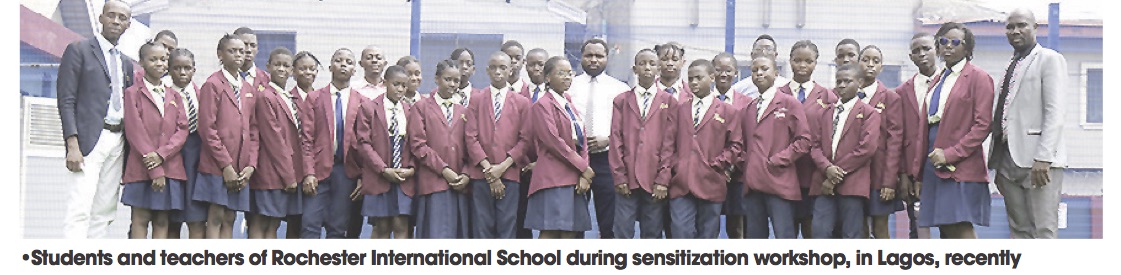
Onwuchekwa disclosed this at a workshop organized by the school, tagged: ‘The role of language in global security; peace and conflict resolution’. The event was to sensitize the students on the use of positive language and its impact on conflict resolution.
She said: “After the election, a lot of Nigerians became hurt, made certain derogatory statements without knowing the children were watching and could emulate them. To prevent any form of disunity, there was a need to educate the children.
“The children need to know why we must shun violence and enthrone peace, language use and the means of communication is important in promoting peaceful habitation.”
Onwuchekwa said “every child must know about peace and conflict resolution; and how they can build their capacity for peace” all aimed at ensuring harmonious co-existence in the nation.
The executive director of the school, Mrs. Ifunanya Uzochukwu-Emedolu, recommended the inclusion of peace education and conflict management in the school curriculum in Nigeria.
Uzochukwu-Emedolu said it was a welcome development and urged Nigerians to encourage any effort that would usher in peace in the country.
Speaking on the need to inculcate conflict resolution skills in pupils/students as well as other young Nigerians, she said the teaching of peace initiative in school remains a potent force to address the problem of insecurity and other crises in the country.
She stated that the events of February 25 and March 18 created unrest in the minds of these children, as a lot of them came to make enquiries on how they should relate with other students from different ethnic backgrounds.
She said: “This gave rise to the sensitization workshop, in order to clear the air among them, despite the explanation we gave them,we saw the need for advocacy.
“Rochester is a leadership school, the students needed the leadership training for them to have an understanding. Leadership remain a core part of the culture here. We are delighted to raise children who can think, see beyond the surface and create strategies for solving problems.
“I want the children who pass through my school to have the best foundation possible. It is a tough world and they must be equipped to do well.
“We should welcome all efforts to set down reflections on what is no less than a crisis of humanity. Attention to the place of children in conflict resolution is especially encouraging – ‘catch them young’ being a sound principle of nation building.
“I realised that it is important in the context of Nigeria to address conflicts. It is important to build capacity among children, among youths, among citizens for peaceful engagement and to be able to address conflict in a way that facilitates peaceful coexistence.”
The head of the department of humanities, in the school, Mr. JohnPaul Iwu, stressed that the event couldn’t have come at a better time than now, when the country is in dire need of dialogue and conversations, that are geared towards peace, unity and national cohesion.
Iwu added that the rapid escalation of violence and other related crimes in different parts of Nigeria was not far from the lack of attention given to dialogue and adherence to peace process.
He further explained, that if all-inclusive dialogue was encouraged in secondary schools, the next generation of Nigerian leaders will not see violence as a means towards conflict resolution and management
Iwu enjoined the children to be wary of causes of conflicts and factors that can hinder peace and impinge on friendship.
On his part, head of department, language, Mr. Chijioke Nwaoha, who presented a paper on ‘The role of language in global security peace and conflict resolution’, said language is the most important and unique property of man because it enhances communication which is basic requirements in the life of any group of people. Human use language as a powerful tool to ensure peace and security.
Nwaoha said the former president Good luck Ebele Jonathan is a worthy peace and conflict resolution ambassador who should be emulated. Jonathan chooses words and has never said anything that can create ethnic tension he pointed out.
He explained further that peace is kept in our social relationship and is important in nation building.
60% of conflicts are among peers but we have to stem them from negative body language.
“Body language can tell a lot about how a person feels.
Keeping your body language in check takes some serious effort. In most instances, you may not even know you are doing it and you may be hurting someone in the process.
” A slumped posture can demonstrate a lack of confidence or boredom. Averted eye contact can be an indicator or even lying. Crossed arms can signal defensiveness or disagreement. A forced smile can mean insincerity. How amazing is it that the body can communicate so many things without the person speaking a word.”