Follow Us on Google
By Chekwube Nzomiwu
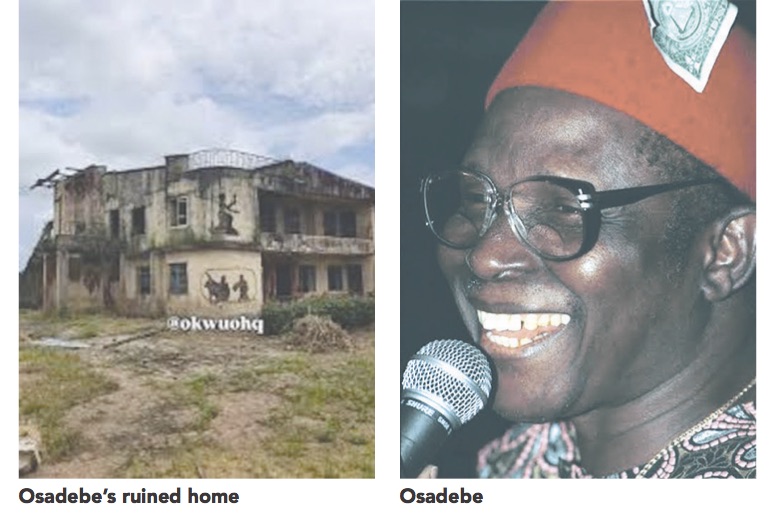
Recently, I saw a trending video of a dilapidated one-storey building said to be the country home and resting place of late highlife music maestro, late High Chief Stephen Osita Osadebe. The building is located at Atani town, on the Eastern Bank of the River Niger, in Ogbaru Local Government Area of Anambra State, Southeastern Nigeria. The voice at the background said Osadebe’s home lying in ruins shows the vanity of life.
The music legend died in St. Mary’s Hospital Waterbury Connecticut, United States of America on May 11, 2007 at the age of 71. From what I gathered, most of his children now live abroad, far from the place the “Oso ndi Owendi” crooner once called home, which is now lying in ruins.
Although Osadebe predominantly sang in Igbo language, his music is global. Born March 17, 1936 in Atani, Osadebe left his job as a clerk in SCOA to begin a singing career in Lagos, Southwestern Nigeria, performing in several nightclubs and social events.
His unique brand of music, combined Igbo traditional music elements with calypso, samba, bolero, rumba and jazz, among others. At the peak of his career, his performances took him beyond Africa, to different European countries and the United States of America, where he eventually died. He titled one of his last albums released in 1996 “Kedu America,” meaning “How are you doing America?” Even in death, Osadebe remains one of the most influential musicians in Nigeria’s highlife music genre.
Besides “Oso ndi Owendi,” which Nigerian pioneer rapper/hip hop artist, late Obiajulu Nwozor, popularly known as MC Loph, attempted to recreate with Chinedu Okoli (Aka Flavour), many of Osadebe’s songs such as “Makojo, Aye Mama, An’Edo Social Club, Jesu Bu Onye Ndu, Yoba Chukwu,” are still “radio hits” today. With the convergence of the old and new media, 18 years after the transition of this genius, thousands of people across the world still stream and download his songs in music apps, such as YouTube Music, Boomplay, YT Music, Spotify, among others.
Given Osadebe’s accomplishments, the video of his ruined home pained me, not only because of the condition of the house where he once lived, but the nonchalant attitude of Nigerians to this ugly development. I will quote two comments from Phoenix news to buttress this point. Responding to the person who created the video, Odoemelam Victor wrote: “ask him, who will live there if they renovate it? Similarly, Michael Gbenga wrote: “where are his children and wives?”
These responses baffled me seriously because I know that the late Osadebe needs nobody to immortalize him. His evergreen songs have already immortalized him. The house lying in ruins was not build with stolen government money or funds from other illegitimate sources but with money he made by combining his music talent and hard work.
However, in other climes, nothing is spared to preserve the legacies of great men like Osita Osadebe. In Nigeria, we allow the legacies of our heroes to die with them. This is reprehensible.
Musicians like the Beatles and Bob Marley have museums dedicated to their memory. The Beatles Museum is in Liverpool, England. Visitors to the museum follow the history of the Beatles through recreated sets. Anybody who visits the museum will see remarkable memorabilia, including George Harrison’s first guitar and John Lennon’s glasses. Lennon was the person who formed the band and was most instrumental in its development as a group. The Beatles made global impact as a rock band in the 1960s. Their performances took them beyond the United Kingdom to the United States of America and other parts of the world. Their music had impact on generations that followed.
Similarly, a visitor to Kingston, Jamaica today can see the Bob Marley Museum, located on the site of the Reggae musician’s home. Elvis Presley’s mansion, now known as Graceland Museum is listed on the National Register of Historic Places in the United States of America. A visitor to the mansion, built on a 120-acre estate, can walk through the life of Presley. This is to mention but a few.
Osadebe’s home lying in ruins in Atani can be converted to a music museum. The instruments and costumes he used, if they are still available, can be displayed in the museum, to enable visitors walk through his life. Osadebe home can host annual international music festivals, which will attract lovers of music from across the world.
Highlife music is part of the Nigerian culture. We have Federal Ministry of Art, Culture, Tourism and Creative Economy, headed by Honourable Minister, Hannatu Musa Musawa Esq. Osadebe’s home in Atani is a “goldmine” for Nigeria waiting for Musawa to harness as part of Federal Government’s $100 billion Creative Economy Growth Plan to Corporate Nigeria.
In Anambra State, there is a Ministry of Culture and Entertainment, headed by Donatus Onyeji, a distinguished broadcaster. Onitsha, the commercial city of Anambra State used to be a hub for highlife music lovers in Eastern Nigeria. This can be reinvented by the state government either on its own or in collaboration with the private sector.
The N2 billion being used by Governor Charles Soludo to build his so-called “iconic tower” in Ekwulobia can be used to recycle Osadebe’s ruined home into an entertainment hub for traders living in Onitsha and environs to go and hang out at weekends. Sincerely, I hate to talk about the whooping N12 billion lavished by Governor Soludo in building the “unprofitable” Awka Fun City for students and civil servants earning N70 thousand minimum wage. I challenge him to publicise how much so far realised from the Fun City since it was commissioned in June.
I will conclude by calling on the Federal Government and Anambra State government to rise to the occasion and convert Osadebe’s home from waste to wealth. They can do this in collaboration with the private sector. Often, government in Nigeria pays lip service to the diversification of the economy. Time is rife for us to match our words with action. The world has left us behind. We must catch up.
• Dr. Nzomiwu MNPIR is the Director of Media and Publicity, Development Communication Research Association of Nigeria (DECRAN). Reactions are welcome via [email protected] and WhatsApp number: 08037752672