Follow Us on Google
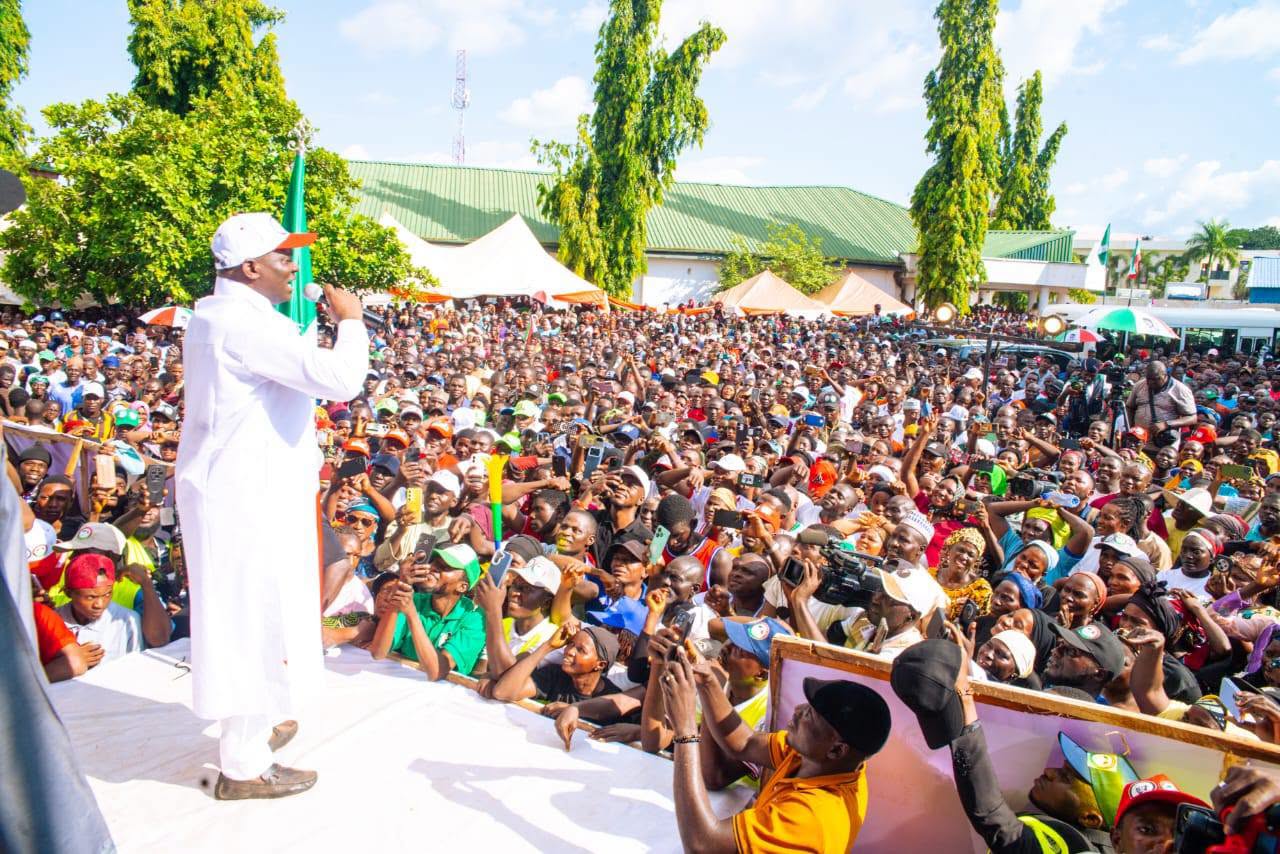
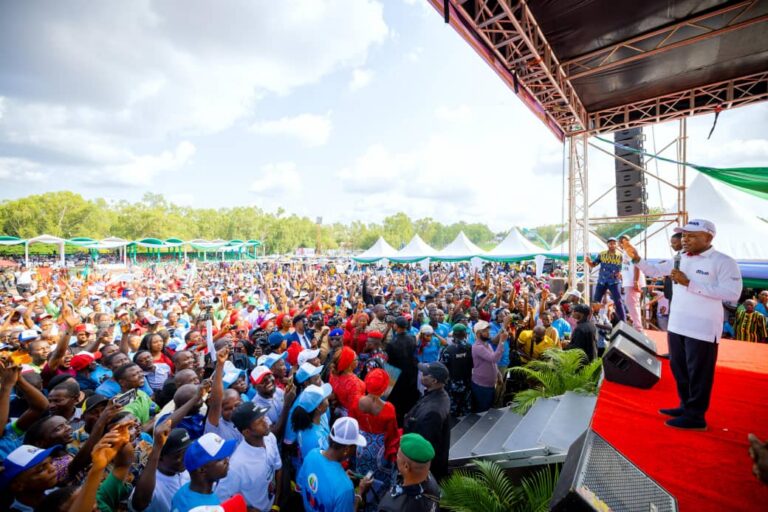
The 2027 governorship race in Nasarawa State may have entered a new phase following the massive crowd that turned out in Lafia on Saturday for the formal flag-off of the campaign of the Peoples Democratic Party (PDP) candidate, Dr David Emmanuel Ombugadu.
What happened at the flag-off was bigger than the unveiling of a campaign structure or the presentation of a candidate before party supporters. It was a public demonstration of political organisation at a time when the contest for the Government House, Lafia, is gradually moving from private consultations, endorsements and party calculations into full-scale mobilisation.
The size of the crowd immediately raised a bigger question: what does a rally of this magnitude mean for the 2027 contest?
For the PDP, it provides an opportunity to demonstrate that its 2027 campaign has moved beyond the internal arrangements that produced Ombugadu as its candidate and into the wider electorate.
The party had earlier affirmed Ombugadu as its governorship candidate after a consensus process, with the candidate promising that the party’s campaign would be built around a blueprint for the state. Saturday’s flag-off therefore came at an important moment.
Only two days earlier, the Eggon Political Forum had adopted Ombugadu as its preferred consensus candidate after considering six Eggon governorship aspirants. The forum said it considered factors including grassroots presence, party structures, political experience, previous public records and candidates’ manifestoes.
That development, however, has not translated into a claim of unanimous Eggon support.
President of Eggon Youth Nationwide and the Eggon Cultural Development Association, Friday Haruna, who witnessed the forum’s meeting, said wider consultations among Eggon stakeholders were still necessary before a broader collective position could be established.
That distinction is important because the crowd at a political rally, like an endorsement by a political forum, is evidence of mobilisation, but it is not by itself an electoral result.
The significance of the Lafia flag-off may therefore lie less in predicting the result of the election and more in the benchmark it has created for the campaigns that will follow.
Candidates of the APC, ADC, Labour Party, NDC and other political parties will now have to mobilise their own supporters and present their programmes to the electorate.
The APC, for instance, has already completed important aspects of its own political preparations. Senator Ahmed Aliyu Wadada emerged as the party’s governorship candidate, while Emmanuel Ombugadu was subsequently unveiled as his running mate following consultations among party stakeholders. Governor Abdullahi Sule said the decision was intended to promote unity within the party ahead of the election.
The PDP and APC are therefore approaching the 2027 contest from different political circumstances.
While the APC enters the election as the governing party in Nasarawa, the PDP enters it with Ombugadu, a candidate who was the party’s 2023 flag bearer and who mounted a strong challenge against Governor Sule.
Official figures from the 2023 governorship election show that Sule polled 347,209 votes against Ombugadu’s 283,016. That previous result gives Saturday’s mobilisation an important context.
Ombugadu is not entering the 2027 contest as an unknown candidate. He is attempting to rebuild and expand an electoral base that already demonstrated considerable strength in the last governorship election.
The crowd and the real political question
The most visible feature of the flag-off was the crowd.
But political analysts caution that crowd size should not automatically be translated into votes. Campaign rallies measure mobilisation capacity. Elections measure something different: the ability to convert political support into accredited voters and actual ballots across polling units.
That distinction has become increasingly important as Nigeria moves towards the 2027 elections.
Recent political analysis has similarly cautioned against treating political structures, defections and rallies as automatic evidence of electoral support.
Other News
Channels Television, in its latest political analysis, noted that the real test increasingly lies in evidence from voters and ballots rather than political declarations and claims of control.
For Ombugadu, therefore, the challenge after Saturday is to sustain the energy displayed at the flag-off beyond the rally ground. Can the crowd be converted into ward-level organisation? Can the campaign reach rural communities? Can the party maintain its structures across the 13 local government areas? Can it persuade undecided voters who did not attend the rally? And, perhaps most importantly, can the promises made at the campaign become a clear proposition that voters can compare with those of other candidates?
This is where the next phase of the campaign becomes particularly important. Ombugadu and the PDP have indicated that their campaign will be built around a five-year plan for Nasarawa, with emphasis on areas including security, agriculture, healthcare, jobs and human development.
The candidate has previously said the 2027 manifesto would build on the PDP’s earlier policy documents while focusing on projects and programmes intended to benefit residents.
The real test will be the details: how much will the programme cost? Where will the money come from? Which projects will be completed in the first 100 days, one year or five years? What will happen to existing projects? What will be the administration’s approach to the state’s growing mining economy? How will farmers be protected? What is the plan for healthcare financing and access? How will youth unemployment be tackled?
And what institutional reforms will accompany the promises? These are the questions that can transform a campaign rally into an issue-based political contest.
One likely consequence of the Lafia flag-off is that other candidates will now be under pressure to match its level of organisation and public mobilisation. That does not necessarily mean copying the exact format of the rally.
It could mean larger grassroots meetings, stronger digital campaigns, more elaborate manifestoes, greater involvement of women and youth groups, more local government-level mobilisation and more aggressive presentation of policy alternatives.
In that sense, Saturday’s event may have changed the political conversation even beyond the PDP. The next major rallies will inevitably be compared with it, not necessarily because crowd size determines elections, but because voters and political observers now have a visible reference point for the level of mobilisation expected from the major contenders.
But the opposition has questions to answer too because the size of a rally does not remove the challenges confronting the PDP.
The party must maintain unity, manage competing interests and ensure that the enthusiasm generated at the flag-off reaches the grassroots.
It must also convince voters that its candidate offers something substantially different from the governing APC.
The APC, on the other hand, has its own challenge, demonstrating that its structures, incumbency advantage and succession arrangement can translate into sustained grassroots support.
Recent reporting has highlighted questions around the management of divisions arising from the APC’s governorship primary, including the movement of former Inspector-General of Police Mohammed Adamu to the SDP. The emergence of other candidates has also widened the contest.
INEC’s published list includes candidates from the APC, PDP, SDP, Labour Party, ADC, APGA, ADP, NDC and other parties, meaning the 2027 race cannot simply be reduced to a two-party contest on paper.
Perhaps the most important message from Saturday’s flag-off is that the Nasarawa contest has moved from the stage of political speculation to competitive public mobilisation.
For months, politicians have been holding consultations, making defections, seeking endorsements and building campaign structures. Now the people are beginning to see the contestants physically before them. That changes the nature of the contest.
Every candidate will increasingly be forced to answer the same basic questions: Who are you? What do you want to do? How will you do it? How much will it cost? What have you done before? And why should voters entrust you with the state?
For Ombugadu, Saturday provided the first major opportunity to put those questions before a mass audience.
For his opponents, it has provided a reference point. And for the electorate, the real work has only begun. The crowd can make a political statement. The manifesto can make a policy statement. But ultimately, it is the voters who will decide whether the energy seen at campaign grounds translates into votes at polling units.
That is why the real significance of Ombugadu’s flag-off may not be what happened on Saturday alone, but what every candidate does from Monday onward.