Follow Us on Google
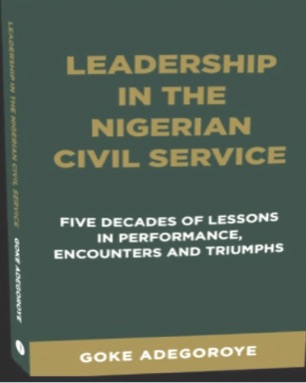
Title: Leadership in the Nigerian Civil Service – Five Decades of Lessons in Performance, Encounters and Triumphs
Pages: 420
Author: Goke Adegoroye
Publisher: Kachifo Limited, Lagos, Nigeria
Year: 2025
Reviewer: Abdullahi Shehu
This scintillating 12-chapter book dedicated to Nigeria, acknowledges the contributions of various individuals and organizations that shaped the author’s profile in public service, especially his advocacy for leadership integrity, which he termed “my Ministry”. The preface of the book, written by the author himself, begins with a captivating statement that “leadership remains the single important determinant in management and governance” and that is why he anchored his “service on a commitment to integrity as the foundation for leadership”. He, however, recognized from the outset that “leadership is neither a straight path nor an easy sail”.
The author did not leave anyone in doubt regarding the purpose of his writing the book – which is to “provide learning material to today and tomorrow’s leaders”. This is commendable not only because of the courage to reflect on some of the difficult and challenging moments in his career, but also because of the dearth of proper account of professional experiences and legacies that senior public servants could provide to enrich the reservoir of knowledge on leadership and governance.
The book is structured into 12 chapters, each focusing on a specific and pertinent issue of leadership and effectiveness of the civil service. Leadership is about mentoring – the transmission of values. The author gives an account of his journey in leadership in chapter one, including the values that shaped his vision and career development. He recalled the episode that reinforced his conviction that “leadership must balance accountability with compassion” (p.6) and rolled out his transformation from ‘science and academic to civil service not by design or personal ambition, but by sheer accident of circumstances’. To that extent, we can say that Dr. Adegoroye was an ‘accidental civil servant’ and his account is a testament that people who carve a niche in different fields and make tremendous impacts are probably accidental this and that.
The author gives an account of his transition into environmental management at the Federal Environmental Protection Agency (FEPA) to his regularization into the main stream civil service, which began with two women: Dr. Selina Adjebeng Assem and Mrs. Comfort Owolabi who helped to redirect his path from science and academic to public service. Dr. Selina Assem, a post-graduate student colleague of his in Canada recommended him to participate in an expert meeting at the International Centre of Insect Physiology and Ecology (ICIPE), in Kenya, reconnecting him with his international research and academic base; while Mrs. Owolabi, then a staff of FEPA, was the person who encouraged him to apply for a job as Assistant Director in FEPA which eventually launched him into the environment policy space.
Chapter two brings out Dr. Adegoroye’s trait as a ‘midwife of change and reform’. He chronicles his appointment as the pioneer Director General of the Bureau of Public Service Reform (BPSR) and his travails and remarkable achievements in that capacity with gratitude to God and appreciation to his mentor (Yayale Ahmed) and some of his colleagues who influenced him one way or another during his leadership role in the civil service. He attributed his success to his cognate experience in academia and environmental management, as well as his five years serving in advisory capacity to the Secretary to the Government of the Federation (SGF), which exposed him to the intrigues and rigours of public service. His landmark achievements as DG, BPSR included: Development of Generic Guidelines for the Reform of MDAs; Review and Revision of the Public Service Rules and Financial Regulations; Creation of the Nigerian Public Service Integrity at Work CD/DVD as a training tool for ethics and integrity; Installation of the Integrated Payroll and Personnel Information System (IPPIS); and Financial Prudence, among others.
The author further availed the reader with his experience in managing the politics of reform, as well as the travails and triumphs he went through in driving reforms. He recounted one of his successes in midwifing change and reforms but, not without facing intense trials. He recalled the “divide and rule tactics” by Yayale Ahmed, his mentor, which contributed in his perceptible transformation as “a tormentor” and acknowledged that “the truth is that many bosses do play this game – it’s a classic tactic to maintain control and neutralize unified opposition” (p. 74).
Ultimately, he gave his frank and candid assessment of Yayale Ahmed as the best Head of the Civil Service of the Federation since 1999, describing him generously through his meritorious career From Deputy Director and Secretary of the Customs, Immigration and Prisons Services Board in 1986, to Director in 1988, Perm Sec in 1994, to Minister of Defence and finally SGF, his ascent was meteoric. As a civil servant in public office, he combined brilliance with strategic shrewdness. Being Fulani, and gifted with both benevolence and ruthlessness in equal measure, he handled official power with deft calculation. Often, he cloaked his harshest responses in benevolence. Truly, in equipping a person to navigate and command the civil service, it’s hard to imagine that the Creator left anything out when moulding Mahmud Yayale Ahmed (p. 75).
Driving integrity in government, which is at the heart of Dr. Adegoroye, is explained in chapter three. He expressed regret that “within the Nigerian civil service, certain forms of misconduct have sadly become normalized. Yet, upholding integrity is not only the right thing to do – it ultimately pays” quoting George Washington aptly who said: Truth will ultimately prevail where there are pains taken to bring it to light (p. 85). He recalled some instances of conflict of interests and lack of integrity in the official conduct of some public officials in and out of service, including: Customs officers facilitate clearance procedures as long as your clearing agent is one of their own; Teachers offer paid after-school lessons to the same students they teach during official hours; Police officers provide unofficial escort services or act as private security agents, with no record of official assignment; There have been grave allegations of state-sanctioned arms being “rented out” to criminal elements; Consultant-grade doctors in government hospitals routinely refer patients to their private clinics under the pretext of “better attention”. (p. 95).
Dr. Adegoroye questions if pragmatism can be an excuse for compromising values; if so, where is the position of leadership that seeks to transform and challenge the culture of decay? He demonstrated how, despite the ‘murky waters’, he held firm to his principle that his conduct as a public servant “must be unsullied by bias or compromise, citing a number of moral quandaries that continue to define the Nigerian public service landscape, including the appointments of Retired Permanent Secretaries and Directors to Company Boards, which tantamount to rewarding favours they may have dispensed during their time in office. Being passionate about his concerns, he was courageous to mention specific cases, including the appointments of some retired public office holders to private companies they had supervised or regulated while in service at pp. 96-97.
Thus, illustrating the ‘insiders’ perception of corruption as integrity dilemma, the author concluded that over the years, “corruption in the Nigerian civil service has worsened across generations” (p. 105). Nevertheless, he argued that corruption is neither peculiar to nor is it a culture of the Nigerian civil service system. According to him, “most civil servants do not want to be corrupt. The system was not designed to foster corruption. The civil service, by its very nature, is rooted in discipline, trust, and professionalism. What we witness today is a betrayal of its foundational values” (p.109). He then concluded that drawing from his experience in service, civil servants can rise above societal pressures when leadership is driven by integrity. To him, “integrity, though costly, is always noticed and remembered” as he was honoured with the Head of the Civil Service of the Federation Award for Integrity and Courage in Public Service, in recognition of his commitment and dedication to service with integrity.
As a lesson for today and tomorrow’s leaders, Dr. Adegoroye recounts his encounters with leadership at various instances. It is impossible to recall all such instances in this review for lack of space. Suffice it to mention that not only did he fail to clinch the coveted post of the HCSF, his candidacy for the position of Chairman of the Federal Civil Service Commission (FCSC) could not also materialize, despite strong support from influential cabinet members like Dr. Ngozi Okonjo-Iweala, who was the Minister of Finance and Coordinating Minister for the Economy under the Jonathan administration due to the ‘prevailing sentiment in the Villa that he was “uncontrollable”, obviously due to his uncompromising stance on integrity’. Consequently, he observed that had he been appointed HCSF, perhaps he would have been branded an “impostor” in a service that had long considered him as “a gate crasher” upon his transfer from the parastatal system. Indeed, power belongs to God and He giveth to whomsoever He wishes and taketh from whomsoever He wishes. God does not make a mistake.
The author discusses the “politics of appointments at the top” in chapter five in which he observed with empirical evidence that “the domination of director and permanent secretary positions by officers from Bauchi, Borno, Kaduna, Kano, and Niger States by the late 1990s aligned directly with the state of origin of the nation’s top leadership at the time” (p. 166). Thus, suggesting a case of nepotism in civil service recruitment and promotion. He went further to prove that the screening exercise, which was introduced to ensure that appointment of Perm Sec was based on merit, turned out to be flawed by nepotistic tendencies and personal aggrandizement.
The author’s sensitivity to gender was not neglected as he narrated how the first female HCSF, Engr Ebele Okeke, who did not lobby for the post emerged. Her appointment, according to the author, “was an act of divine grace”. On his own, he learnt from one of President Yar’Adua’s closest confidants, that “the President liked both the reform and himself as its driver, and that if the appointment had been made a week before inauguration, he might have been named HCSF”. He also illustrated how timing is crucial and inversely related to destiny with the appointment of Isa Bello Sali, which happened in less than 24 hours following the presentation of his CV even when the President was about to approve another candidate. All these exemplify destiny, which is an important lesson to learn about leadership. Perhaps, this is why Dr. Bukar Usman, in his Foreword to this book alluded that “in many respects, Dr. Adegoroye remains widely regarded as the best Head of the Civil Service of the Federation that Nigeria never had”. And, without sentiments, Dr. Adegoroye singled out Engr Okeke among the female HCSF as one that handled the office with dignity and integrity.
He, however, criticizes the appointment to that position based on a skewed political expediency or political zoning formula, whereas in the judiciary, the position of the CJN, which is also career-based must be based on seniority, merit, and service, not political balancing (p.177).
No one is an island onto his/herself in the civil service, and so everyone must have been promoted, supported or mentored by another to get to higher echelon of the service. In chapter 6, Dr. Adegoroye availed his personal experience in supporting and promoting the candidacy of his colleagues even for the post of HCSF, which he could not attain. He gave example with Dr. Folashade Yemi Esan (FYE), whose success he felt a sense of personal duty to support, even though he did not know her when he was in service. However, it turned out that he was disappointed not only in the way she ignored his wise counsel in some instances, but also in her overall performance.
Another experience in influencing appointment for service improvement was in the case of Isa Bello Sali (IBS), whom he took upon himself to secure the support of Dr. Ngozi Okonjo-Iweala, then Minister of Finance and Coordinating Minister for Economy, to prevail on President Goodluck Jonathan to appoint IBS as Head of the Civil Service of the Federation (HCSF). He felt obliged to offer him guidance to assist him in office. Again, not only was he disappointed with the way he disregarded his recommendation on a certain appointment, but also did not meet his expectations in terms of overall performance. Although the author did not mean to be an ombudsman for the OHCSFs, his message is clear, that a few better candidates could have been appointed if merit was strictly the main criterion for appointment. The detailed and objective evaluation of the various HCSF which he revealed in chapter 10 proved him right.
The author goes further to narrate his benevolence in mentoring and supporting other colleagues in chapter 7. Most of those he mentored and supported, including Dr. Tunji Olaopa, who rose from Deputy Director under his tutelage to become a permanent secretary and later the Chairman of the FCSC, a position which he, Dr. Adegoroye had once aspired to but did not attain. Another successful mentee whose potential was fulfilled and whose loyalty and gratitude the author is proud of is Tijjani Umar, who rose to become an influential Perm Sec in the State House. Other rewarding potentials in mentorship included David Gende, Dr. Antonia Ekpa and Toyin Adenopo who were brought to his attention and who proved to be high performers. Some of them gave very good and positive accounts of their relationships with Dr. Adegoroye and appreciated the values they imbibed from him. This is the ‘enduring legacy of mentorship!’
Some crucial issues and lessons in leadership effectiveness are discussed in chapter 8. The author, whilst justifying the introduction of the tenure policy in the civil service, revealed that after all, the implementation of the policy leaves much to be desired. ‘The lack of understanding in applying the Tenure Policy, according to the author, has led to its overlay on the 60 Years of Age/35 Years of Service rule, allowing permanent secretaries to exploit both provisions’. Overall, the effective implementation of the Tenure Policy must address some flaws, including: “The uniform application of an 8-year tenure to both Directors and Permanent Secretaries without recognizing differences in their roles and responsibilities. The lack of clarity in how to treat Directors who were not Heads of Department; and The misapplication of tenure limits alongside the age/service retirement rules, particularly for Permanent Secretaries”.