Follow Us on Google
•Nation bleeding from insecurity, political desperation – Anglican Primate, Ndukuba
From Adesuwa Tsan, Abuja
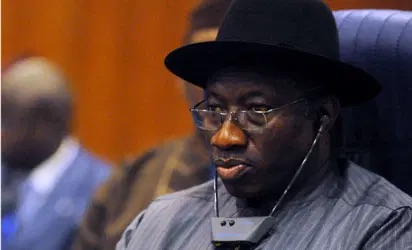
Former President Goodluck Jonathan has expressed optimism that Nigeria would overcome its economic, political and security challenges, despite growing concerns over rising violence, moral decline and hardship across the country.
Jonathan spoke yesterday at the first session of the 13th Synod of the Diocese of Abuja held at St James Anglican Church, Asokoro, Abuja, where the Primate of the Church of Nigeria (Anglican Communion), Henry Ndukuba, delivered a sweeping address touching on insecurity, the economy, corruption and the political climate ahead of the 2027 elections.
Also present at the event were former military Head of State, Gen Yakubu Gowon, former Imo State governor, Emeka Ihedioha, and Sen. Ireti Kingibe who represented Senate President Godswill Akpabio and former Chief of Staff to President Jonathan, Mike Ogiadomhe, among others.
Addressing bishops, delegates and worshippers at the Synod, Jonathan said although the country was passing through a difficult phase, he remained convinced that with prayers and good leadership, Nigeria would emerge stronger.
“We are in a society where the church has a lot of work to do, but I believe as a country we will get over our challenges. God will not abandon Nigeria,” he declared.
Jonathan said the rebuilding of the country would require discipline, patience and committed leadership, drawing parallels with Asian countries that took decades to attain economic transformation.
“When I became Vice President, I used to wonder how Asian Tigers moved from third world to first world. It took between 30 and 40 years for some countries to move from where we are now to near first world status. Progress takes time, good and focused leadership, and commitment,” he said.
The former president also raised the alarm over what he described as growing moral decay and violence in society, warning that the conduct of young people and the erosion of social values had become a source of concern.
“What is happening in our society, the way we push ourselves, the way we treat ourselves, society has become so complex that sometimes we don’t even know where we are going,” he said.
Jonathan said religious leaders had continued to play a stabilising role in the country through prayer and moral guidance.
“If religious leaders had not been praying seriously for this country, probably it would have been worse than what we are seeing today,” he stated.
He lamented increasing violence among young people, saying the social environment had changed drastically from what obtained in previous decades.
“These days, a young person will pick up a gun, go into a classroom and kill another student, and everything goes on normally.
“When we were in school, most students died natural deaths. But today, the situation is different,” he lamented.
Earlier in his address, Ndukuba warned that worsening hardship and political manoeuvring ahead of the 2027 general elections were distracting leaders from governance and deepening public frustration.
Other News
“It is clear that the political class is jostling for its survival rather than the service and welfare of the people,” the Anglican Primate said, adding, “Our political leaders have abandoned governance to pursue their strategy for contesting the 2027 elections.”
Ndukuba noted that the wave of defections across political parties, the absence of strong opposition politics and increasing “toxic political manoeuvres” showed that many politicians were more interested in power struggles than solving the country’s economic and security problems.
He urged the leadership of the Independent National Electoral Commission (INEC) to remain neutral, ensure fairness in the electoral process and provide a level playing ground for all to participate ahead of 2027.
On the economy, Ndukuba commended President Bola Ahmed Tinubu for pursuing structural reforms despite global economic pressures triggered by the Russia-Ukraine war and tensions involving Iran, the United States and Israel.
He also noted that inflation had dropped from 27.6 per cent in April 2025 to 15.15 per cent in December 2025 before rising slightly to 15.38 per cent in March 2026, while the naira had stabilised around N1,380 to the dollar.
However, the cleric said these improvements had not translated into relief for ordinary Nigerians.
“With 133 million out of 220 million Nigerians in multidimensional poverty, macroeconomic gains have not reached the citizens on the streets,” he said, adding: “The link between macroeconomic stability and household relief remains disconnected.”
Ndukuba described inflation as one of the biggest threats to household welfare, saying salaries and pensions were still being eroded by the high cost of living.
He also expressed concern over unemployment, warning that economic growth would remain meaningless if it failed to create jobs for young Nigerians. According to him, Nigeria must prioritise industrialisation, agro-industries and stable electricity supply to unlock growth and reduce poverty.
The Primate further warned about the country’s rising debt profile, which he put at N159.28 trillion, saying high lending rates and poor power supply continued to hurt productivity and economic expansion.
On insecurity, Ndukuba said Nigeria was “bleeding,” stressing that the genocide against the citizens of Nigeria is evident, especially against Christian communities in the North and some Southern states.
He faulted attempts to describe attacks as communal clashes or farmer-herder conflicts, insisting that religious extremism, expansionist agendas and criminal control of mineral resources were major drivers of insecurity.
“The propaganda and play of words for political correctness before the international community is a disservice to Nigerians,” he added.
Ndukuba called for sustained military offensives against criminal groups, improved support for local vigilantes and stricter prosecution of sponsors of violence, while also raising concern over growing drug trafficking and addiction.
However, Ndukuba maintained that Nigeria could still recover if leaders placed national interest above politics and citizens remained committed to unity, justice and peace.
In his good will message, the President of the Senate, Godswill Akpabio, represented by Ireti Kingibe, noted that the church plays a crucial role in building the society and restoring hope in times of uncertainty. He urged believers to continue to stand as courageous voices for national peace and stability.