Follow Us on Google
• Residents accuse govt agency of colluding with land grabbers
• We’re not involved in land matters –Community leaders, ESHDC
From Jude Chinedu, Enugu
For years, the struggle over land in Ngwuagu Odunejeogu, a community in Abor, Udi Local Government Area of Enugu State, has moved through family meetings, community assemblies, police stations and courtrooms.
Now, it has reached the doorstep of the Enugu State Housing Development Corporation (ESHDC) and Government House, Enugu.
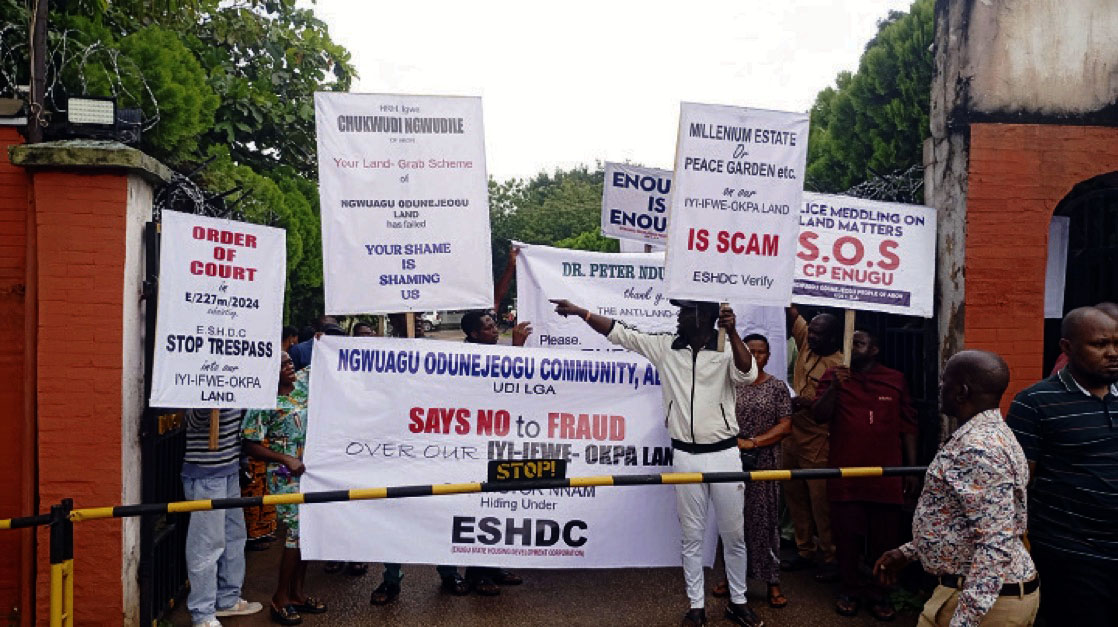
On Wednesday, September 23, 2026, members of the community staged a protest over what they described as attempts to appropriate, develop or otherwise deal in portions of their ancestral land, particularly the area known as Iyi-Ifwe-Okpa.
Their complaint is not simply about a piece of land. It is about who has the authority to speak for a community, who can dispose of communal property, the validity of documents used to establish ownership and, increasingly, the role of government agencies and security authorities in disputes that remain before the courts.
Some of the placards carried by the protesters captured the mood: “No to police intimidation on our land; Ngwuagu Odunejeogu Udi L.G.A people; Dr Peter Ndubuisi Mbah, thank you for the anti-land grab law. Please enforce the anti-land grab law; S.O.S, Ngwuagu Odunejeogu Community, Abor Udi LGA, says no to fraud over our Iyi-Ifwe-Okpa land; E.S.H.D.C stop trespass into our Iyi-Ifwe-Okpa land,” among others.
Behind the slogans lies a history that stretches back decades.
Odunejeogu, meaning “The finisher of battles”, is the name the people say reflects the military stature of their ancestors. According to the community’s account, Ngwuagu’s ancestral territory was acquired through settlement and conquest and historically shared boundaries with seven of Abor’s eight villages.
The community describes Abor as having two broad divisions: Ikenge, comprising Ugwunani, Ozalla and Amukwu, and Ibute, comprising Ngwuagu, Ebongwu, Ubiekpo and Amaezike.
Over generations, relationships between the villages changed. Amaezike, which the community says once had a small population, became closely associated with Ngwuagu after members of Ekama Ngwuagu kindred merged with it. The relationship eventually evolved into the Ngwuagu and Amaezike Union in the 1970s.
Land, however, remained a separate matter.
The community says its ancestral holdings included Ekwesu, Onu-agu Ngwuagu and a number of distant farmlands collectively associated with Agu-Ngwuagu. Among them was Iyi-Ifwe-Okpa, the piece of land now at the centre of the latest dispute.
Other areas named in its historical account include Uzami, now associated with the Golf Estate, Ugwuobokolo-Ugwueke, Mkpu Akpoti, Ogwugwu Nevo, Ugwu-oba and Ogbenyi Anieta.
According to the petitioners, people from neighbouring communities were historically permitted to cultivate parts of these lands without that arrangement amounting to a transfer of ownership.
After the civil war, the community says, people from Amaezike, Ebongwu, Eke and other areas were allowed to farm and put up temporary houses on portions of Agu-Ngwuagu as they struggled to rebuild their lives.
The dispute became more pronounced in the early 1980s.
The community says an attempt was made under Amaezike leadership to share Uzami land through the old Ngwuagu-Amaezike Union. Money was reportedly collected from some people, alongside two cartons of beer, in connection with the exercise.
Ngwuagu objected, insisting that the social union did not confer joint ownership of communal land.
Relations deteriorated further over subsequent land transactions.
Around 2005, the community says Dominic Ogbologu produced a document described by the petitioners as a “holographic document”, which purportedly established co-ownership of some Ngwuagu and Amaezike lands.
The community rejected the claim, and the union eventually broke down.
The dispute entered the courts in Suit No. E/589/2006. Members of Amaezike sued representatives of Ngwuagu over ownership.
A court document sighted by this reporter showed the existence of the suit over the competing ownership claims, while the community maintains that the case was eventually struck out on December 17, 2024, after years of litigation.
But the litigation did not end the controversy.
The community also disputes what happened to land acquired by the state for the development now associated with the Golf Estate. It alleges that 81 compensatory plots were allocated to Amaezike interests and another 81 to the two Ngwuagu villages.
The petitioners have called for an investigation into the allocation, including who received the plots, whether any were sold, how much was realised and how the proceeds were accounted for.
The battle has also become entangled with disputes over community leadership.
The 2011 Constitution of Ngwuagu Odunejeogu Community, obtained by this reporter, provides for a two-year tenure for elected executives, renewable for one further term. It also contains provisions governing the management and disposal of communal property, including the role of a seven-man Power of Attorney committee.
The community says successive administrations followed this arrangement, while accusing the administration led by Francis Ukwu of attempting to alter the constitutional structure and extend tenure.
Ukwu and others are also accused by the petitioners of unauthorised dealings in community property, including the alleged sale of Ngwuagu House at Ogbenyi Anieta and dealings connected with the Uzami acquisition.
These allegations have not been established as facts by the courts and were presented by the community as part of its case against former leaders and other individuals.
The present leadership says its more immediate concern is Iyi-Ifwe-Okpa.
In a September 24, 2026 letter to ESHDC, a copy of which was sighted by this reporter, the community described Iyi-Ifwe-Okpa as ancestral communal land and alleged that about 5.6 hectares had become the subject of transactions or development without the authority required under its constitution.
The letter demanded disclosure of “the precise area, survey plan, root of title, transferor, date, consideration, recipient/account, instrument, legitimacy of executors, government approvals, survey/registry records” and the complete ESHDC file relating to the property.
The community also disputes documents it says were presented as evidence of government approval or title.
A copy of the petition obtained by this reporter alleged that two documents purportedly originating from the Government Gazette were checked with the Government Printer and found not to correspond with official records. That claim would require independent verification by the relevant authorities.
Another document described as a “Deed of Customary Grant” is challenged by the petitioners on the grounds that some of those who purportedly executed it were not authorised representatives of the community and that the document did not adequately identify the land.
The dispute has increasingly spilled into security matters.
The petitioners allege that police and other security personnel have been used to intimidate members of the community whenever they resisted disputed land transactions.
They cite several incidents involving arrests, detention, petitions and competing claims over different portions of the community’s land.
The community also alleges that Francis Ukwu and other individuals were involved in efforts to partition or dispose of portions of Ugwuobokolo-Ugwueke.
Other News
It says resistance to the alleged transactions led to criminal proceedings against some community leaders and members, including Suit No. MEN/444c/2025, which it maintains was subsequently abandoned or struck out.
In another incident, the community alleges that a group opened fire during a confrontation over land zoned for schools, markets and public parks, injuring one of its members.
The community alleges that, after leaving office, a former chairman became involved in land-related activities that undermined the current leadership. It further alleges that cultists attacked youths at Iyi-Ifwe-Okpa on January 26, 2026, with buildings allegedly pulled down by a bulldozer during the incident.
The community says the incident was reported to the police and that the case has since generated further legal proceedings.
A signpost at the scene, according to the petitioners, cited “order of court in E/908/2024”.
The community says it obtained the case file and disputes the validity of the consent judgment, arguing that those who entered into it had no title or authority over the land.
That position is now being challenged in Suit No. E/174/2026, according to the documents supplied by the community.
The disputed Iyi-Ifwe-Okpa land has also featured in other proceedings, including NK/81/2026, involving Geo-Synergy Services Ltd, Victor C. Nnam, ESHDC, contractors, the Enugu State Geographic Information System and the Attorney-General of Enugu State, according to the community’s petition.
The community alleges that the land was subsequently associated with different estate names and development interests.
Those allegations, like the wider claims of unauthorised land dealings, remain contested matters.
The security dimension of the dispute has become particularly contentious.
The community alleges that its chairman and another official were invited over what it described as a fictitious petition dated June 16, 2026.
It says both were later arrested and detained by the Force Intelligence Department’s Special Tactical Squad on July 27.
What is clear from the documents is that the land dispute has generated a web of petitions, suits and counterclaims involving community leaders, former officials, private interests and government institutions.
It is no longer merely a quarrel over boundaries. It has become a contest over documents, authority, community leadership and the institutions through which ownership is recognised.
At ESHDC, the protesters were received by Precious Nnaji, who spoke on behalf of the corporation’s Head of Administration and Supply.
She told them she was unaware that the community had previously protested and advised them to formally write the new managing director, who, she said, might not have been aware of the earlier complaint.
The protesters subsequently proceeded to Government House, where they were received by Charles Okafor, Special Assistant to Governor Peter Mbah.
He asked the protesters to, “Write a memo chronicling everything that was captured in your placard. Also write a formal letter to the governor so that we can work with it and make sure that your protest is not thrown under the carpet.”
The community had already written.
In its September 24 petition to Governor Mbah, obtained by this reporter, the community requested an independent investigation into the alleged dealings in Iyi-Ifwe-Okpa, determination of the root of title, preservation of the land and investigation of the 81 compensatory plots connected to the earlier acquisition.
It also asked the government to protect residents from what it described as unlawful coercion, preserve relevant documentary evidence and respect pending court proceedings.
“This is a request for justice, not favour,” the petition stated.
It added: “The community is not opposed to lawful development, nor is it opposed to the legitimate functions of Government or its agencies. What we seek is transparency, lawful process, equal protection and the preservation of property rights pending the determination of the relevant disputes.”
That position places the dispute within a wider conversation about land administration in Enugu.
The state government has introduced reforms aimed at modernising land administration and addressing problems associated with land grabbing, double allocation and opaque property transactions.
The protesters now want those reforms applied to their case.
For the people behind the protest, however, the immediate issue is older and more personal.
They say their ancestors acquired and protected the land long before the present generation, and that successive generations have depended on it for farming, settlement and communal development.
The community’s current leadership has also begun allocating portions of some of its land to eligible members, including widows and families whose children are not yet of age, according to its account.
It says the exercise was conducted through balloting and the use of surveyors, but alleges that some of the identification marks and beacons were subsequently destroyed.
Its leaders are therefore asking government not merely to receive another petition, but to examine the documents, trace the transactions, identify those with lawful authority and preserve the disputed land until the courts and relevant institutions have had their say.
Ngwudile denies involvement
When contacted, HRH Igwe Chukwudi Ngwudile, traditional ruler of Abor community, Udi Local Government Area, denied involvement in the land matter, saying he was not from the village in question.
“I am not involved in any land issue in that community. What you should do is reach out to the Enugu State Housing Development Authority and ask them who gave them land.
“You know I am not from that community. My own is, if there is an issue among any parties, they will bring it to me to settle. I am not involved in their land matter,” he said.
Ukwu: Land belongs to Ngwuagu, Amaezike
Former chairman of Ngwuagu Community, Chief Francis Ukwu, said he was surprised that his name was mentioned in connection with the dispute, insisting that he was no longer chairman and was not a member of the executive.
He alleged that someone initially approached the housing corporation for a partnership but was rejected after the corporation discovered that he was not the recognised chairman.
“He was the first person who wrote to the housing corporation to partner with him. When Housing noticed that he is not the chairman, they said they will not partner with him,” he said.
Ukwu also disputed the community’s claim that Ngwuagu alone owned the disputed land, insisting that the land belonged to both Ngwuagu and Amaezike communities.
On the disputed constitution, Ukwu said: “The issue of the constitution is in court.”