Follow Us on Google

The words of George O. Sylvester will remain indelible in history for its prophecy of the manipulation of citizens by incompetent and corrupt governments whose development exists only on papers, while the citizens wallow in poverty. He postulated that “when a nation’s growth rises on paper but its people sink in hunger, that is not progress – it is polished poverty wearing a mask of statistics.”
President Tinubu in his independence anniversary speech reeled out some of his achievements. In his own words, he said: “Three and a half years later, the evidence that Nigeria’s economic outlook has improved is undeniable. Our economy has grown by over four per cent this year. Both oil and non-oil sectors have contributed to the renewed period of stable growth.”
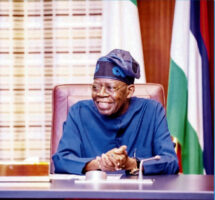
He went further to declare that: “Oil theft is down. Inflation has fallen substantially from its peak. Our foreign reserves have been rebuilt, our foreign exchange market has stabilised, and in 2025 this country recorded its highest revenue from non-oil exports in its history, exceeding $6 billion. This is real money being made by real Nigerian businesses.”
The evidence he adduced to prove that his claims are not idle claims is that international observers, journalists, NGOs and multilateral institutions can see the change. Each has concluded that his reforms have strengthened Nigeria’s economic stability and resilience. The private sector has long since delivered its verdict, and foreign direct investment continues to rise each year. All his achievements border principally on macroeconomic indices.
The only people he did not tell the world have seen the positive changes are the Nigerian people. What people have seen in Tinubu’s regime include that Tinubu met fuel at N195, but it has increased to N1,500. He met naira at about N450 to a dollar, but it has depreciated to about N1,400 per dollar. He met cement cost at about N3,800 but it is now about N12,500. He met about N77trn total debt, but it has ballooned to N166.6trn total debt, and he is still borrowing more. Indeed, there’s a loan of $1.5b Tinubu is eyeing to borrow from the World Bank now.
The people also observe that insecurity is at its worst under Tinubu. Transportation and food costs are horrible, electricity and employment are absent, poverty is ravaging, and roads are deplorable.
Notable citizens have maintained that the macroeconomic figures have not cascaded downwards to the microeconomic level. This simply means that all the grammar by the President on his achievements has not yet reflected positively in the lives of the citizens of Nigeria.
Macroeconomic variables are the broad, aggregate indicators used to measure the overall health, performance, and direction of a national or global economy. The core macroeconomic variables include the gross domestic product (GDP), inflation rate, unemployment rate, interest rates, unemployment rate, exchange rates, balance of payments.
By the reports of the World Bank, which Tinubu called as witness, being a multilateral institution, Nigeria’s poverty rate is 63 per cent (equivalent to about 140 million people living in poverty in a population of about 220m people). National Poverty Headcount rose from 56 per cent in 2023 to 61 per cent in 2024, and reached 63 per cent in 2025/2026. Vulnerable Population: About 79 per cent of Nigeria’s population is either poor or vulnerable to falling into poverty. Extreme Poverty ($2.15/day) is at about 61.2 million people.
The main drivers of poverty in Nigeria include inflation and real income squeeze: Even as headline and food inflation rates have shown signs of cooling, by the purported rebased Tinubu inflation figure, cumulative price spikes have severely eroded household purchasing power and wiped out savings. Inflation was galloping towards 39 per cent before it was rebased to about 18 per cent with the prices not reducing. The government simply said that the formula they used to compute the inflation had changed, without change in prices.
Tinubu’s economy has witnessed weak job creation: Economic growth (such as modest GDP gains in services and industry) has not translated into enough productive, wage-paying jobs. Agriculture is also lagging behind in Tinubu’s regime: The agricultural sector which employs a large share of low-income and rural citizens has been constrained by high power, transport costs and security challenges.
Interest rate in Nigeria is still very high at about 30 per cent. At this rate, small and medium-sized enterprises will find it difficult to borrow money and repay with interest at the maturity date of the loan without governmental subsidy. This is why the regime of Tinubu has become the burial ground for small and medium-sized enterprises. Large companies have also collapsed in droves and foreign ones have since closed shops and left.
Even in the macroeconomic indices, the government has not fared well. The deception in the foreign reserve increase needs to be addressed. The government is opining that the foreign reserve has increased to about $54.91b since it came into power. It forgot that it met a debt of about N77trn but has increased it to more than N166.6trn. Nigeria is owing more than $118b. If a country has $54.91b and is owing $118b, it then means that the country is in a net debt of $63.09b.
So the strategy of this government is simple, keep borrowing and avoid tampering with the foreign reserve to create the illusion of macroeconomic growth. This implies that this government is actually borrowing to sponsor the foreign reserve. Is it not callous that a government would borrow and pay interest to create the impression of growth, when it could utilise the foreign reserve it has in which it would pay no interest.
Contrast this with the Obasanjo-Atiku regime that inherited an external debt of about $40b. They made savings of more than $18b from increase in the international crude oil price. They used about $12b to negotiate a debt forgiveness of more than $18b. This exited us from our debts.
Microeconomic variables are specific economic factors that measure the behaviour, choices, and conditions of individual economic units like single consumers, households, or businesses. The key microeconomic variables include price, wages, individual expenditure, individual investment, cost of inputs, market share, quantity produced, and quantity demanded.
None of these variables is faring well on the microeconomic level. The Nigeria Labour Congress (NLC) has just issued a two-week ultimatum to the Federal Government to address the issues of exorbitant petrol prices and inadequate minimum wage. Labour seeks reduction in petrol prices and an increase in the minimum wage. This automatically reveals that the price and wage components of the microeconomic indices are in an abhorrent negative.
The cost of inputs for businesses is becoming abominable under this regime. With almost a total absence of energy and electricity, insecurity, and high interest rates, the cost of producing a unit of product is almost the highest in the world. Nigeria is suffering from a cost of production-induced inflation, not a demand-pull inflation. The average cost of producing a barrel of oil in the world is about $12. In Nigeria, it is about an average of $30 per barrel. This is why even with the entrance of Dangote Refinery in Nigeria, prices of refined fuel is still very high and unaffordable to the Nigerian people. Fuel sells at about N1,500 per litre at the filling stations.
The government appears to admit that the domestic price of refined fuel has gotten out of hand and unsustainable because on Thursday, 8 October 2026, it announced, through the Minister of Finance, Dr Taiwo Oyedele, that “We are offering a discount on petrol dispensed by NNPC limited for the next 30 days in the first instance with priority for public transporters nationwide.”
This is a total departure from its earlier stand that the issue of subsidy is forever closed. Tinubu declared from the first day in office that fuel subsidy was gone. He even boasted that whoever preaches for the return of subsidy was ignorant. The question now is whether Tinubu is ignorant for advocating for a return of subsidy. Tinubu’s subsidy is even worse because it is a repeat of the import related subsidy, which was riddled with corruption.
Of course, the main reason for the return of subsidy by Tinubu is to appease the growing public demand for relief from the hardship caused by the removal of the fuel subsidy and the realisation that Atiku’s commitment to restoring subsidy is gaining widespread support. It was a political strategy rather than a well thought out economic policy.
Whatever may be the strategy of this government in attempting to restore fuel subsidy, one thing that is clear is that such attempt is an admission that its macroeconomic figures are bogus and is increasing hardship on the people rather than making their lives better. Any macroeconomic index, which does not manifest in a positive microeconomic variable is a manipulation of economic indices to scam the people through amassing illicit wealth for the rich and powerful class.