Follow Us on Google

By Olakunle Olafioye
For four or more years, they endured lectures, examinations, sleepless nights and the financial sacrifices required to earn a university degree. Some battled strikes, inadequate facilities and the uncertainties of life after graduation before eventually crossing the threshold of academic success.
But for thousands of Nigerian graduates, the journey to acquiring a university education appears to end not with the collection of their certificates, but with leaving them behind in the custody of the institutions that issued them.
Across the country, tertiary institutions are grappling with substantial backlogs of unclaimed academic certificates, prompting periodic appeals, collection drives, penalties and, in some cases, threats to destroy documents that have remained untouched for years. The recurring announcements have raised questions about why graduates who worked so hard to obtain academic qualifications would fail to claim the documents that formally authenticate their achievements.
Few weeks ago, the University of Ibadan (UI) reignited the debate when it announced new guidelines for the collection of statements of result and certificates, warning that certificates left unclaimed for more than 10 years could be shredded.
The university also introduced financial penalties for delayed collection, with graduates required to pay N25,000 for certificates collected after one year but within five years, and N50,000 for those collected after five years but within 10 years.
The guidelines, contained in a special bulletin dated September 15, 2026, and signed by the institution’s Registrar, Ganiyu Saliu, stipulated that graduates must collect their statements of result within six months of being notified that the documents were ready. Failure to do so would attract a non-collection penalty of N2,500 before the document could be released.
According to the university, statements of result would remain valid for two years from their respective dates of issuance and serve as interim records pending the collection of certificates. It, however, emphasised that certificates remained the institution’s official and permanent evidence of graduation and qualification.
Under the new arrangement, certificates would be available for collection from the date of convocation until one year afterwards, during which graduates would pay a statutory fee of N7,500 for issuance and collection.
Certificates collected after the initial one-year period would attract additional penalties, while those remaining unclaimed for more than a decade would be liable to shredding. The university urged graduates and other stakeholders to comply with the guidelines to avoid penalties and the possible loss of their academic credentials.
3-month window for LASUSTECH graduates
The University of Ibadan is not alone in its efforts to clear the backlog of unclaimed certificates. The Lagos State University of Science and Technology (LASUSTECH) recently announced a three-month window for former students of Lagos State Polytechnic who completed their programmes between 1979 and 2021 but had yet to collect their certificates.
In a statement signed by the institution’s Registrar, Dr David S. Ogungbe, the university directed the affected graduates to visit the Examinations and Records Unit of the Registry Department between October 1 and December 31, 2026, for collection. The institution warned that failure to take advantage of the window would result in an upward review of the existing collection fee.
The statement read in part: “It should be noted that after the three (3) months period indicated above, the University will undertake upward and appropriate review of the existing fee for collection of the certificates.”
The announcement was another indication of the enduring challenge confronting tertiary institutions in managing unclaimed academic credentials.
A problem with a long history
The accumulation of unclaimed certificates is not a recent development. In December 2020, the University of Abuja announced that 14,307 certificates belonging to graduates between 1994 and 2018 were ready for collection.
The disclosure, made by the then Vice-Chancellor, Professor Abdul-Rasheed Na’Allah, exposed the scale of the problem at the institution. Na’Allah apologised to affected graduates for the delay in producing and distributing their certificates, assuring them that the situation would not be repeated.
“We had this prolonged delay for some reasons, but that has been corrected, and I can assure you that it won’t happen again.
“I hereby ask students who graduated between 1994 and 2018, and have not collected their certificates, to quickly visit the school and collect theirs,” he said.
The University of Lagos (LASU) also confronted a similar challenge.
In November 2018, reports indicated that the institution had 32,522 certificates in its custody, many of them belonging to graduates of its former external campus programmes.
The university subsequently launched an operation to facilitate their collection. The problem had reportedly become so significant that two former vice-chancellors, Professor Lateef Hussain, who served from 2005 to 2010, and Professor John Obafunwa, who served from 2010 to 2015, complained about the volume of certificates awaiting their signatures.
When Professor Lanre Fagbohun assumed office as vice-chancellor, tackling the backlog of certificates reportedly became one of his immediate priorities. He established a task force to address outstanding results and related documentation.
At the University of Ilorin, the management, in December 2024, directed graduates who had not collected their certificates to do so by January 17, 2025. In a memo dated December 18, 2024, the Registrar, Mr Mansur Alfanla, warned that a fine of N3,000 per week would be imposed on unclaimed certificates after the deadline.
Graduates were advised to come with evidence of payment for convocation, the original statement of result and their student identity cards. The institution described the certificate as a vital component of the graduates’ academic achievements.
When university certificate becomes suya wrapping paper
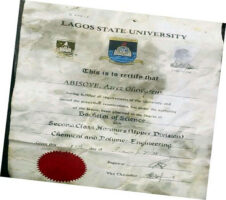
Perhaps nothing captures the absurdity of the unclaimed certificate crisis more vividly than the discovery of an original university certificate at a roadside barbecue stand. In 2015, an original certificate belonging to a Lagos State University graduate, Abisoye Azeez Oluwaseun, reportedly found its way to the custody of a suya seller in Epe, Lagos State.
The certificate, according to information released by the Lagos State Traffic Management Authority (LASTMA), was allegedly about to be used to wrap suya.
It showed that Abisoye had graduated with a Second Class Upper Division degree in Chemical and Polymer Engineering in 2008.
LASTMA announced the discovery in a social media post, appealing to members of the public to help locate the owner.
“This original certificate was found at a suya spot and was almost being used to wrap suya in Epe. If you know anybody bearing Abisoye Azeez Oluwaseun, please contact us,” the agency stated.
The incident generated public reactions, not only because of the apparent mishandling of an important academic document, but also because it illustrated how certificates that represent years of intellectual labour can become worthless to their owners when they are not collected or properly preserved.
Bureaucratic maze behind certificate collection
While some institutions have attributed unclaimed certificates to graduates’ failure to return for them, available evidence suggests that the problem is more complicated.
A 2020 conference paper titled “Leaning the Process of Final Certificate Collection in Tertiary Institutions in Nigeria” examined certificate-collection procedures and identified administrative inefficiencies, delays and the burden of repeated visits by former students as major challenges confronting graduates.
The experience of many former students appears to support these findings. For some graduates, collecting a certificate is not a straightforward administrative exercise. It may involve multiple visits, long queues, payments for various services, missing records and uncertainty about when the document will eventually be released.
In some cases, graduates leave school with statements of result or documents bearing the phrase “To whom it may concern” because their final certificates are not ready. By the time the certificates become available, many have already moved to other countries, states or cities, secured employment or begun pursuing other priorities. For others, the financial cost of collection becomes a major disincentive.
‘I’ve worked for over a decade without my certificate’
Mr Bidemi Adeoye, who has spent more than a decade working with a private company, told the Sunday Sun that he had never been compelled by his employer to produce his university certificate.
“My certificate was not available at the time I was mobilised for the National Youth Service Corps scheme. We were only issued with statements of result in our school. At the end of the programme, I was retained, and I have been working with what I was given. But since my employer seemed not bothered about my certificate, I didn’t feel compelled to produce it until I decided to apply for my master’s degree,” he said.
Adeoye’s experience reflects the situation of many graduates whose employers accept statements of result, NYSC discharge certificates or other documentation as sufficient evidence of academic qualifications. Once employed, the urgency associated with obtaining the original certificate often diminishes.
For some, the document becomes necessary only when applying for postgraduate studies, professional registration, employment abroad or a new position requiring formal verification of qualifications.
The price of an academic achievement
For Austin Chukwuebuka and Mrs Uju Akunima, both graduates of two prominent Nigerian universities, the challenge has been a combination of cost, inconvenience and the absence of immediate pressure to collect their credentials.
More than a decade after graduation, neither had taken possession of their original certificates. Chukwuebuka, a Banking and Finance graduate, explained that his institution issued him a temporary document while his certificate was being processed.
“We were given ‘To whom it may concern’ after graduation because our certificates were still being processed at the time. But when it was ready, I was told we would have to pay N14,000 or so to get the certificate. That was a big amount for some of us, considering that we were yet to get employed at the time.
“Those who were lucky to get employed did not see any compelling reason to go for it because their employers, who engaged them with the documents they produced in lieu of their original certificates, did not put them under any pressure to produce their certificates,” he said.
Akunima also cited the cost and inconvenience of travelling to her alma mater. “I so much desire to get it, but when I consider what it will cost me in terms of money and time, because you may not be able to get it in a day, and the money I have to pay to get it processed, I feel constrained to defer it to another time,” she said.
Her experience raises a critical question: should graduates have to choose between paying for an essential academic document and meeting their immediate financial obligations?
Fresh graduates caught between unemployment and collection fees
For many young Nigerians, the period immediately after graduation is marked by financial uncertainty. After years of paying tuition-related charges, accommodation expenses, transportation costs and other levies, graduates often leave school without employment or a dependable source of income.
Against this background, fees charged for certificate collection may appear burdensome, particularly when the document is not immediately required.
A graduate of the University of Lagos, who requested anonymity, recalled his frustration when he attempted to collect his certificate shortly after graduation.
“I was frustrated when I went to my school to collect my certificate and was asked to pay N20,000 as a fresh graduate who was still seeking employment at the time.
“I abandoned the certificate and used my ‘To whom it may concern’ document that was issued to us during our clearance exercise. That is what I have in my file in the office,” he said.
Mrs Sarah Uweh, another graduate who is yet to get her certificate, also complained about the cost of obtaining the certificate. But beyond the fee, she said the document had not become an immediate necessity in her life.
“I didn’t bother myself since I have my NYSC discharge certificate and other documents. Again, I am a business person; I am not looking for any job in the office,” she said.
Her position captures another dimension of the problem: for graduates who are self-employed or working in sectors where employers do not insist on original certificates, the perceived urgency of collection may be low.
When competence takes precedence over certificates
There is also a changing attitude among some employers towards academic credentials. While certificates remain important evidence of educational attainment, certain employers place greater emphasis on practical skills, experience and the ability to perform assigned tasks.
Mr Philips Isiegbe, an employer and Chief Executive Officer of Demvic Poly and Allied Products Ltd., said he prioritised competence over the possession of impressive academic credentials when assessing prospective employees.
According to him, a certificate confirms an employee’s academic background, but does not necessarily establish the person’s ability to perform effectively.
“I have a number of people working with me whose certificates I have yet to sight, although, I am sure they submitted them at the point of joining the company.
“Getting a certificate is just evidence to confirm employees’ academic qualifications, and that, to me, pales in significance compared to the competence or proficiency of the candidate.
“Don’t forget that there are graduates who have the certificates but cannot justify them performance-wise. So what matters more to me is an employee’s ability to sufficiently demonstrate mastery of the tasks given to him or her,” he said.
Isiegbe’s position helps explain why some graduates do not consider certificate collection an urgent priority after securing employment.
However, the fact that certain employers are willing to engage graduates without original certificates does not diminish the document’s long-term importance.
A document that may become indispensable
Notwithstanding, Isiegbe noted that the value of an academic certificate could become more apparent when circumstances changed for many graduates. “A person who secures employment with a statement of result may later need the original certificate for postgraduate admission, foreign travel, professional licensing, promotion, employment verification or migration-related documentation.
He pointed out that the difficulty in retrieving a certificate years after graduation might be more expensive and complicated than collecting it within the period stipulated by the institution.
“Records may need to be updated, fees may increase, signatures may become difficult to obtain, and graduates may have to travel long distances to resolve issues that could have been addressed earlier,” he said.
This is partly why universities continue to urge former students to collect their certificates before penalties accumulate. Yet, the responsibility cannot rest entirely on graduates.
Between institutional responsibility and graduate apathy
The growing backlog of unclaimed certificates raises questions about the responsibilities of both tertiary institutions and their former students.
Universities are expected to maintain accurate academic records, produce certificates promptly, communicate effectively with graduates and establish collection systems that are accessible and transparent.
Graduates, on the other hand, are expected to follow up on their academic documentation and ensure that their credentials are collected and preserved.
Where institutions delay the production of certificates for years, graduates may understandably lose confidence in the process. Where documents are ready but former students fail to collect them, institutions are left with storage, administrative and record-management challenges.
The way forward
Isiegbe believes that reducing the backlog of unclaimed certificates requires more than periodic ultimatums and financial penalties.
Institutions, he suggested, could explore improved communication systems, online application and verification platforms, appointment-based collection, courier delivery and decentralised collection centres for graduates living far from their alma mater.
Clear information about collection fees, processing timelines and required documents could also reduce uncertainty and unnecessary visits.
He also made a case for reviewing the financial burden imposed on fresh graduates, particularly those who have yet to secure employment.
For graduates, the message is equally clear: an academic certificate is not merely a document to be collected when an employer demands it. It is a permanent record of educational attainment that may become indispensable at a later stage in life.