Follow Us on Google
From Sylvanus Viashima, Jalingo
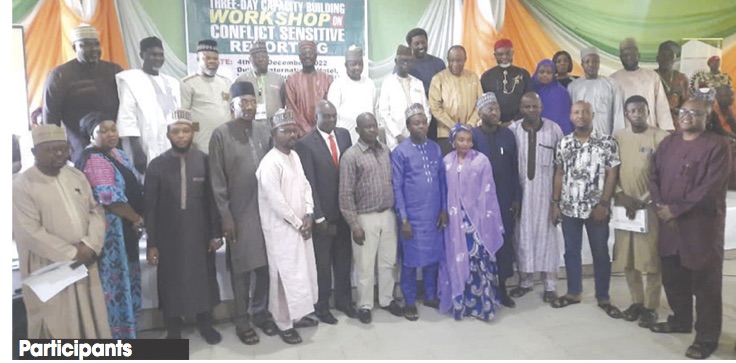
In a bid to better equip journalists covering the crisis in the North-East region of the country that is ravaged by Boko Haram terrorism, the North East Development Commission (NEDC) recently hosted over 70 journalists selected across the six states in the region to a three-day intensive training on crisis-sensitive reporting, in Maiduguri, Borno State.
For a crisis-torn northeastern region of Nigeria, the imperative of responsible coverage and reportage of the crisis cannot be overemphasized as anything to the contrary could thwart military efforts at tackling the situation, embolden the terrorists and leave indelible scars on the psych of the people.
The NEDC was set up by President Muhammadu Buhari and the bill establishing the commission was signed into law on the October 25, 2017. The commission was established as a focal body with the responsibilities to assess, coordinate, harmonies and report on all programmes and initiatives by the Federal Government or any of its ministries, departments and agencies, states and other development partners and for the implementation of all programmes and initiatives for the six North-East states of Taraba, Borno, Adamawa, Yobe, Bauchi and Gombe.
The managing director/chief executive officer of the commission, Mohammed Alkali Goni, in an address at the training, said that the training became imperative as journalists are considered key partners in the efforts to win the war against insurgency and ensure that peace and normalcy is returned to all parts of the region.
Goni said that while most of the journalists are doing a great job in carrying out their reportorial responsibilities, it was important that they are specifically trained and their skills horned more in conflict sensitive reportage.
He said: “Two years ago, this meeting would not have been conceivable, at least not here in Maiduguri because most of you would not have come. It would have also been unreasonable on our part. However, by the grace of God, the situation is gradually returning to normal. Most parts of the region and even Borno State are relatively safe now and people are beginning to go about their activities without hightened fear as it was in the past.
“Consequently, as the physical situation is coming under serious control, it is important that we pay attention to other aspects of the whole effort. That is why it is very important that we have this training so that the reports coming from the press would not be such that would escalate the situation or cause more injuries to the people, but such as would help to bring about peace, remove fear, and create mental healing for the traumatized.
“What we have here is the media in the value chain from reporters to Media executives from various media organizations. We know that journalists are indispensable to our mission. While we would not want to control your editorial content and or policies, we consider it vital to assist in providing this further training to help you to do your jobs even better” Goni said.
Chairman of the Governing Board of NEDC, Major General Paul Tarfa (retd), commended the federal government for setting up the Commission, which has greatly aided stability that is been experienced in the region as victims of the insurgency are most resettled and are gradually returning to their normal way of life.
“Your roles as journalists towards the achievement of the goals of this Commission can not be taken for granted. We have been able to achieve much of what we have recorded partly because you also played your roles well. We would continue to partner with the media to ensure that this relationship is sustained”.
Group Captain Sadiq Shehu, who represented the minister of humanitarian and disaster management, Hajia Sadiya Umar Farouq, declared the workshop open and urged the journalists yo take the training serious.
Dr. Nathaniel Danjibo, the director, Institute for Peace and Strategic Studies, University of Ibadan, in his presentation at the workshop on the topic, ‘Conflict Sensitive Reporting: Applying the do no Harm Principle,’ said that conflict beat is not only a specialized beat but a very sensitive one that requires careful reportage to avoid a situation where reports in the media will rather escalate crisis rather than controlling it.
He said the media have the obligation to report only what is morally right, objective and truthful and that it set agenda for a prospective outcome and that in terms of conflict the outcome can either be peace or war.
According to Danjibo, “Reporting conflicts as journalists should do no harm by dousing tension and not escalating it. Peace journalism reports the truths and facts differently. Crisis-sensitive reporting requires that the reporter weighs his words and message carefully before dishing it out to the people.
A single word can set the whole place on fire. That is the power of the media and it is only right that this enormous power is exercised responsibly.
“Conflict is an inevitable phenomenon of human existence and manifests in the expression of disagreement between peoples, communities and among nations, albeit violence and war as a result of the pursuit of incompatible or unmet goals.
“Mass media often plays a key role in today’s conflict. Basically, their role can take two different and opposed forms. Either the media takes an active part in the conflict and has responsibility for increased violence, or stays independent and out of the conflict, thereby contributing to the resolution of conflict and mitigation of violence.
“Increasingly, the centrality of the mass media in defining the direction of conflicts in Nigeria is acknowledged to the extent that a debate is raging on the culpability of the traditional and mass media in some of the violent disruptions in Nigeria.
“We cover conflict simplistically, vividly, incessantly but we do not cover it with sophistication. We don’t cover causes, only consequences, and we don’t cover solutions. What is required of us as responsible Journalists is a kind of journalism and media ethics that attempts to transform conflicts from their violent channels into constructive forms by conceptualizing news, empowering the voiceless, and seeking common grounds that unify rather than divide human societies” Danjibo said.
He urged participants to always exercise professional ethics of accuracy, veracity, fairness and respect for human rights and dignity.
The vice chancellor, of the Federal University Kashere, Gombe State Professor Umaru Pate, who spoke on ‘Conflict Sensitive Reporting from Humanitarian Dimension’, said media can contribute to the escalation of conflict based on what they say and how they said it and advised journalists to be up to date and digitally literate to move with the wind of change in the profession.
“Conflict is a threat to societal survival, peaceful coexistence and system endurance. The media reports conflict as part of its traditional role of providing information, education and entertainment. Reporting conflict translates into their surveillance function in the society. Conflict is attractive and a source of news. It is “the bread and butter” of journalism and sells as ready raw materials.
“Conflict coverage reflects socio-cultural and other diversities in the country. The media, through selective reporting, determines what the public sees and thinks. Media can contribute to the escalation of conflict based on what they say and how they say it” Pate said.
Some of the participants who spoke to our correspondent hail the commission for organizing the workshop and describe it as eye opener.
According to Mr Martins Abochou of News Agency of Nigeria (NAN), “this is one of the most educating workshop I have attended in recent times. In all my years of professional practice, it never occurred to me that some common expressions we use have tendencies to further escalate crisis rather than controlling it.
“I have no regrets at all for taking the risk of coming to Maiduguri. Initially, I was reluctant to come to Maiduguri because of the fear of insecurity. Now I have seen for myself that the situation is not as bad as we are made to believe. I am also highly impressed at the rehabilitation efforts of the NEDC for the displaced persons. It is a nice outing”.
The Deputy National President of the Nigeria Union of Journalists Alhassan Yahya, appreciated the NEDC for the training and solicited for more of such to create visibility for the commission and sensitise the public of its activities.
Yahya advised that the training be rotational so as to cover the entire North-East states.
Learning, they say, is a continuous process that only stops when one breaths his last. For the over Seventy journalists that participated in the training, it is a major addition to their knowledge bank and it’s implementation will enormously affect the report of crisis in the region, giving reports a human perspective.