Follow Us on Google
The Nigerian Air Force (NAF) has honoured Captain August Okpe, one of the pioneer pilots whose early training formed part of the foundation of the service, in recognition of his contributions to military and civil aviation.
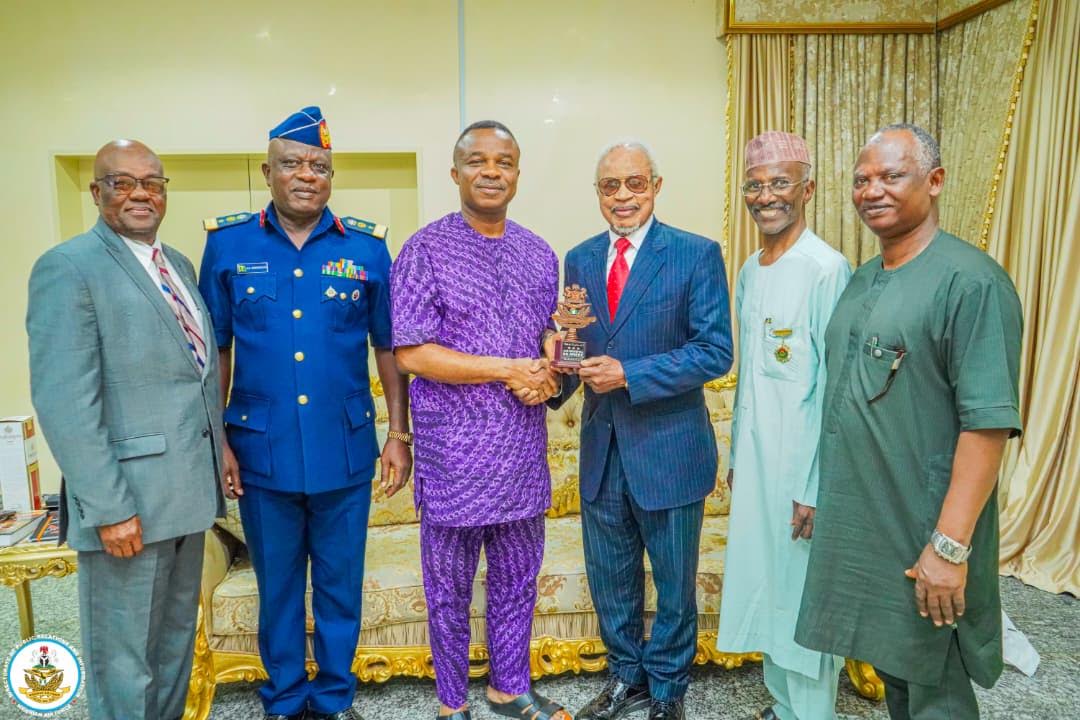
The Chief of the Air Staff (CAS), Air Marshal Sunday Kelvin Aneke, presented a commemorative plaque to Okpe in Abuja recently, acknowledging his long career and contributions to aviation training and operations.
Okpe is regarded as the last surviving most senior pioneer pilot of the Nigerian Air Force and belongs to the generation of officers who were recruited and sent abroad for flight training during the formative years of the service.
A product of the prestigious Government College Umuahia, Okpe was among the first batch of Nigerian trainee-pilot candidates selected in late 1962 to undergo flight training as part of efforts to develop the nucleus of an indigenous Nigerian Air Force.
His training took him to Canada, where he commenced his aviation education at the Central Officers School of the Royal Canadian Air Force in Centralia, Ontario.
He subsequently proceeded to the Royal Canadian Air Force Flight School at Penhold, Alberta, where he continued his pilot training.
The early Nigerian military aviation programme was part of the country’s efforts to build indigenous capacity at a time when the newly established Nigerian Air Force was still developing its personnel and operational structures.
Okpe’s career would later extend beyond basic flying training to aviation instruction and flight safety.
In preparation for a career as a military instructor pilot, he attended the Royal Canadian Air Force Flight Instructors School in Moose Jaw, Saskatchewan, as well as the School of Instructional Technique of the Royal Canadian Air Force in Clinton, Ontario.
He also received training at the United States Air Force Flight Safety Centre in Valdosta, Georgia, United States.
His professional education included exposure to the training systems of both the Royal Canadian Air Force and the United States Air Force, two of the most developed military aviation establishments of the period.
Other News
Okpe also attended the University of Southern California in Los Angeles, where he studied within the institution’s College of Aerospace Sciences.
His aviation career spanned both military and civil operations, giving him experience in areas that included piloting, instruction and aviation training.
However, his career coincided with one of the most turbulent periods in Nigeria’s history.
Following the outbreak of the Nigerian Civil War, Okpe’s aviation career took a different direction, and he subsequently became involved in aviation operations on the Biafran side of the conflict.
His wartime experience formed part of the complex history of aviation personnel who served during the conflict, before the country returned to peace and reconstruction.
Decades later, the Nigerian Air Force’s recognition of Okpe provides an opportunity to acknowledge the contribution of its early personnel to the development of military aviation in Nigeria.
The presentation by the current Chief of the Air Staff also connects the service’s present capabilities with the efforts of the pioneers who underwent some of the earliest overseas training programmes for Nigerian military pilots.
The NAF has since evolved from the small organisation that depended heavily on foreign training and support in its formative years into a major component of Nigeria’s national defence architecture, with capabilities spanning combat operations, intelligence, surveillance and reconnaissance, airlift, humanitarian assistance and other specialised missions.
The history of the service, however, remains closely linked to the pioneering generation that received its initial professional training abroad and subsequently helped establish the foundations for local aviation expertise.
For Okpe, the recognition by the service he helped pioneer represents an acknowledgement of a career that crossed both military and civil aviation and included flying, instruction and professional training.
The presentation of the plaque by Aneke in Abuja therefore served not only as a personal honour but also as a reminder of the individuals whose early efforts contributed to the development of Nigeria’s military aviation capability.