Follow Us on Google
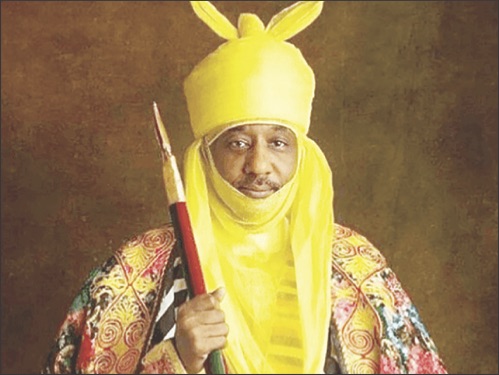
A surprise comeback of dethroned monarch
“The greatest glory in living lies not in never falling, but in rising every time we fall.”
—Nelson Mandela
By Cosmas Omegoh
Former Central Bank of Nigeria (CBN) governor, Muhammadu Sanusi, 62, last week returned as the 16th Emir of Kano.
Last Thursday specifically, Sanusi who was first installed as Emir in 2014 by the Rabiu Kwankwaso regime, but was dethroned in 2020, against the current of expectations, was reinstated as Emir of Kano.
Sanusi was deposed by the immediate past Governor of Kano State, and the current Chairman of the All Progressives Congress (APC), Umar Abdullahi Ganduje in a controversial circumstance.
But last Thursday, the table turned, exemplifying Sanusi as the proverbial cat with nine lives.
Sanusi’s sin at the time he was axed allegedly bordered on his expressive views adjudged to be critical of ex-Governor Ganduje.
The former CBN boss’ dethronement was made possible by the controversial 2019 Kano State Emir (Appointment and Deposition) Law passed by the state House of Assembly. That also gave impetus to the creation of addition four emirates namely Bichi, Gaya, Karaye and Rano out of Kano Emirate Council.
It was a move observers reckoned was calculated to water down the powers of Emir Sanusi and reduce the gargantuan sphere of influence of the Kano Emirate Council.
And by elevating the four new emirs to the status of first class kings, Ganduje curried the favour of some stakeholders and beneficiaries of his act.
The climax of the exercise was the dethronement and subsequent removal of Emir Sanusi 11 on March 9, 2020 – a deft maneuver many insisted was politically-motivated.
Consequently, Sanusi was sent on exile in Nasarawa State, to live in solitary confinement. But he rose from the ashes of his troubles to find fresh rhythm to move on.
Now, nearly four years after the Kano Emirate debacle, Sanusi is back to retake the throne he vacated in a manner said to be untidy.
Some days ago, when the Kano State House of Assembly commenced repealing the law creating the additional emirates and removal of Sanusi, those who followed the move dismissed it as a joke taken too far.
Indeed, not many last week gave what happened the slightest chance of happening, neither did they have the littlest inkling that the end game was to return Sanusi to power.
But when the coast got clearer, the state governor, Abba Yusuf, left ample hints that he had a ready ball pen to ink whatever resolution that came out of state Assembly chambers into law.
With the signing of the Kano State Emirate Council Law 2024, the history of Kano took a corner. Sanusi was returned in the same manner he was dethroned to now replace Aminu Ado Bayero who ceased to be Kano Emir alongside the other four who were handed 48 hours to vacate the palaces they occupied.
But a certain Alhaji Aminu Babba Dan Agundi, the Sarkin Dawakin Babba of the Kano Emirate has gone to court to stop Sanusi’s reinstatement.
All eyes, therefore, are focused on Kano to see how things will eventually pan out in the days ahead.
Now, the developments in Kano do not take away anything from the lessons they throw up.
At the moment, Sanusi’s return remains shocking to pundits. It has so far triggered a flurry of ripples and reactions of multiple designs and diameters.
Expectedly, many are still in joyous mood over what went down last week, just as some people are ruing the incident.
Head or tail, however, the Sanusi saga brings to the fore, the import of the burgeoning effects of the political class’ interference in traditional institutions either for the right or wrong reasons.
The growing culture of brutal interventions and interjections in traditional institutions continue to present new sad chapters in the country’s history.
Every now and then, state executives express penchant for harassing and hounding monarchs in the land at the littlest prompting, replacing them at will with their pliable stooges and cronies.
By unnecessarily meddling in the affairs of the traditional institutions, almighty governors desecrate sacred thrones and cause once venerable places to lose their time-hallowed positions and prestige in history. Wielding executive powers, the governors strip occupiers of stools, leaving them naked before their subjects.
What the governors do now leaves a culture of subservience that sees monarchs and custodians of the people’s culture and tradition bowing to elected persons, who are ordinarily their subjects.
People worried by the governments’ overbearing influences in traditional matters nowadays stand together in urging elected officials to thread with caution in handling issues of culture and history many of which touch on the sensibility of the people.
Indeed, failure of the governments to establish boundaries and know their own limits as in the case of the Kano Emirate, is an open invitation to chaos.
Close to four years now the Kano Emirate Council has had its own unfair share of government meddlesomeness in traditional matters.
However, in whichever direction the pendulum might swing now, a huge lesson appears to have been learnt. And the telling reality before everyone now may reinforce the undying aphorism that nothing stays permanent – truth no one can refute.
As Emir Sanusi returns to the throne he once vacated, a need beckons on him to wholly appreciate the gamut of events leading to his dethronement and subsequent return as humbling.
Before he mounts the saddle, he needs to respond to the invitation to look back, reflect on the journey thus far, see the road not taken, and then commit to threading on a fresh path.
Being there for all as a father figure might be the best way to engineer a true comeback, while working to secure the welfare of his subjects and residents of the ancient city, and fostering mutual co-existence among all look like the right way to follow.