Follow Us on Google
From Juliana Taiwo-Obalonye, Abuja
Minister of Women Affairs and Social Development, Imaan Sulaiman-Ibrahim, on Monday in Abuja called for a decisive national shift in the way Nigeria views caregiving, saying the work should no longer be treated as invisible domestic labour but as an essential economic and social infrastructure.
Speaking at the National Caregivers Summit held at the Maryam Babangida National Centre for Women Development as part of activities to mark the 2026 National Children’s Day, the minister said the gathering was convened to address one of the most important pillars of nation-building.
She said, “Today, we gather not merely for dialogue, but to address one of the most fundamental pillars of nation-building: the Care Economy and the social infrastructure that sustains human dignity.”
Sulaiman-Ibrahim said the Federal Government’s Renewed Hope Agenda and the declaration of 2026 as the “Year of Families and Social Development” had created the right policy environment for strengthening caregiving systems and social protection across the country.
“When His Excellency, President Bola Ahmed Tinubu, GCFR, unveiled the Renewed Hope Agenda, it signaled a decisive shift in governance, from statistics to humanity, from promises to people-centered development,” she said. “The Agenda recognises that sustainable economic growth cannot thrive without deliberate social investment.”
The minister said caregiving responsibilities still fall disproportionately on women and girls, forcing many to abandon education, career growth and income opportunities.
“Traditionally, the overwhelming burden of caregiving, raising children, supporting persons with disabilities, and caring for the elderly, has rested disproportionately on women and adolescent girls,” she said. “No nation can attain sustainable prosperity when a significant segment of its productive population is constrained by invisible and unsupported care responsibilities.”
She warned that Nigeria’s growing population and ageing demographic were increasing pressure on existing support systems, noting that more than 6.5 million citizens are now aged 65 and above.
“The urgency of these reforms becomes even clearer when we examine the social realities confronting our nation today,” she said. “Nigeria stands at a unique demographic intersection, characterised by a rapidly expanding youth population alongside a growing elderly demographic.”
Sulaiman-Ibrahim said the summit was aimed at formally recognising caregiving as a professional sector that must be structured, standardised and supported.
“Today, we are formally recognising caregiving not as an invisible domestic obligation, but as a vital professional sector deserving of structure, standards, investment, and dignity,” she said.
She said the ministry was working with the Caregiver Nigeria Society and other partners to expand training and certification in childcare, geriatric care, special needs support and community caregiving.
“Our vision is to empower thousands of Nigerian youths with employable and globally relevant skills in childcare, geriatric care, special needs support, and community caregiving services,” she said. “By formalising the care sector, we are simultaneously creating pathways for sustainable employment while enabling more women to actively participate in the economy with the confidence that their dependents are receiving safe and professional care.”
The minister added that the administration’s social intervention programme was designed to extend protection, safety nets and human capital support to all 774 local government areas, stressing that the approach marked “a historic transition from viewing social development as charity to recognizing it as a national economic imperative.”
Suliaman-Ibrahim said the family remains the foundation of social order and economic stability, describing Tinubu’s declaration of 2026 as the “Year of Families and Social Development” as both “visionary and transformative.”
According to her, “the family remains the first school of values, the first line of security, and the foundational economic unit of society.”
“Indeed, when families are strengthened, nations become stable; when homes are protected, societies prosper. If we secure the home, we secure the future of Nigeria,” she said.
She said the ministry had begun reforms to modernise social protection systems, strengthen the Child Rights Act and improve implementation of the Violence Against Persons (Prohibition) Act.
“We have intensified efforts toward the full domestication and enforcement of the Child Rights Act across the Federation,” she said. “We are also strengthening the implementation of the Violence Against Persons (Prohibition) Act, ensuring that justice moves beyond legislation to real protection for vulnerable citizens at the grassroots level.”
Sulaiman-Ibrahim said the ministry had also activated costed national action plans to end violence against children, child marriage and exploitation of women and girls, while digitising social development data to make vulnerable households more visible to policymakers.
The minister also drew attention to violence against women and child marriage, saying nearly 30 percent of Nigerian women aged 15 to 49 have experienced physical or sexual violence, while about one in three girls is married before age 18.
“These statistics are not merely numbers; they represent interrupted destinies, diminished opportunities, and a collective call to action,” she said.
The minister said the government was also expanding girl-child support through the AGILE project, which she said had already reached over 8.6 million girls in 18 states.
She disclosed that the ministry was establishing additional departments on the Care Economy and Women’s Climate Resilience and Adaptation to improve coordination across ministries.
Other News
Sulaiman-Ibrahim thanked development partners including UN Women, UNICEF, ETF, AOTCOG and the Etiquette Africa Initiative for backing the reform agenda.
She also praised President Tinubu for his commitment to human capital development and social inclusion, and described caregivers as central to national productivity.
“To all caregivers across Nigeria, you are the silent pillars of our national productivity, the custodians of compassion, and the guardians of our collective future,” she said.
The minister urged stakeholders to ensure that the summit produces practical outcomes rather than ending in rhetoric.
“Our work must now move from conversation to implementation,” she said in effect, stressing that the care economy must be turned into a functioning national system.
The UN Women Country Representative to Nigeria and ECOWAS, Beatrice Eyong, said the care economy had become central to women’s advancement in politics, leadership and business, describing the minister’s initiative as timely and necessary.
“It is a wonderful thing that women and children are under one ministry, because you cannot separate mothers from their children,” Eyong said in her goodwill message. “The topic of discussion today is not only important, but also timely and impactful because it has great potential for national development.”
She said unpaid care work still placed an unfair burden on women, especially young mothers trying to balance work and family life.
“For example, if a young woman has three children to care for, and she is still expected to show up at work very early every day without any supportive system in place, that is unfair,” she said. “It only increases the burden on women.”
Eyong commended the minister for “bringing the conversation around the care economy to the table,” saying UN Women was ready to support the effort.
“What the Honourable Minister is doing by bringing the conversation around the care economy to the table is highly commendable,” she said. “We, as women, and even the United Nations, stand firmly behind this initiative.”
She added that UN Women would continue to contribute technology, ideas and technical support to strengthen the sector.
“At UN Women, we still have a lot of work to do across more than 60 countries,” she said. “We may not always have all the financial resources, but we do have the technology, ideas, and technical support that we can provide to strengthen efforts like this.”
UNICEF representative said children should remain in family settings whenever possible, stressing that alternative care should only be used as a last resort.
The organisation’s representative said UNICEF had long supported the ministry in care reform, including the development of alternative care guidelines and an implementation strategy with SOS Children’s Villages.
“At UNICEF, we believe that the home is the best place for a child,” the representative said. “We encourage that children should be at home with their loved ones, and alternative care service provision should only be as a last resort.”
The organisation said the Child Rights Act should guide every decision affecting children, adding that “in all you do the best interest of the child shall be paramount”.
UNICEF also said the summit could mark the beginning of a broader reform of care services in Nigeria.
“I congratulate the children of Nigeria who are here today and hope that this is the beginning of a long journey that will reform the care service provision in this country,” the representative said.
In a technical presentation at the summit, founder of Caring Africa, Blessing Adesiyan, said Nigeria’s care sector had the potential to create millions of jobs while expanding women’s labour force participation and boosting economic output.
She said women globally perform enormous amounts of unpaid labour, warning that Nigeria’s economy loses value when care is ignored.
“Care is not welfare policy. We’re not here to discuss it. We’re not looking for charity. What we are looking for is an investment in care,” she said.
Adesiyan said Nigeria adds close to 10 million babies every year and has no adequate structure for feeding, educating and supporting that population.
“Every year, we add close to 10 million babies to our country,” she said. “And that 10 million, we do not have any kind of structure for how that 10 million will actually feed, educate, and add value to our economy.”
She said the country was at a demographic and economic inflection point, warning that the absence of a structured care system would hurt productivity.
“Nigeria is at a demographic and economic inflection point,” she said. “If we do not pay attention to this growing care system, we run into an economic issue.”
Adesiyan said women spend five times more time than men on care work and argued that formal care systems could create up to 17 million jobs in Nigeria.
“If we formalise the care workforce, people will get employed, and it will bring strong demand across income levels,” she said. “Care is not just infrastructure, but it’s also industry.”
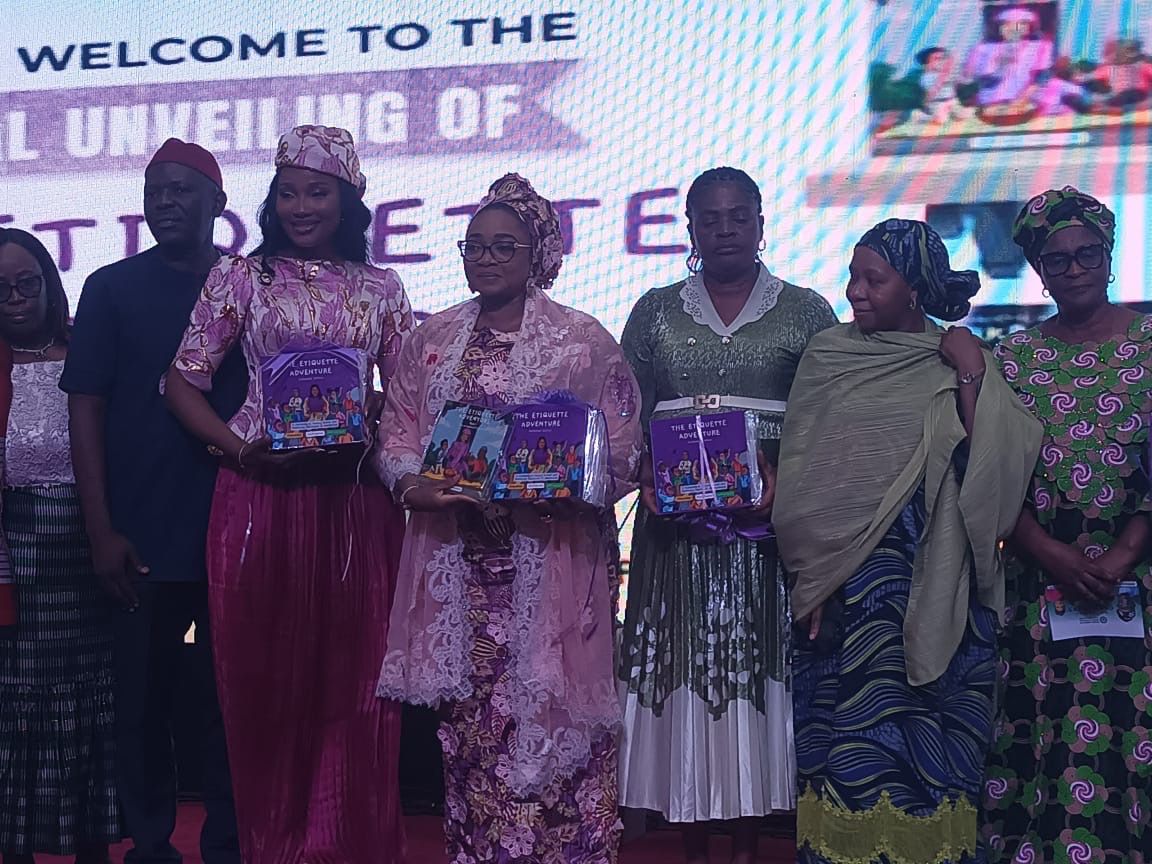
The highlight of the event was a presentation by members of Etiquette Africa Club, alongside the launch by the minister of How Etiquette Education Advances the Child and Society: Introduction to The Etiquette Adventure Series by Etienying Akpanusong. The book underscores the importance of etiquette education in shaping children’s character, improving social behaviour, and supporting their overall development as responsible members of society.