Follow Us on Google
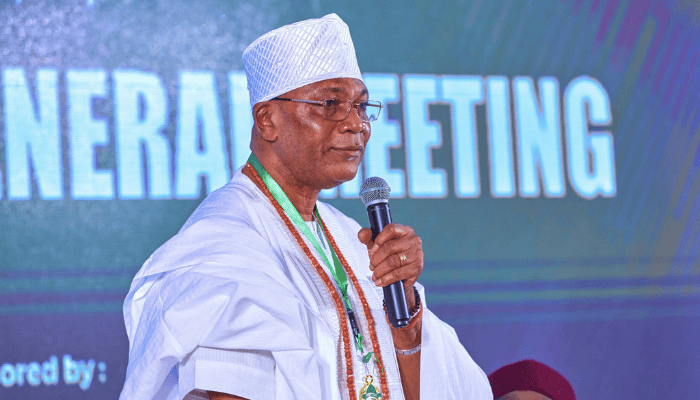
Manufacturers and the National Institute for Policy and Strategic Studies (NIPS) have called for the swift and effective implementation of Nigeria’s industrial policies to raise the manufacturing sector’s contribution to the nation’s Gross Domestic Product (GDP) from the current 3.3 per cent to 25 per cent.
They made the call at the opening ceremony of the 54th Annual General Meeting (AGM) of the Manufacturers Association of Nigeria (MAN) and the Made-in-Nigeria Products Exhibition, themed, “Leveraging National Industrial Policy to Position Nigeria as Africa’s Industrial Hub”, held recently.
MAN President, Francis Meshioye, decried the country’s continued dependence on imported raw materials, revealing that Nigeria imported approximately N3.53 trillion worth of raw materials in the first half of 2025, with about N1.72 trillion sourced from Asia. This he said illustrates the extent to which domestic production continues to depend on imported inputs.
Meshioye advised that the performance of the Made-in-Nigeria agenda should be assessed through measurable industrial outcomes, including increased domestic value addition, lower production costs, higher capacity utilisation, stronger domestic supply chains, increased manufacturing investment and greater participation in regional and international markets.
“Each year, our Made-in-Nigeria exhibition serves as a mirror that reflects both our accomplishments and our ambitions. The exhibition is evidence of our determination as manufacturers to deliver high-quality, competitive and advanced goods, yet often produced under very tough microeconomic environments,” he said.
According to him, the theme of the exhibition reflects the need to activate the recently approved industrial policy and create a conducive operating environment for manufacturers.
He urged the Federal Government to fast-track the implementation of Executive Orders 003 and 005, as well as the Nigeria First Policy, which he said were designed to promote domestic production through patronage of locally manufactured goods.
“It is in this regard that we call on Mr. President to fast-track the implementation of these orders and programmes. It is time for action. The government should ensure strict compliance with the orders. Ministries, departments and agencies of government that fail to comply with the Executive Order should be sanctioned accordingly,” Meshioye said.
He also urged the Independent National Electoral Commission (INEC), political parties and other government agencies involved in the electoral process to patronise locally manufactured products, especially as the country approaches national, state and local government elections.
“We know that we consume a lot of materials during this period. We buy a lot of things, have a lot of promotional materials. But it would benefit every one of us if we give priority to the patronage of Made-in-Nigeria items at this very crucial electoral period, at all times, and in all cases, even after the election,” he said.
Meshioye said the exhibition demonstrated the capacity of Nigerian manufacturers to produce goods for the domestic and international markets.
He, however, stressed that positioning Nigeria as an industrial hub required more than increased production volumes.
He identified energy costs, access to finance, availability of industrial inputs, logistics, regulatory predictability, productivity and the ability of firms to invest and scale as critical factors affecting industrial competitiveness.
Meshioye said recent improvements in manufacturing indicators must be viewed against the high cost of production confronting businesses.
He noted that manufacturers reportedly spent approximately N1.35 trillion on alternative power in 2025, compared with about N1.1 trillion in 2024.
“The expenditure supports business continuity but also places additional pressure on resources that could be made available for capacity expansion, technology acquisition and productivity improvement,” he said.
He warned that increasing local production of finished goods without simultaneously developing domestic sources of raw materials and intermediate inputs would limit the extent of local value addition.
According to him, the operating environment also requires continued policy attention as energy costs, foreign exchange exposure, financing costs, logistics, taxation, regulatory charges and weak consumer purchasing power continue to affect production costs and investment decisions.
He said MAN would continue to engage the government and regulatory institutions on reforms capable of supporting productive investment and improving manufacturing competitiveness.
For the Director General of NIPS, Prof. Ayo Omotayo, manufacturing must work for Nigeria to achieve $1trn economy.
Omotayo said the effectiveness of Nigeria’s industrial policy would depend largely on implementation rather than policy formulation alone.
“It is not policy that will make manufacturing work, but how we approach implementation. Policy has its own role. How we approach implementation of the policies is what matters,” he said.
“It is how we try to ensure that the provisions of the policies are used for the benefit of manufacturing that will make the difference.
“If Nigeria is going to work, economically, manufacturing must work. If Nigeria is going to reach the $1 trillion economy, manufacturing must contribute substantially to it,” he said.
He said NIPS studies showed that the manufacturing sector was capable of contributing far more to Nigeria’s GDP than its current level.
“We are under-punching. Even though we understand that the micro-environment for business is tough, yes, we know it is tough, we are challenged by the issue of power,” he said.
Omotayo also challenged MAN and the government to develop a special policy framework for raw materials to reduce the country’s heavy dependence on imports.
On electricity, he said manufacturers should also explore ways of generating cheaper and more reliable power while government works to reform the energy sector.
“We have to begin to look beyond waiting for a particular sector to supply us the power. Manufacturing by itself must begin to look at ways and means of providing cheaper power to make their businesses cheaper,” he said.
He disclosed that NIPS was proposing to President Bola Tinubu that the power and energy sector be reviewed to ensure the availability of affordable electricity specifically for manufacturing.
Omotayo also called for stronger collaboration between universities, government and manufacturers to develop machinery and industrial technologies locally.
“A lot of the machines we use are imported. What can our universities contribute? What is the relationship with the federal government and manufacturing sector? There has to be a relationship,” he said.
He said NIPS would engage relevant Ministries, Departments and Agencies (MDAs) to address challenges confronting manufacturers, particularly power and raw materials.
He added that the Federal Government was committed to the sector and expressed the ambition of seeing manufacturing account for 25 per cent of Nigeria’s GDP.
“Mr. President, we wish a manufacturing sector that is contributing as much as 25 per cent of the GDP, not the 3.3 that we are struggling with as we speak. Manufacturing is huge, and it is only when manufacturing does well that we can bring down the value of the naira to the dollar,” he said.
Director General, MAN, Segun Ajayi-Kadir, acknowledged that Nigeria has substantial manufacturing capacity, adding that the exhibition was designed to showcase Nigeria’s productive capacity and connect manufacturers with commercial opportunities.
“It is clear that there is substantial capacity within the Nigerian manufacturing sector. Our exhibitors have demonstrated the range, quality and diversity of products that can be manufactured in Nigeria across different sectors of the economy,” he said.
Ajayi-Kadir said the products on display represented investments in production facilities, technology, skills, supply chains and market development.
He reeled out some challenges like energy availability and affordability, production input costs, logistics and the regulatory environment, which he said remained major impediments to industrial competitiveness and investment.
“Addressing these challenges requires sustained policy action and effective collaboration between governments and the private sector. This is particularly relevant if Nigeria is to become the industrial hub of Africa because manufacturers must be able to produce competitively and reliably, develop stronger domestic supply chains and reach regional markets with products that meet the required standards, quality and price,” he said.
He described NIPS as “a veritable partner” to MAN and pledged continued collaboration to advance Nigeria’s industrial renaissance.
Ajayi-Kadir also commended manufacturers for continuing to invest, produce and create jobs despite the difficult operating environment.
He said Nigeria’s industrial policy provided a clear roadmap, but stressed that policy adoption alone could not industrialise the country.
“Building a globally competitive manufacturing sector requires that same long-term vision, policy consistency and unwavering commitment. The Nigerian industrial policy provides a clear roadmap, but nations do not industrialise by adopting policies alone. They industrialise by implementing them consistently and conscientiously,” he said.
According to him, the success of the industrial policy would ultimately depend on its ability to deliver measurable improvements in industrial investment, productive capacity, manufacturing productivity, value addition, employment and overall industrial competitiveness.