Follow Us on Google
• As Amupitan seeks editors’ partnership •Voter register exceeds 103m; 57,000 new BVAS acquired
From Romanus Ugwu, Abuja
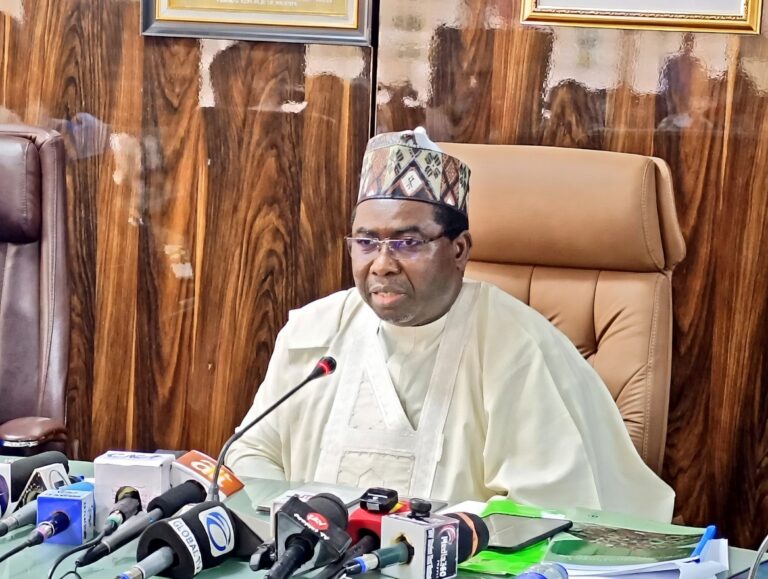
The Independent National Electoral Commission (INEC) has warned that perpetrators of vote-buying and financial inducement will face arrest and prosecution, as it strengthens collaboration with anti-graft agencies to track suspicious campaign spending ahead of the 2027 general elections.
INEC Chairman, Prof. Joash Amupitan, said the commission was working with the Economic and Financial Crimes Commission (EFCC), the Independent Corrupt Practices and Other Related Offences Commission (ICPC) and the Nigerian Financial Intelligence Unit (NFIU) to monitor election expenditure and strengthen surveillance around polling units.
“Elections must be decided by the conviction of the voter, not the depth of a candidate’s pocket,” he declared.
Amupitan spoke yesterday in Abuja at a strategic workshop organised by the Nigerian Guild of Editors (NGE) in collaboration with INEC, where he sought editors’ partnership in protecting the electoral process against malpractice, misinformation and political mischief.
The chairman also warned against violence, intimidation and campaign hate speech, stressing that political competition must not descend into conduct capable of undermining credible elections.
Reaffirming the commission’s neutrality, he said: “We have no preferred candidate, no preferred political party, and no agenda other than guaranteeing a free, fair, transparent, and credible election.”
Amupitan said cooperation among election managers, editors and civil society organisations was essential to safeguarding the polls and sustaining democratic governance.
“Democratic governance is a continuous journey that requires constant care, vigilance, and institutional courage. Democracy is a journey, not a destination.
“The strength of that journey depends on the quality of the partnership between those who manage the vote, those who monitor the vote, and those who report the vote.
“If we stand together—Editors, CSOs, and INEC—we create a fortress that no amount of electoral malpractice or political mischief can breach,” he said.
NGE President, Eze Anaba, called for transparency, timely access to electoral information and sustained engagement with the media, saying credible elections depended on citizens’ confidence that their votes would count and electoral institutions would act fairly and professionally.
“Elections are not merely about casting ballots. They are about trust,” Anaba said in his opening statement.
He explained that editors influenced the information reaching citizens, its presentation and the context in which it was understood, making accuracy, fairness, balance and the public interest essential obligations.
The NGE president said, however, that the media needed credible, timely and accessible information from INEC to discharge those responsibilities, particularly amid misinformation, disinformation, manipulated content, deepfakes and partisan narratives.
He urged a relationship founded on openness, mutual respect and regular engagement, while challenging participants to identify ways of improving INEC’s public communication and the accuracy of electoral reporting.
Anaba also called for measures to confront disinformation while preserving legitimate criticism, stressing that INEC, political parties, candidates, journalists and citizens each had responsibilities in securing credible elections.
Responding to the need for closer engagement, Amupitan proposed arrangements under which newsrooms would have direct access to INEC to verify incidents, logistics updates and security reports before publication.
Other News
He said the commission would work with security agencies to protect accredited journalists and facilitate their access to polling units and collation centres, while a regular feedback mechanism with the Guild would address emerging concerns throughout preparations for the elections.
The chairman said electoral officers and temporary staff would be required to take an oath of neutrality, warning that partisanship, negligence and compromised ethical conduct would attract sanctions.
On operational preparations, Amupitan said INEC was drawing lessons from recent elections and working to improve logistics, personnel deployment and technological performance.
“I want to see a general election where voting starts in all the polling units in Nigeria at the same instance.”
He disclosed that early procurement and distribution of non-sensitive materials had commenced, while operational vehicles had been acquired to improve the movement of personnel and election materials.
Readiness assessments, including physical audits and staff engagements, had been completed in the South-West and North-West to identify vulnerabilities, test contingency arrangements and remove potential bottlenecks.
Amupitan said transparent results management remained a critical lesson from the challenges following the 2023 elections, adding that results should be announced promptly after collation was completed.
He announced that the national voter register had exceeded 103 million following the Continuous Voter Registration exercise and biometric cleanup.
According to him, nationwide collection of Permanent Voter Cards (PVCs) would begin on Friday, October 9, while the register would be displayed for claims and objections from October 9 to 15.
He said printable PVC technology was intended to reduce delays and help eligible voters obtain replacement cards when necessary.
The chairman also disclosed the acquisition of 57,000 new Bimodal Voter Accreditation System (BVAS) devices, saying the commission was strengthening established technologies ahead of the polls.
The upgrades included an enhanced electronic EC8A system for authenticating polling-unit results before uploading them to the INEC Result Viewing portal, alongside systems to detect suspicious database activity and improve cybersecurity.
INEC National Commissioner, Mohammed Haruna, said the workshop followed several elections conducted under the present commission, including the Anambra, Ekiti and Osun governorship polls, FCT Area Council elections and legislative bye-elections.
Chief Press Secretary to the INEC chairman, Adedayo Oketola, said the engagement sought to rebuild institutional trust, strengthen verification and promote shared responsibility for credible elections.
INEC Director of Voter Education and Publicity, Victoria Eta-Messi, said the workshop would align media engagement with the commission’s operational preparations.
“We’re in the eye of the storm a lot of the time these days, and so it’s important that we are on the same page,” she said.
Centre for Media and Society Executive Director, Akin Akingbulu, urged stronger institutional disclosure to support newsroom verification, while International Press Centre Executive Director, Lanre Arogundade, sought timely communication that preserved editorial independence.
Arogundade also called for the protection of journalists covering elections, while DAI Team Leader, Rudolf Elbling, urged action against disinformation.