Follow Us on Google
•We must learn to live together and forgive one another •How I was detained for blowing up Niger Bridge
From Jude Owuamanam, Jos
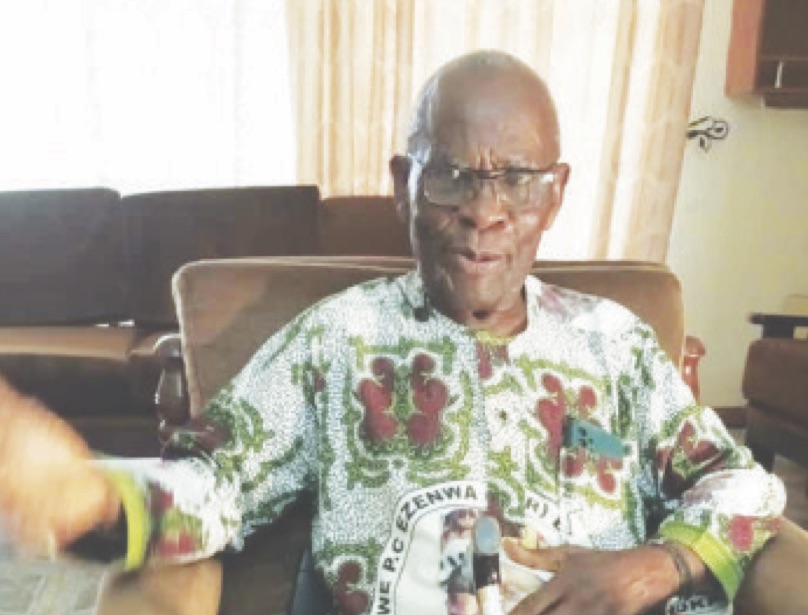
The stories of the first coup d’etat and the three-year old civil war that ensued, which have become a watershed in the annals of Nigeria’s history, will continue to be told and retold by the dramatis personae in those epic periods. In this encounter in his Enugu home where he’s spending his retirement, the Ozubulu-born retired Col. Emmanuel Udeaja, recounts events of those dramatic eras.
You’re known as Col. Emmanuel Udeaja, a retired officer of the Nigerian Army, who fought on the side of Biafra during the civil war. Tell us more about your background and your interest in joining the army
I was born in 1938 at a village in Ozubulu. And from there I went to live with my uncle in Onitsha. From there I went to Government College, Umuahia. I joined the army in 1958, along with Olusegun Obasanjo, Esuene, Adegoke, Adekunle. That’s six of us. We were of the same set . Six of us went to Ghana at the same time. That’s where they trained officers initially before going to Britain. From there to Sandhurst, from Sandhurst to another and then back to Nigeria. I was commissioned in January 1960.
What circumstances led to your joining the army? Was it your ambition or were you forced or conscripted?
No, that was my ambition. I was a cadet at school, at Government College, Umuahia , and our principal then encouraged me to join the army. Then as a young man full of life and things like that, I enjoyed the activities because we were doing some military training, being in the officer-cadet unit of our school. I loved it as a young man and I thought I could make a profession out of it.
So what was the motivation?
The motivation was just that I thought I loved the profession. Joining the army was what I just loved to do and encouraged by my principal of my college then.
Looking at the events that turned out in your career, did you at any point now regret joining the army?
Not really. But there are certain stages of it that weren’t what I envisaged or what I thought of in my life.
What stages were these?
Like the military coup and the war we fought. I didn’t know that it would come up. The two events led to loss of lives and things like that .
Were you involved in the military coup of January 15, 1966?
No.
So what circumstances led to your detention?
I was in detention on two occasions. The first detention was after the coup. After the first , I was among those detained on the allegation that somebody said that they saw me during the coup or that I was with them or because of my friends who were involved. But eventually during the board they found out that i was nowhere involved and with another person; three of us were in fact released from detention by Gowon. I went and by then the crisis had started and Ojukwu ordered the release of everybody, irrespective of whether the board that investigated the thing had exonerated you or not. The three or four of us were released
Then after the civil war, you were detained again?
Yes, after the civil war, all of us, those who were detained before, and some senior officers in the Biafran Army, were detained. I was detained according to them, because during the board, that was what I was questioned on, that I blew the Niger Bridge.. That I demolished it, you know, and I mean, they knew better. They knew that if I had to blow such a bridge, I had to get orders from above, that I just carried out my duty as an engineer officer.
You said you were detained for blowing up the Niger Bridge?
Well, so they said during the board of inquiry interview
Were you really the one that blew the Niger Bridge?
No, I wasn’t but I was the chief engineer officer of the army. I commanded the engineers. You know, it’s the job of the engineers. They blow bridges in the front of any squadron that is attached to a battalion. If there is a bridge to be blown, they are the ones to do it. It’s just that I was the commander of the Army Engineers.
So who ordered the blowing up of the bridge?
The leader of the squadron must have ordered the blowing up of the bridge when he might have envisaged the problem ahead and the purpose of blowing the bridge was to slow down the advance of the Nigerian forces. To prevent them from crossing from Asaba to Onitsha because that’s the only way
When they interrogated you about blowing off the Niger Bridge what did you tell them?
I told them that I was the commander of the engineers, that, the squadron leader on the ground, blew up the bridge on the orders of the army commander. Whoever is in charge of operations there will give the order, the infantry commander. That’s the normal thing. I won’t know, of course, who gave the order. But as I told you, the bulk must have ended on my table as the head of the engineering corps
So who ordered your detention on account of that? Was it General Gowon?
No, I don’t know. I know after the war, we were all interrogated, you know, and after the interrogation, I think all of us were sent back to detention. Although, previously, on April 27th, I think it was, just before the war started, I was among the three officers released by Gowon, myself, Ayanya, and J.C. Ojukwu. But after the war, they think they have forgotten all that and sent us all back to detention.
The only person is Major Humphrey Chukwuka. He was my coursemate.We joined the army at the same time. So he was a friend of mine.
Other News
At the time of the coup, where were you?
I was in Lagos. I was on leave. I had just finished my leave. I was going back to Kaduna and I had to go through Lagos because I had to go and talk about my promotion. At that time, I was still a captain when my juniors were senior majors because I spent a lot of time in the UK.
After the Biafran civil war, were you reintegrated into the army?
No. After the war, most of us were retired.
So the rank you attained was the one you got as an officer of the Biafran army?
Yes, after my cadet training, I was commissioned. I went to school of military engineering to do the military engineering course. After that, I went to the university to do a Bachelor of Science degree in engineering. So I stayed a long time in Britain. A lot of people, in fact, didn’t know me when I came back except very close friends.
Let us look at the dramatis personae in the whole saga like Gowon. What made you think that they acted the way they did in those days?
I think that some acted out of responsibility and some found themselves in a place where they really didn’t choose to be, but circumstances brought them there and they have to salvage the situation the best they could.
How do you describe Ironsi’s action in scuttling the coup because he was subsequently killed on account of that?
I suppose he was acting to the best of his ability. He was doing what he thought was good or the best way he thought he could salvage the situation, which was an ugly situation in his hands.
Taking a retrospection, do you have any regrets about the coup and the subsequent civil war?
Now, of course I have a lot of regrets about it. I lost my cousin, Col. Unegbe in the coup. Col Unegbe and I were from the same village. It was such a painful loss. I know that people who lost their loved ones won’t be happy, especially when you know that that person has not done any wrong or doesn’t deserve the fate that befell him. We also lost a lot of gallant officers like Col. Pam, Maimalari, and others. These officers, I don’t know much about them because as I told you, whether I would say it’s fortunate or unfortunate, I wasn’t much in the country. All my service years before the coup were in Britain, outside. So I really didn’t have to deal with them on a daily basis. I was a member of the Nigerian Field Squadron, that’s the engineering regiment, nobody knew me there except my course mates and people who were so familiar. .
You were in the same engineering corps with Obasanjo?
Oh yes. I was commanding Two Field Squadrons. Obasanjo was commanding one field squadron. Obasanjo was my best mate, we all trained together from scratch till we went to Britain, He went to Mons, I went to St. Louis but we maintained good relations. We have been friends since then. Obasanjo was such a humble man, because he came from a very humble beginning.
There were rumours of a coup recently because things really haven’t changed since the first coup of 1966. Do you think that there is a possibility of another coup in Nigeria? I pray not because it’s an evil wind that blows no one any good. We don’t know who will become victims, whether those who think will salvage the situation, will be the firts to be killed. So it is something that does no one any good and should be avoided.
How do you describe the character of politicians of today? Do we have any alternative to democracy?
I don’t think so. I think what we should do is to pray, really pray, pray to God to change the mind of some of our politicians and put the spirit of love into them to think of their welfare of their fellow human beings because that is all we need to do. If I think of my fellow human beings, as I think of my family, my wife and children, I mean the place would be so good because we would all be thinking in the same direction. But unfortunately in Nigeria it’s not so. There’s so much greed.
There is this agitation for the creation of a sovereign state of Biafra by some people who call themselves Indigenous Peoples of Biafra, Do you envisage the creation of Biafra now or in the future?
All these things are politics. In Nigeria we don’t know where we are going and so people just get up, say whatever they like or do whatever they like but that’s not how to rule a nation . There has to be a concerted effort. There has to be agreement on what to do and what not to do. So calling for Biafra and things like that is an individual effort , it’s not unanimous.
So Baifra died and was buried in 1970?
So they said. The thing is, for Biafra to be buried and forgotten, there has to be a change of attitude of certain people in Nigeria. We should make Nigeria one. We should all believe in one Nigeria and work towards one Nigeria.
Gowon declared the three R’s. Reconciliation, Rehabilitation, and Reintegration after the war. Did the 3Rs achieve its purpose?
How much it worked can hardly be seen. How do you talk about rehabilitation when every ex-Biafran or easterner was given 20 pounds after the war? Even if you had 100 million in the account, you were only given 20 pounds. And you had to start life afresh with 20 pounds. And in fact, not everybody got these 20 pounds. So, you know, it was far-fetched. We are still talking about marginalisation in the east. That’s evidence that the 3Rs did not achieve much.
Now from the benefit of hindsight were the two events justified?
I don’t think so because they led Nigeria into chaos and loss of lives . I don’t know whether you can say you can justify any coup. I don’t know whether you can justify any coup because a coup is an action taken by a group of people who thought otherwise, or that things should have gone the other way. It wasn’t a sort of a decision taken by all and sundry,
What lessons can we learn from them?
First of all, you have to love one another. You have to love your fellow human beings, no matter where he is from, no matter who he is and be truthful about whatever you are doing. We also learn to live together and forgive one another.
With the current situation, what do you think the future holds for Nigeria?
Well, I think as long as we continue to pray, get more educated Nigerians, by that I mean people who can understand, who knows what is happening in the world over, and try to change the mindset of certain people in their midst. And we should do away with greed., I think that is our biggest problem. So much accumulation of wealth from many corners all because of our stupidity. Because how much can you eat? How much can you make use of in your lifetime? You are accumulating wealth because of your children. What if they die before you? What becomes of your wealth. I think that we really need to sit back and have a good rethink about ourselves and our society. Do we love one another? Because if you love one another, Nigeria will be a better place.