Follow Us on Google

• Maria: Thrice we paid ransom after hubby’s abduction, but they killed him the fourth time
• I’ve been here since bandits killed my husband in 2018, says another victim
From Sola Ojo, Abuja
“My husband was kidnapped three times and released three times in our village, Konti. Each time, we took loans to bring him back. Each time, he returned alive. Each time, we believed it would be the last. But we were wrong.”
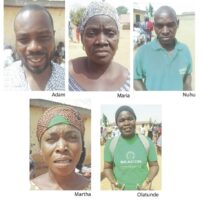
These were the words of a 58- year-old, Maria Samuel, as she lamented the gruesome killing of her husband eight years ago when terrorists unleashing murder and other forms of evil on parts of Kaduna State wreaked havoc upon several communities in Chikun Local Government area of the state.
In their villages, life had already become a negotiation with danger. But like many others, Maria’s family chose to stay. Their land was there. Their home was there. Their history was there. It was their ancestral home. Perhaps, the only place Mr Samuel and his kinsmen ever knew.
“It was not easy. But he refused to leave. He kept saying, ‘This is our home.
“When they came again, they didn’t kidnap him. They just killed him. And that was when it dawned on us that strangers were coming to take over our land in a state with constituted authorities,” she said.
There was no warning. No demand. No chance to negotiate. Just a final, irreversible loss. For her, widowhood did not come suddenly, it came in stages. First, the fear. Then the debt. Then the trauma. And finally, the silence of her husband, the breadwinner of her home.
Each kidnapping had taken something from the family, including money, peace, and dignity. By the third ransom, survival itself had become fragile.
“We were already struggling. We had taken loans which we didn’t even know how we would repay,” she decried.
Still, they held on to the belief that life would stabilise. But when the attackers returned for the fourth time, they ended not just a life but a future.
Today, she lives in Juji, an informal settlement in Chikun LGA that has become home to hundreds of internally displaced persons. But even here, her family is incomplete.
“I have six children with my late husband. “Three are with me here, and three are somewhere else. They had to go. There was no way to keep all of them with me,” she stressed, even as tears freely rolled down her cheeks.
Now, instead of managing a household built on farming and stability, Maria navigates survival with limited support, no steady income, and the constant worry of how to provide for the children still in her care.
“Life is not what it used to be. I don’t even know where to begin again,” she said.
Within the same community in Juji, Martha Wada shared a similar grief, though her story began differently.
“When the bandits came, they didn’t kidnap my husband; they killed him. That was how I was left to take care of our three children,” she said.
Displaced since 2018 from Mararaba Rido in Kaso community, Martha now survives by doing menial jobs.
According to her, “I go from house to house, asking for cleaning work. And sometimes, spirited Nigerians like Beacon Transformation do assist us with relief items. That is how I feed my children.”
Before the attacks, life had structure and dignity, “When we were in the village, we farmed enough to feed ourselves and even send our children to private school. Now they are in a public primary school, and even that is difficult. We need help. Seriously, we need help.”
Juji is a quiet settlement that has become an unplanned refuge for displaced families from Kaso, /p”Olheir life here is very, very critical They don’t have any source of income, especially during the dry season when farming activities are kept at bay,” Adam stated.
For many in Juji, survival comes with painful compromises.
Chairman of the IDPs in Juji, Nuhu Adamu, described the situation as “pathetic,” pointing to growing social vulnerabilities.
“Rumours are going round that some of the young widows are following men for survival. But we cannot confront them. If we do, what empowerment can we offer? We don’t have anything. We only offer prayers and general advice,” he lamented.
It is a reality shaped by desperation, where choices are limited and dignity is often sacrificed for survival.
Other News
Children, too, are bearing the consequences. Many are out of school, while others attend under-sourced public schools without basic learning materials.
“Right now, we are crying because the future of our children is sinking into danger. We don’t have what to cater for them. We don’t even have the means to take them to school. The available public primary school in Juji needs intervention. Ordinary chairs and tables are not available,” he revealed.
Even the option of returning to their villages or nearby to farm – which was once a lifeline – has become dangerous.
“Anytime they plan to go back, they are attacked again. Some have even been kidnapped and ransoms paid before they were released,” added Sule.
The cycle of violence has trapped many families in displacement, cutting them off from their primary means of livelihood.
“The majority of them are peasant farmers who don’t know any other business. Now they cannot farm, they cannot work, and they cannot return home,” he added.
Amid the despair, a recent intervention by the Beacon of Transformative and Inclusive Development Centre offered a brief moment of relief.
Supported by the President of Cornerstone Vision Interdenominational Ministry Lagos, Mr Busayo Adeniyi, the organisation distributed food items including rice, maize, salt, and palm oil to hundreds of families.
The organisation’s Executive Director, Mrs Abigail Olatunde, said: “We were told that people don’t usually come here, maybe because people are not aware or because they are scared of coming around.”
She explained that the organisation discovered Juji while engaging with displaced persons in Mararaba Rido, a short distance from Juji.
“We got to know that there are other IDPs around. We heard about one at Sabo and this one, so we thought of what we could do,” she said.
Although the intervention was initially planned for the Easter period, logistical challenges delayed the visit.
“During Easter, we felt we should be with them, but due to logistics, we came this week,” she explained.
Even as she spoke, Olatunde acknowledged that the support was far from enough.
“Sincerely, I’m touched. I feel that this support is too small. You cannot tell someone to leave their home and then give them just this,” she said.
Still, the visit meant something to the residents.
“Even if you don’t give us anything, just coming means a lot,” one woman said quietly.
Representing the Kaduna State Ministry of Women Affairs and Social Development, Social Welfare Officer Mercy Madaki commended the initiative, noting that it aligns with the ministry’s mandate.
“As we all know, the mandate of the ministry is to cater for women, children, the vulnerable, and the elderly. What Beacon is doing here aligns with our core responsibilities,” she said.
She emphasised that empowering women remains critical in situations like this.
“When you empower a woman, you empower an entire community. When people come to see them, they feel a sense of belonging and know they are not alone,” she said.
While about 600 displaced persons currently live in Juji, while an estimated 5,000 are spread across the Chikun Local Government Area alone.
Many of these communities remain undocumented and underserved, falling outside the reach of formal humanitarian structures.
The result is a growing population of invisible victims including widows, orphans, the aged, persons with disabilities, and displaced families struggling without consistent support.
To Olatunde, addressing their plight requires more than sympathy. There is an urgent need for the formal recognition of settlements like Juji to enable structured intervention.
“Targeted livelihood programmes for widows can help restore dignity and reduce vulnerability, while access to education must be prioritised to prevent long-term consequences for children.
“Psychosocial support is equally critical for those dealing with trauma, just as improved security remains essential to breaking the cycle of displacement.
“Increased humanitarian presence and stronger collaboration between government and non-governmental organisations will also be key to ensuring that no community is left behind and survivors like Maria and Martha will once again live a dignified life,” she suggested.